EUTI Training – Call for Applications: Training of Trainers (ToT): Communication & Conduct

EUTI Training – Call for Applications: Training of Trainers (ToT): Communication & Conduct

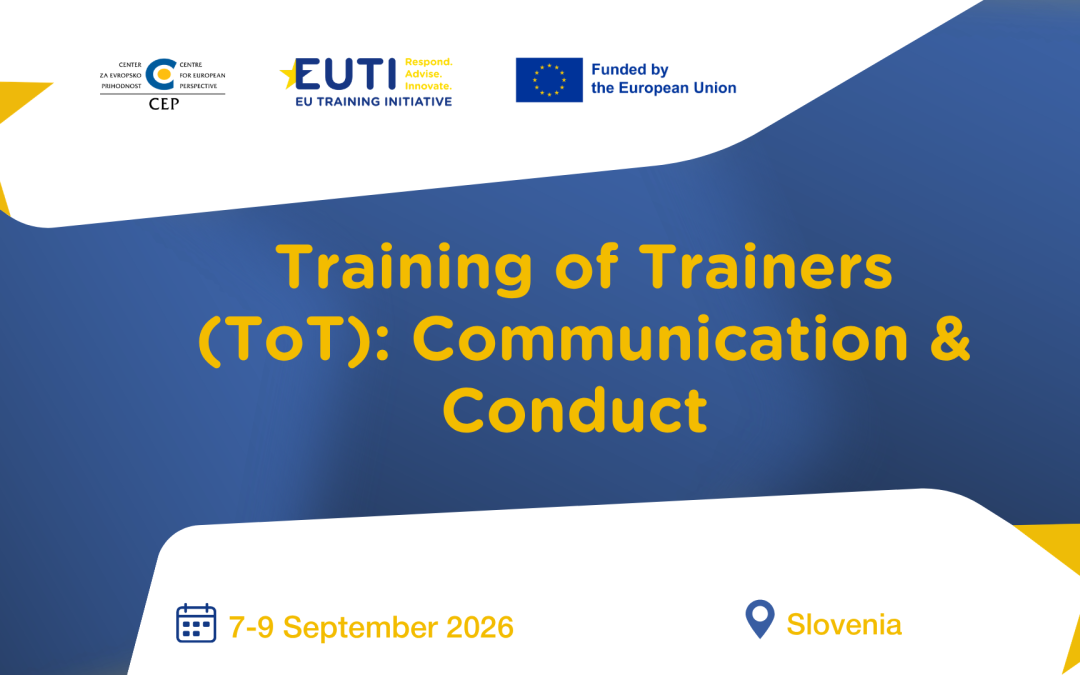
The Centre for European Perspective (CEP) and the Peace Operations Training Centre (POTC), under the auspices of EUTI – European Union Training Initiative, will hold the Training of Trainers (ToT): Communication & Conduct.

The call for applications is now open.

This course is designed to equip participants, eg. trainers, to transfer expertise and knowledge to their target groups. It focuses heavily on inclusive communication and non-exclusionary communication approaches, systematically identifying and neutralizing hidden barriers that can marginalize participants. As such, it serves as a vital tool to ensure proper preparedness of peace operations personnel and the effective dissemination of updated peacekeeping standards.

Training dates: 7–9 September 2026

Training location: Jable Castle, Loka pri Mengšu, Slovenia

Target Group: Primarily police and civilian trainers and instructors involved in preparing personnel for national and international missions and operations. Also open to military personnel, mission staff, and professionals who regularly facilitate workshops or group processes.

Capacity: 20 participants.

Priority: Given to participants from EU Member States.

More information—including the full training agenda, detailed module breakdown, specific course learning outcomes, and logistics (travel and accommodation arrangements)—is available in the call for applications.

Application

Interested candidates must apply using the Application Form by Friday, 9 August 2026.

New Research Paper: Integrating Artificial Intelligence in EU Civilian CSDP Missions

New Research Paper: Integrating Artificial Intelligence in EU Civilian CSDP Missions

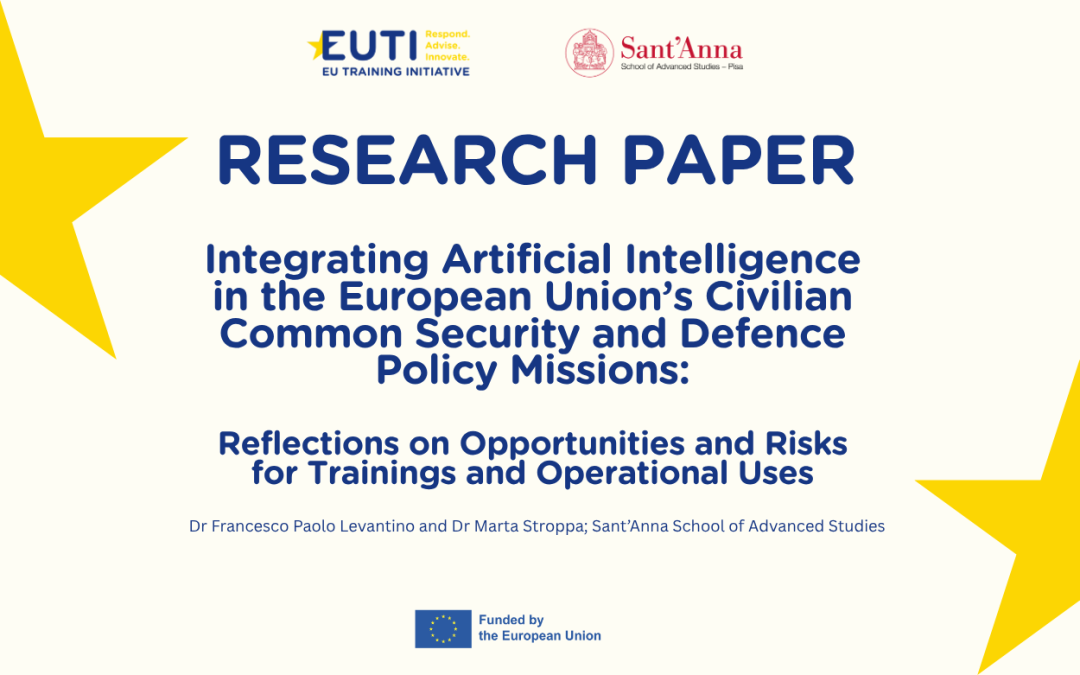
Within the European Union Training Initiative (EUTI), a new research paper exploring the opportunities, structural risks, and regulatory implications of embedding Artificial Intelligence (AI) into EU Civilian Common Security and Defence Policy (CSDP) missions has been published.

Drafted by Dr. Francesco Paolo Levantino and Dr. Marta Stroppa from the Sant’Anna School of Advanced Studies (SSSA) within the framework of the EUTI Working Group on Innovation, the paper aims to contribute to current discussions on the responsible, effective, and human rights-compliant use of AI in civilian crisis management, in line with relevant EU and international legal and policy frameworks.

Shifting from Reactive to Anticipatory Crisis Management

As geopolitical instability, hybrid threats, and human rights violations intensify globally, civilian crisis management faces operational pressure. The paper outlines how AI systems can support a transition from reactive responses to a more proactive and adaptive framework.

Some of the insights from the Paper:

  • The authors examine how Generative AI (GenAI) can move training beyond generic case studies. By utilizing frameworks like the BOPPPS model, instructors can leverage AI to instantly build role-specific scenario “injections”.
  • Across the live mission lifecycle, AI can significantly improve situational awareness through satellite imagery and computer vision, reduce cognitive overload for human decision-makers, and optimize smart logistics or personnel matching.
  • A core focus of the analysis is dedicated to technical limitations. The paper notes that fragile crisis environments often suffer from incomplete or biased datasets, warning that uncritical reliance on AI can trigger automation bias, deskilling, or create contextually plausible but factually flawed hallucinations.
  • The integration of technological innovation must not occur in a normative vacuum. The paper highlights that under the EU AI Act, systems used to evaluate learning outcomes or guide vocational pathways in training environments are classified as High-Risk, legally mandating strict human oversight, logging, and data governance.

Actionable Recommendations

The publication concludes with seven foundational benchmarks aimed at guiding the European External Action Service (EEAS), the Civilian Planning and Conduct Capability (CivOpsHQ), and member states as they design official official EU operational strategies:

  1. Embed AI initiatives logically within existing CSDP training and operational policies.
  2. Utilize the EU AI Act, GDPR, and EUDPR as strict baseline quality benchmarks even where their direct application isn’t strictly mandatory.
  3. Conduct thorough, use-case-specific impact assessments (such as Fundamental Rights Impact Assessments) prior to any deployment.
  4. Prioritize comprehensive AI literacy across all personnel lines to preserve and reinforce meaningful human judgment over automated systems.

Read the full paper to explore the complete findings and policy recommendations:


1st Regional Roundtable on UN Peace Operations

1st Regional Roundtable on UN Peace Operations

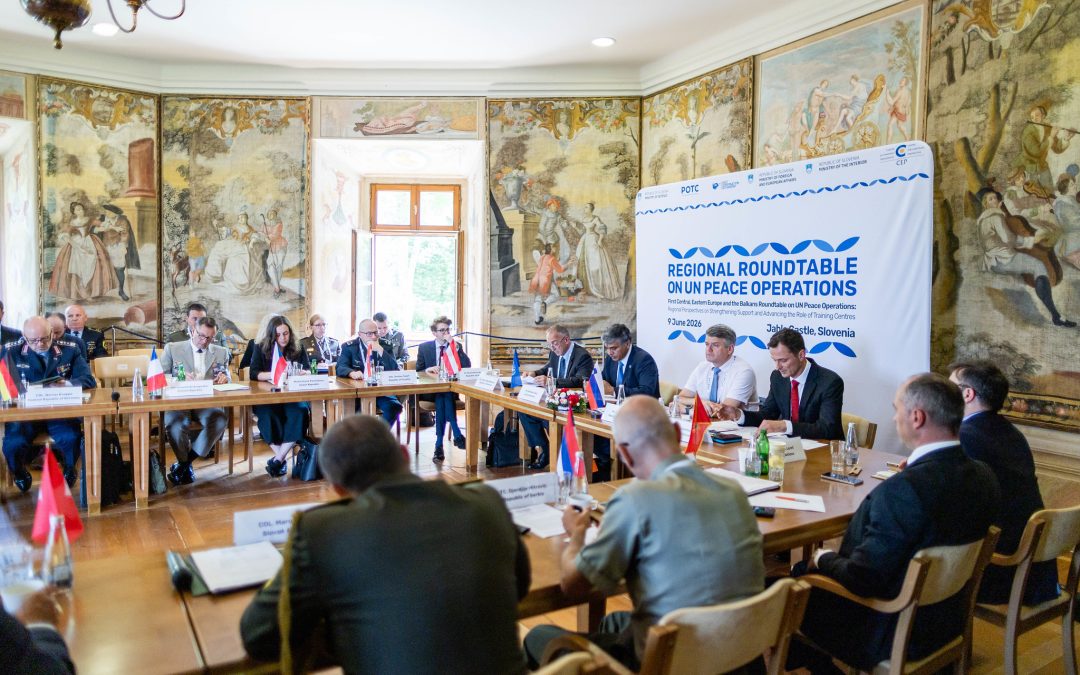
“The First Central, Eastern Europe and the Balkans Roundtable on UN Peace Operations: Regional Perspectives on Strengthening Support and Advancing the Role of Training Centres” (hereinafter referred to as the Regional Roundtable on UN Peace Operations) took place at Jable Castle on 9 June.  

This international intergovernmental event focused on the future of regional engagement in United Nations peace operations. It was organised by the Ministry of Defence of the Republic of Slovenia and the Peace Operations Training Centre (POTC), in cooperation with the Light Coordination Mechanism (LCM) in the Integrated Training Service (ITS) of the UN Department of Peace Operations (DPO).   

With this event, Slovenia initiated a regional process, expanded in a “regional-plus” format, aimed at fostering regional cooperation in peace operations, developing the role of training centres, and strengthening cooperation with the UN and partner institutions. The event brought together representatives of participating regional Member States, observer Member States with speaking roles, the United Nations, partner institutions, and academia with the aim of strengthening regional cooperation, improving operational preparedness, and developing capabilities and training, including the evolving role of peacekeeping training centres. Peace operations are a key tool for conflict prevention, civilian protection, and post-conflict stabilisation.  

As the first meeting of its kind in the region, the event also followed the 2025 UN Peacekeeping Ministerial in Berlin and recent mission developments, including  the upcoming closure of the UN Interim Force in Lebanon (UNIFIL) at the end of 2026, the event provided a timely platform to reflect on future priorities and lessons learned. Peace operations remain one of the most important tools of the international community for conflict prevention, the protection of civilians, and post-conflict stabilisation, but require continuous adaptation. They involve military, police, and civilian units that monitor ceasefires, protect civilians, and assist in rebuilding institutions and the rule of law. They reduce violence, prevent the spillover of conflicts, and create the necessary conditions for long-term peace and development.   

To ensure the successful and effective implementation of peace operations, countries must provide sufficient personnel, material, and financial resources, which remains an ever-present challenge in planning and executing these operations. Despite the current focus of many European nations on the war in Ukraine and their commitments within NATO, alongside Slovenia’s active participation in EU CSDP missions and operations, maintaining readiness and participating in United Nations peace operations remain a vital dimension of Slovenia’s approach to international security cooperation and multilateral crisis management.  

Countries in the region, including Slovenia, regularly face considerations regarding which UN missions to participate in, in what manner, with which units, and what or how much to contribute.  During its mandate as a non-permanent member of the UN Security Council (2024–2025), Slovenia actively contributed to discussions on the future of peace operations.  

Regional cooperation and the key role of training centres 

As emphasised by mag. Aljoša Selan, Acting Director General of the Defence Policy Directorate at the Ministry of Defence of the Republic of Slovenia, future peacekeepers will require competencies that extend beyond traditional military skills. They will need to operate in complex information environments, understand emerging technologies, support the protection of civilians, engage with local populations, and contribute to integrated approaches involving military, police, and civilian actors. Training institutions, such as the Slovenian POTC, which was co-established, and is co-funded, and co-managed by the Ministry of Defence, the Ministry of Foreign and European Affairs, and the Ministry of Interior of Slovenia, and operates within the Center for European Perspective, therefore play a particularly important role in ensuring that personnel remain prepared for future operational requirements. 

Strengthening training, education, and professional networks is the primary answer to maintaining readiness, expertise, and influence during a period when traditional operational opportunities are becoming less frequent.  Furthermore, the Slovenian representative, Mr Selan, stressed that Slovenia does not see regional cooperation as an option, but as a necessity. It should develop along three main lines: first, closer links between peace operations training centres; second, joint training activities, exercises, and personnel exchanges; and third, a more coordinated regional approach within the United Nations system.   

The Head of POTC, Samo Selimović, added that when connecting these centres, this refers to highly concrete forms of interstate cooperation. This includes trainer exchanges, opening training courses to personnel from other nations, and the collaboration of centres in preserving and transferring skills, knowledge, and practical experience from complex missions, such as UNIFIL. 

Overall, the roundtable participants agreed that regional cooperation should primarily focus on fostering information sharing and lessons learned (e.g. from MINUSMA and UNIFIL), while also building partnerships on peacekeeping training, capacity building, and co-deployments. They emphasized that UN peacekeeping must be adaptable, shifting toward flexible, scalable models that rely on interoperability and preparedness. They also highlighted the importance of realistic mandates, noting that overbroad or unfunded “Christmas tree mandates” present a serious issue. At the same time, they concluded that investment in training is one of the most cost-effective forms of support to UN peace operations, as maintaining readiness today is less costly than rebuilding capabilities tomorrow.  
 

Razpis za delovno mesto: Projektni asistent

Razpis za delovno mesto: Projektni asistent

Ustanova – Center za evropsko prihodnost (CEP) razpisuje delovno mesto:  PROJEKTNI ASISTENT – M/Ž 

Projektni asistent opravlja naslednje naloge: pomoč pri pripravi projektov, samostojno oblikovanje manj zahtevnih gradiv, informacij, poročil in drugih gradiv, podpora pri izvajanju projektov ter druge naloge v skladu z navodili. 

Na razpisano delovno mesto bo imenovan kandidat, ki izpolnjuje naslednje pogoje: 

  • državljanstvo države članice Evropske unije, 
  • visokošolska izobrazba 2. stopnje oz. univerzitetna (prejšnja) družboslovne smeri, jezikoslovja, novinarstva, ekonomije, ipd., 
  • poznavanje področja mednarodnih odnosov in EU politik, 
  • vozniški izpit B kategorije, 
  • tekoče ustno in pisno znanje angleškega jezika (C1/C2), 
  • znanje jezika ciljnih regij (B/C/M/S, ukrajinski jezik) na ravni B2, 
  • usposobljenost za delo z računalnikom (delo s urejevalniki besedil, delo s preglednicami, delo z bazami podatkov, poznavanje računalniških omrežij, poznavanje operacijskih sistemov), 

*Razgovor bo vključeval pisni test angleškega jezika, ki ga bomo ocenili glede na kriterije, ki bodo predstavljeni kandidatu. 

Prednost bodo imeli kandidati: 

  • z relevantnimi izkušnjami delovanja v mednarodnem okolju, 
  • s poznavanjem projektnega menedžmenta, 
  • z izkušnjami organiziranja mednarodnih dogodkov, 
  • s poznavanjem ciljev politik razvojnega sodelovanja RS, akterjev in ciljnih regij, 
  • z organizacijskimi in komunikacijskimi sposobnostmi, 
  • z izkušnjami sodelovanja z vladnim, nevladnim in/ali EU strukturami, 
  • s sposobnostjo samostojnega komuniciranja in predstavljanja, 
  • s samoiniciativnostjo in timsko naravnanostjo. 

 Delo na razpisanem delovnem mestu okvirno obsega naslednje naloge: 

  • podpora pri načrtovanju projektov, ki izpolnjujejo potrebe držav v razvoju, 
  • pomoč pri pripravi in izvedbi mednarodnih in drugih projektnih aktivnosti, 
  • pomoč pri pripravi poročil, analiz, projektnih predlogov in prispevkov za javnosti, 
  • koordinacija in sodelovanje z mednarodnimi partnerji, 
  • podpora vodji sektorja pri načrtovanju in koordinaciji dela, 
  • komunikacija s slovenskimi in tujimi udeleženci projektnih aktivnosti, 
  • sodelovanje s slovenskimi in tujimi strokovnjaki, 
  • ostala dela in naloge po navodilih nadrejenega. 

 Izbrani kandidat/ka bo delo opravljal/a na sedežu CEP, Grajska cesta 1, 1234 Mengeš. Trajanje zaposlitve: 6 mesecev z možnostjo dolgoročnega sodelovanja. 

 Kandidat mora ob prijavi predložiti: 

  • življenjepis in motivacijsko pismo iz katerih mora biti razvidno, da kandidat izpolnjuje pogoje. 

Kandidati naj pošljejo prijavo z ustreznimi dokazili po elektronski pošti na naslov:  [email protected] z jasno oznako »Prijava na razpis za delovno mesto Projektni asistent«. 

Rok za prijavo poteče dne 15. junija 2026 ob 23:59. uri.Upoštevane bodo vse prijave, ki bodo pravočasno prispele na zgoraj navedeni elektronski naslov. 

Izbrani kandidat/ka bo o izbiri obveščen/a v roku 15 dni po odločitvi o izboru. Razpis je objavljen tudi na spletni strani Zavoda RS za zaposlovanje. 

Vsi izrazi v zgornjem besedilu, ki se nanašajo na osebe in so zapisani vmoški slovnični obliki, so uporabljeni kot nevtralni zaženskiinmoškispol. 

EUTI Training: EU Human Rights and Due Diligence Policy (HRDDP)

EUTI Training: EU Human Rights and Due Diligence Policy (HRDDP)

Training dates: 8–10 June 2026

Training location: Barsey by Warwick, Brussels, Belgium

Participants: field practitioners from 11 CSDP civilian missions and 5 CSDP military missions, alongside representatives from EEAS Headquarters (CivOpsHQ, MPCC, EUMS, PCMD, and EPF).

Background and Core Objectives

The 2022 Strategic Compass for Security and Defence, alongside the 2023 Civilian CSDP Compact, strongly reinforces the European Union’s commitment to systematically mainstreaming human rights and ensuring strict compliance with International Human Rights Law (IHRL) and International Humanitarian Law (IHL). Following the adoption of the EU Human Rights and International Humanitarian Law Due Diligence Policy (EU HRDDP) in February 2024 and the issuance of its Implementation Handbook in June 2025, the European External Action Service (EEAS) requested renewed support to operationalize these guidelines in the field.

To address high staff turnover and policy implementation challenges identified in recent mission assessment reports, this 3-day training activity was organized by the Egmont Institute in the scope of EUTI.

The program was designed as a direct, highly practical follow-up to the March 2026 training on “Mainstreaming Human Rights into Civilian CSDP Crisis Management Missions” conducted by Scuola Superiore Sant’Anna (SSSA). It focused on the following core objectives:

  • Operationalizing the HRDDP: Translating the policy framework into concrete, field-level practices across the core phases of risk management: Identification, Assessment, Mitigation, and Monitoring.
  • Civilian-Military Synergy: Promoting a balanced framework for both civilian and military CSDP missions, as well as European Peace Facility (EPF) personnel, handling both lethal and non-lethal assistance.
  • Risk Mitigation Mastery: Equipping key advisors and operations officers to manage critical risks, particularly regarding Conflict-Related Sexual Violence (CRSV), Sexual and Gender-Based Violence (SGBV), violations of children’s rights, and the “do no harm” principle when engaging with civil society organizations (CSOs).

On the first day, participants benefited from the shared knowledge and diverse perspectives of senior experts from prominent international institutions, including OHCHR, EEAS, DCAF, the Belgian Royal Military Academy, ICRC, and OSRSG CAAC.