
Future of development cooperation discussed at the Slovenian Development Days
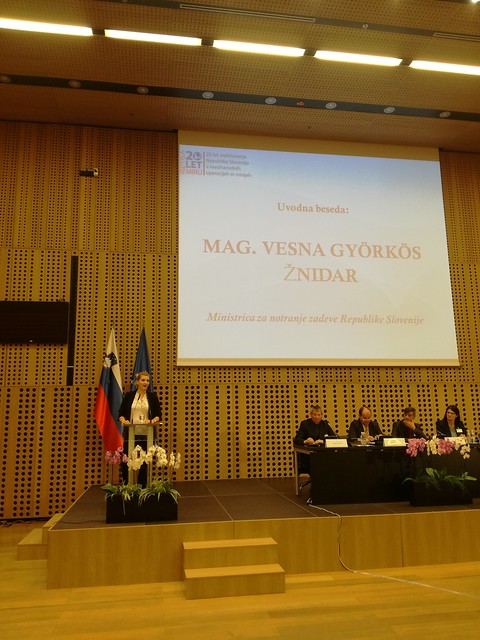
The eighth Slovenian Development Days, organised by the igrationinistry of Foreign Affairs started today in Ljubljana. Two-day event was opened with a series of discussions on future implementation of development cooperation and humanitarian assistance at the Faculty of Social Sciences, University of Ljubljana.
This years’ Development Days were opened by Prof Dr Monika Kalin Golob, Dean of the Faculty of Social Sciences, Karl Erjavec, Minister of Foreign Affairs of the Republic of Slovenia, and Sabina R. Stadler, Director General for Multilateral Affairs, Development Cooperation and International Law at the Ministry of Foreign Affairs of the Republic of Slovenia. Representatives from the Ministry stressed the importance of the new Resolution on International Development Cooperation and Humanitarian Aid of the Republic of Slovenia, which will serve as a basis for future strategies and laws leading to enhanced and more focus development and humanitarian aid projects.
Representatives of the Centre for European Perspective participated at the presentation of the new strategic and legal frameworks for international development cooperation and humanitarian assistance delivered by Andrej Logar, State Secretary at the Ministry of Foreign Affairs of the Republic of Slovenia, and the presentation of the OECD DAC Peer Review conclusions on Slovenian development cooperation and humanitarian assistance by Charlotte Petri Gornitzka, Chair of the Development Assistance Committee at OECD. Petri Gornitzka congratulated Slovenia on successful cooperation with OECD through the Peer Review process. She stressed the importance of peer reviews for the future cooperation and direction of development aid, while the recommendations are to be used as a baseline for Slovenia’s future strategies on the topic. Petri Gornitzka presented 17 conclusions and recommendations resulting from the Peer Review. On one side she presented topics where Slovenia has showed progress, namely in reforming the institutional system, building development expertise, broadening stakeholders ownership, active advocacy, commitment to gender equality, as well as using comparative advantages. On the other side, Slovenia still has work to do in the field of defining strategic directions of approaching poverty reduction in the middle income countries, as well as working on thematic and geographical focus of its development aid; in reviewing business model to enhance impact of bilateral programme; Slovenia should consider the helpfulness of multilateral organisations in achieving strategic aims; make Framework Programme a comprehensive, whole-of-government tool; mainstreaming gender and environment across development co-operation; defining the nature of strategic partnerships with NGOs and private sector; improving transparency about international development; encouraging stakeholders to integrate evaluation and building knowledge and experience in fragile contexts.
Since the first Peer Review of the OECD Development Assistance Committee (DAC) was carried out in Slovenia at the beginning of 2017 with the aim of reviewing the implementation of the development cooperation and humanitarian assistance commitments this year’s Slovenian Development Days hosted a panel discussion, moderated by Dr Boštjan Udovič of Faculty of Social Sciences. The panellists Andrej Logar, Charlotte Petri Gornitzka, Marjeta Jager, DEVCO Deputy Director General at the European Commission, Lotta Karlsson, Director for Administrative and Legal Development Cooperation Matters, Ministry for Foreign Affairs of Finland, and Albin Keuc, Director of SLOGA Platform, addressed the opportunities and challenges of development cooperation, deriving from the recommendations of the Peer Review that provide orientations for future work, and indicates the priorities and challenges of Slovenia’s development cooperation and humanitarian assistance. Special emphasis was given on the importance of cooperation between all stakeholders, development agencies, ministries, NGOs and companies.
A project titled “Global for local – local for global” was presented, where students of Faculty of Social Sciences and Faculty of Education, under the leadership of two mentors, prof. dr. Maja Bučar and Ms Adriana Aralica, SLOGA, were enhancing young people’s awareness about sustainable development through the prism of migration and disseminating sustainable development goals together with the Agenda for sustainable development 2030. A multidisciplinary group of students prepared 10 sets of contents on the objectives of sustainable development through the prism of migration and verified them with the implementation of workshops in Ljubljana. Prepared contents are intended for teaching staff to support them in addressing sustainable development and the migration in the classroom.
A special workshop, moderated by Dr Melita Gabrič, Acting Head of the Department for Development Cooperation and Humanitarian Assistance, was carried out on the topic of DAC Peer Review recommendations and their implementation, focusing on interministerial cooperation, improvements of the Policy Coherence for Development (PCD) and mainstreaming of the cross-cutting issues (gender equality and environment).
An insight of children and youngsters was contributed through the opening of the exhibition “Europe at School”. The exhibition presents the awarded works created for the competition ‘The World I Want to Live In’ by children and young people from elementary and secondary schools who participated in four categories: art, writing, photo and video.
The second day of the event will focus on the role of the Slovenian private sector in development cooperation, integration of Slovenian companies and investments.