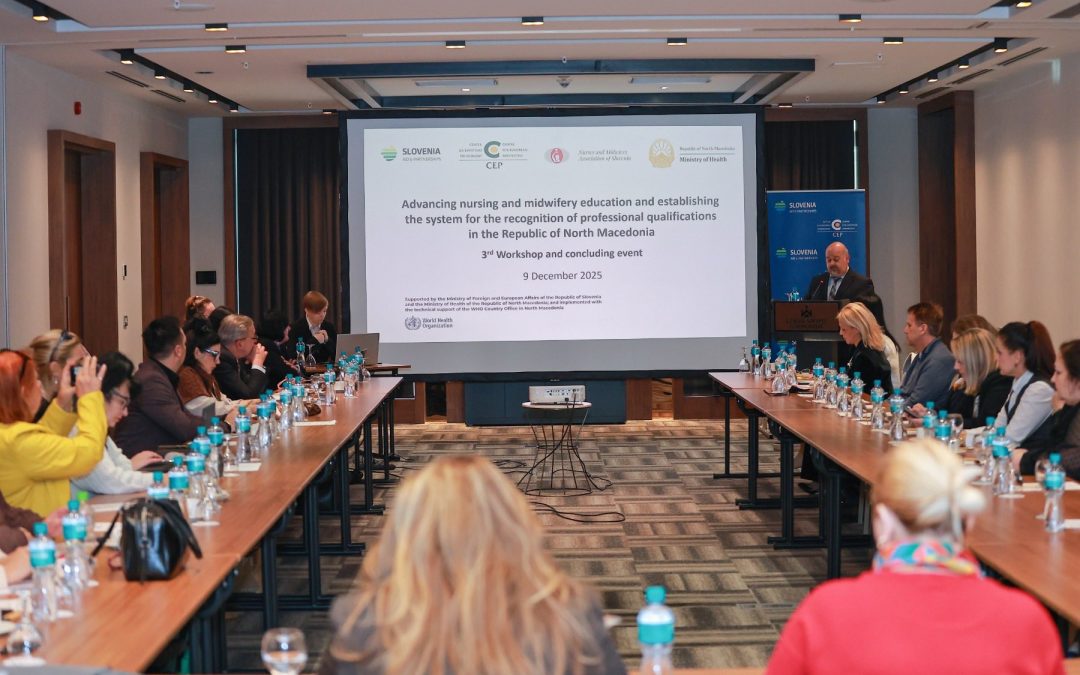
10 December 2025, Skopje, North Macedonia – Yesterday, we concluded the project “Advancing Nursing and Midwifery Education and Establishing the System for the Recognition of Professional Qualifications in the Republic of North Macedonia (2024–2025)”. The final event brought together representatives of the Ministries of Health and Education, higher education institutions, professional associations, and Slovenian experts to reflect on progress and outline the path ahead.
The event opened with an address by Mr Jovica Andovski, Deputy Minister of Health, who emphasised the significance of the reforms initiated through the project. He highlighted that the collaborative work has already supported the beginning of necessary legislative processes and strengthened the foundations for long-term development of the professions. In his speech, he underlined: “These results are not merely formal documents – they are an investment in future generations of nurses and midwives.” He also recognised the project’s role in making long-standing challenges visible to the wider public and institutions, noting that sustainable change will require continued commitment from all sides.
This was followed by remarks from Mrs Nika Rotar, Minister Plenipotentiary and Deputy Ambassador of Slovenia in Skopje, who reaffirmed Slovenia’s strong support in aligning North Macedonia’s nursing and midwifery systems with EU standards.
During the workshop sessions, members of the Macedonian working groups presented their achievements, including analyses of the education system, regulatory gaps, and legislative needs, as well as the development of the national curriculum proposal for nursing and midwifery. These insights were complemented by contributions from Slovenian experts, Mrs Monika Ažman (Nurses and Midwives Association of Slovenia) and Prof. dr Brigita Skela Savič (Angela Boškin Faculty of Health Care), who provided guidance on regulatory models, professional autonomy, and curriculum modernisation aligned with the EU Directive.
The discussions reaffirmed the project’s two core achievements:
• supporting the development of a national regulatory and institutional framework for nursing and midwifery; and
• preparing a harmonised national curriculum aligned with European standards and ready for further consideration by the Ministry of Education and Science.
With the completion of this first phase, the partners agreed that the foundations for reform are now well established. Continued cooperation will be essential to sustain the momentum—particularly in updating legislation, enhancing professional autonomy, and ensuring consistent implementation across educational and clinical environments.
The project was implemented with the support of the Slovenian Ministry of Foreign and European Affairs, the Ministry of Health of North Macedonia, and with technical support from the WHO Office North Macedonia.
