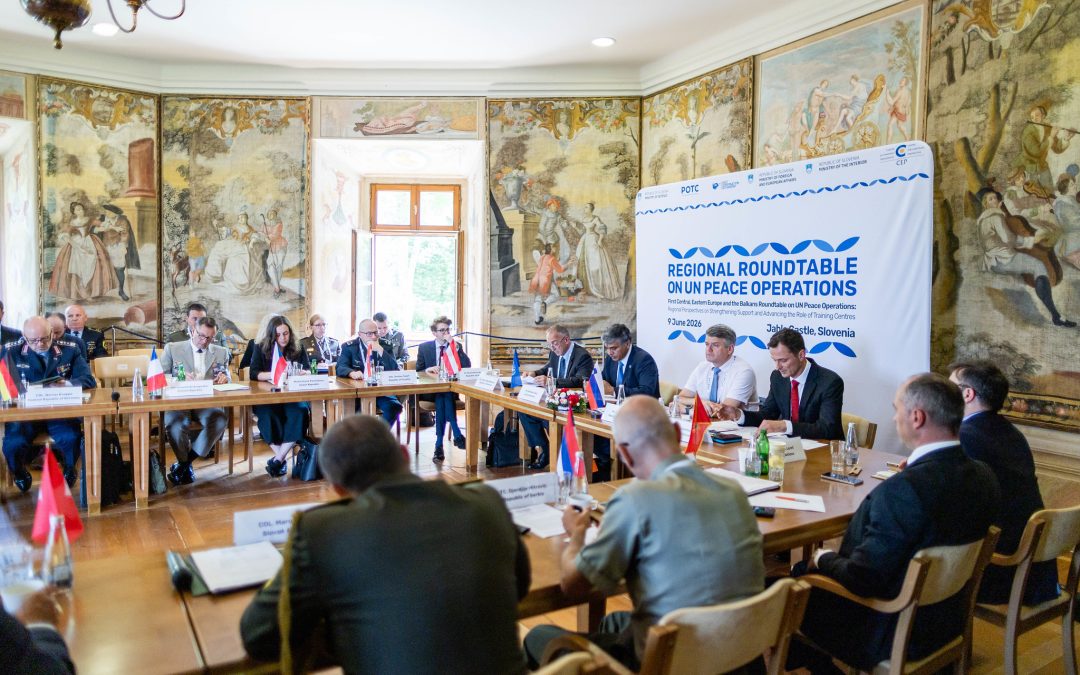
“The First Central, Eastern Europe and the Balkans Roundtable on UN Peace Operations: Regional Perspectives on Strengthening Support and Advancing the Role of Training Centres” (hereinafter referred to as the Regional Roundtable on UN Peace Operations) took place at Jable Castle on 9 June.
This international intergovernmental event focused on the future of regional engagement in United Nations peace operations. It was organised by the Ministry of Defence of the Republic of Slovenia and the Peace Operations Training Centre (POTC), in cooperation with the Light Coordination Mechanism (LCM) in the Integrated Training Service (ITS) of the UN Department of Peace Operations (DPO).
With this event, Slovenia initiated a regional process, expanded in a “regional-plus” format, aimed at fostering regional cooperation in peace operations, developing the role of training centres, and strengthening cooperation with the UN and partner institutions. The event brought together representatives of participating regional Member States, observer Member States with speaking roles, the United Nations, partner institutions, and academia with the aim of strengthening regional cooperation, improving operational preparedness, and developing capabilities and training, including the evolving role of peacekeeping training centres. Peace operations are a key tool for conflict prevention, civilian protection, and post-conflict stabilisation.
As the first meeting of its kind in the region, the event also followed the 2025 UN Peacekeeping Ministerial in Berlin and recent mission developments, including the upcoming closure of the UN Interim Force in Lebanon (UNIFIL) at the end of 2026, the event provided a timely platform to reflect on future priorities and lessons learned. Peace operations remain one of the most important tools of the international community for conflict prevention, the protection of civilians, and post-conflict stabilisation, but require continuous adaptation. They involve military, police, and civilian units that monitor ceasefires, protect civilians, and assist in rebuilding institutions and the rule of law. They reduce violence, prevent the spillover of conflicts, and create the necessary conditions for long-term peace and development.
To ensure the successful and effective implementation of peace operations, countries must provide sufficient personnel, material, and financial resources, which remains an ever-present challenge in planning and executing these operations. Despite the current focus of many European nations on the war in Ukraine and their commitments within NATO, alongside Slovenia’s active participation in EU CSDP missions and operations, maintaining readiness and participating in United Nations peace operations remain a vital dimension of Slovenia’s approach to international security cooperation and multilateral crisis management.
Countries in the region, including Slovenia, regularly face considerations regarding which UN missions to participate in, in what manner, with which units, and what or how much to contribute. During its mandate as a non-permanent member of the UN Security Council (2024–2025), Slovenia actively contributed to discussions on the future of peace operations.
Regional cooperation and the key role of training centres
As emphasised by mag. Aljoša Selan, Acting Director General of the Defence Policy Directorate at the Ministry of Defence of the Republic of Slovenia, future peacekeepers will require competencies that extend beyond traditional military skills. They will need to operate in complex information environments, understand emerging technologies, support the protection of civilians, engage with local populations, and contribute to integrated approaches involving military, police, and civilian actors. Training institutions, such as the Slovenian POTC, which was co-established, and is co-funded, and co-managed by the Ministry of Defence, the Ministry of Foreign and European Affairs, and the Ministry of Interior of Slovenia, and operates within the Center for European Perspective, therefore play a particularly important role in ensuring that personnel remain prepared for future operational requirements.
Strengthening training, education, and professional networks is the primary answer to maintaining readiness, expertise, and influence during a period when traditional operational opportunities are becoming less frequent. Furthermore, the Slovenian representative, Mr Selan, stressed that Slovenia does not see regional cooperation as an option, but as a necessity. It should develop along three main lines: first, closer links between peace operations training centres; second, joint training activities, exercises, and personnel exchanges; and third, a more coordinated regional approach within the United Nations system.
The Head of POTC, Samo Selimović, added that when connecting these centres, this refers to highly concrete forms of interstate cooperation. This includes trainer exchanges, opening training courses to personnel from other nations, and the collaboration of centres in preserving and transferring skills, knowledge, and practical experience from complex missions, such as UNIFIL.
Overall, the roundtable participants agreed that regional cooperation should primarily focus on fostering information sharing and lessons learned (e.g. from MINUSMA and UNIFIL), while also building partnerships on peacekeeping training, capacity building, and co-deployments. They emphasized that UN peacekeeping must be adaptable, shifting toward flexible, scalable models that rely on interoperability and preparedness. They also highlighted the importance of realistic mandates, noting that overbroad or unfunded “Christmas tree mandates” present a serious issue. At the same time, they concluded that investment in training is one of the most cost-effective forms of support to UN peace operations, as maintaining readiness today is less costly than rebuilding capabilities tomorrow.