
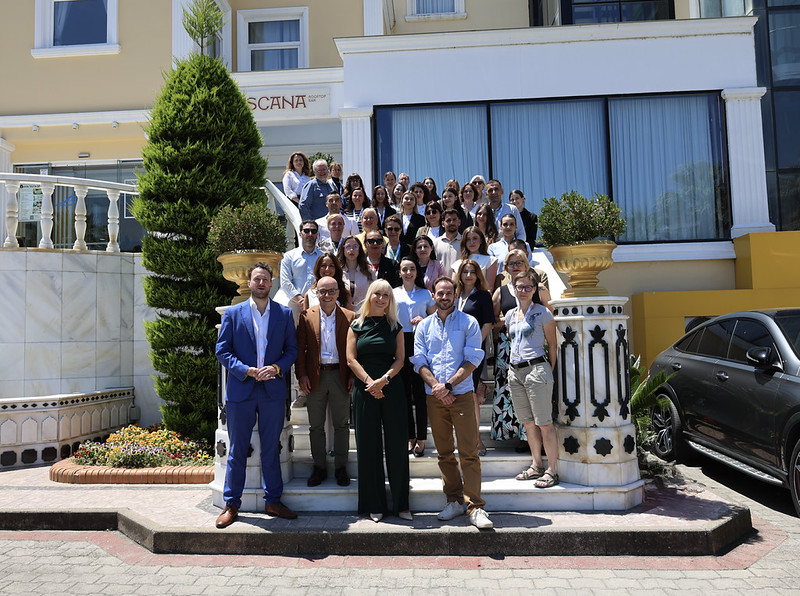
The Centre for European Perspective concluded the four-day European Digital Diplomacy Exchange workshop “Centering Citizens in a Secure Digital Society,” held from June 9–12 in Durrës, Albania. The workshop convened more than 50 participants and speakers from 20 countries across Europe and the United States to examine how public sector adoption of emerging digital technologies can center citizens in democratic processes that bolster social productivity, public trust, and national resilience.
The conference brought together mid- and high-level government communications officials, private technology sector representatives, security experts, media figures, and academic thought leaders to discuss how governments can best empower citizens with the critical political, social, and cultural information necessary to protect national information sovereignty and counter foreign propaganda. These capacities are integral to ensuring that citizens can participate productively in the information economies that increasingly shape their nation’s future.
Across four days, participants engaged in lectures, structured discussions, and hands-on activities that bridged the theory and practice of strategic communications. The workshop emphasized how governments can fulfill their role as strong stewards and facilitators of public information and public discourse, while adapting their communication practices to the norms, values, and behaviors of the digital information environment through which citizens increasingly access, assess, and engage with public information.
The programme began with opening remarks by Nancy VanHorn, Chargé d’Affaires of the U.S. Embassy in Tirana, and Jakob Štunf, Ambassador of the Republic of Slovenia to Albania. The first day focused on digital public affairs, public diplomacy, information sovereignty, citizen engagement, and trust in democratic governance, with sessions led by EDDE organizers Matt Jacobs and Ingrid Omahna, Professor Nicholas Cull of the University of Southern California, and Professor Dejan Verčič of the University of Ljubljana.
The following sessions moved from strategic foundations to practical application. Professor Cull explored the value of national brand and reputational security through “Building Brand Affinity with a National Selfie,” while Celeste Sepessy led participants through “Policy Storytelling,” examining how government communicators can transform abstract policy positions into narratives that speak more directly to citizens’ needs, values, and lived experiences.
The workshop also focused on refining digital strategic communications through audience segmentation, multimedia, and emerging technologies. Celeste Sepessy introduced demographic and psychographic approaches to audience analysis, Magdalena Mactas, Senior Advisor at UNICEF and Founder of MAG Agency, explored how multimedia can make policy narratives more accessible, evocative, memorable, and persuasive, and Oskar Braszczyński, Government and Politics Partner at Meta, addressed the opportunities and challenges of emerging AI tools for public sector institutions.
The final day focused on how proactive, credible, and citizen-centered strategic communications can serve as a national security asset by helping public institutions build resilience against foreign adversarial information activities. In a session led by Steven Hardy and Sabrina Spieleder from NATO’s Office of Strategic Communications, participants examined how foreign adversarial propaganda threatens national security by undermining national information sovereignty, weakening the voices of citizens, and impacting relationships between representative governments and their public. The session also explored processes and practices for identifying and countering foreign informational manipulation and interference, both by individual countries and by collective partners working toward shared objectives.
Throughout the workshop, participants applied the lessons from each session through practical activities, including account analysis, audience segmentation, policy storytelling, multimedia planning, and group discussions on the responsible integration of emerging technologies. These activities supported EDDE’s broader capacity-building approach: helping public institutions develop the strategic communications capacities necessary to ensure citizens are informed, empowered, and able to participate productively in democratic life.
By convening practitioners from across sectors and across national borders, EDDE continues to bolster a vital platform for cooperation and collaboration. The workshop reinforced the importance of ensuring that governments, industry, media, academia, and security experts are collectively engaged in addressing challenges in the information space that continue to pose a threat to national sovereignty, national security, and national social resilience.
The Centre for European Perspective oversees and implements the European Digital Diplomacy Exchange project. Activities are supported and funded by the U.S. Department of State and the Ministry of Foreign and European Affairs, within the scope of the Development Cooperation and Aid programme.