
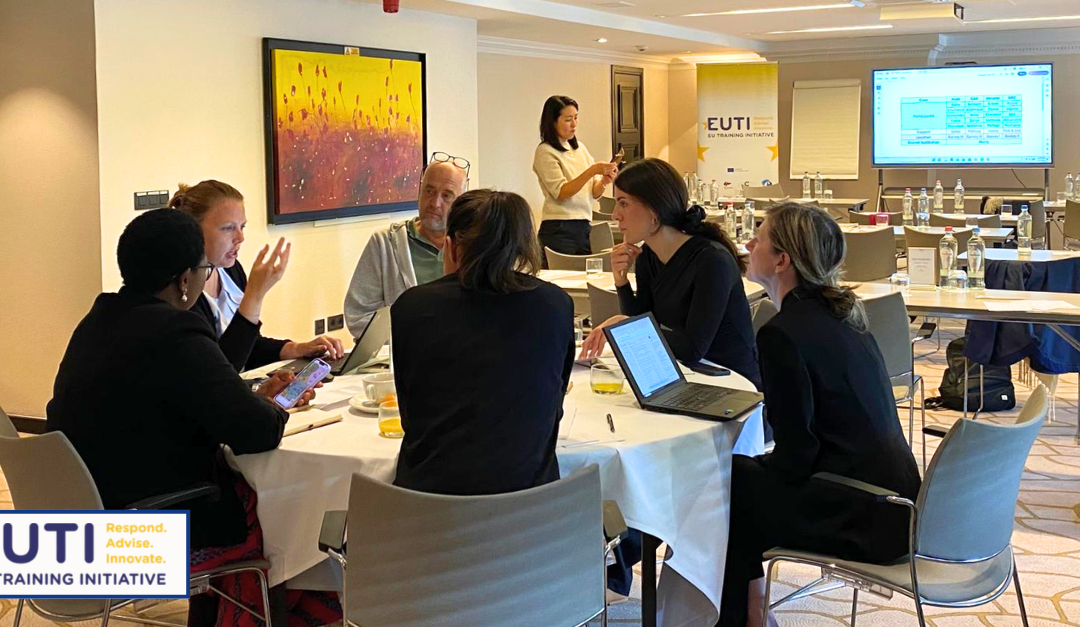
Training dates: 8–10 June 2026
Training location: Barsey by Warwick, Brussels, Belgium
Participants: field practitioners from 11 CSDP civilian missions and 5 CSDP military missions, alongside representatives from EEAS Headquarters (CivOpsHQ, MPCC, EUMS, PCMD, and EPF).
Background and Core Objectives
The 2022 Strategic Compass for Security and Defence, alongside the 2023 Civilian CSDP Compact, strongly reinforces the European Union’s commitment to systematically mainstreaming human rights and ensuring strict compliance with International Human Rights Law (IHRL) and International Humanitarian Law (IHL). Following the adoption of the EU Human Rights and International Humanitarian Law Due Diligence Policy (EU HRDDP) in February 2024 and the issuance of its Implementation Handbook in June 2025, the European External Action Service (EEAS) requested renewed support to operationalize these guidelines in the field.
To address high staff turnover and policy implementation challenges identified in recent mission assessment reports, this 3-day training activity was organized by the Egmont Institute in the scope of EUTI.
The program was designed as a direct, highly practical follow-up to the March 2026 training on “Mainstreaming Human Rights into Civilian CSDP Crisis Management Missions” conducted by Scuola Superiore Sant’Anna (SSSA). It focused on the following core objectives:
- Operationalizing the HRDDP: Translating the policy framework into concrete, field-level practices across the core phases of risk management: Identification, Assessment, Mitigation, and Monitoring.
- Civilian-Military Synergy: Promoting a balanced framework for both civilian and military CSDP missions, as well as European Peace Facility (EPF) personnel, handling both lethal and non-lethal assistance.
- Risk Mitigation Mastery: Equipping key advisors and operations officers to manage critical risks, particularly regarding Conflict-Related Sexual Violence (CRSV), Sexual and Gender-Based Violence (SGBV), violations of children’s rights, and the “do no harm” principle when engaging with civil society organizations (CSOs).
On the first day, participants benefited from the shared knowledge and diverse perspectives of senior experts from prominent international institutions, including OHCHR, EEAS, DCAF, the Belgian Royal Military Academy, ICRC, and OSRSG CAAC.