17. 9. 2021 | POTC, PR, Slovenian Development Assistance
Klikni tukaj za branje prispevka v slovenskem jeziku. 
After successfully delivered two training courses on Gender equality and gender mainstreaming in peace operations and missions (November 2020 and May 2021), Centre for European Perspective (CEP) is further actively involved in empowering women in the field of peace and security. From 14 to 17 September 2021, a series of online workshops on Negotiation techniques and women empowerment was carried out by the European Institute of Public Administration (EIPA) in coordination with CEP and with support from the Ministry of Foreign Affairs of the Republic of Slovenia.
This series of workshops were organized for representatives of the Venezuelan democratic forces who will directly or indirectly participate in international negotiations, mediation, and conflict resolution processes. The program consisted of ground-setting and advanced workshops, where the participants examined the particularities of and advantages for women’s involvement in conflict resolution, negotiation, and mediation processes, analyse negotiation process from a gender perspective (including the analysis of strategies, methods, techniques for negotiation, communication, and influence), and conducted practical exercises to practice the application of various negotiation components.
With the newly acquired knowledge in the field of negotiation, mediation, and conflict resolution, will the representatives of the Venezuelan democratic forces, be able to actively participate in these processes and thus increase the representation of women in these areas and bring challenges faced by women in times of humanitarian crises and conflicts to the peace agreements.
 Virtual workshop on negotiation techniques and women´s empowerment continues the activities of Centre for European Perspective – CEP, aimed at the empowerment of women that began within the Peace Operations Training Centre and EUPCST project.
 The activities are supported by Slovenia’s Development Cooperation Programme of the Ministry of Foreign Affairs of the Republic of Slovenia and carried out together with the European Institute of Public Administration (EIPA) .

21. 5. 2021 | EUPCST, POTC, PR
Following a successful pilot training organised in 2020, the Centre for European Perspective is organising an online training on Gender Equality and Gender Mainstreaming in Peace Operations.
The Peace Operations Training Centre, operating within CEP with the support of the European Union Police and Civilian Services Training, has successfully concluded the Gender Equality and Gender Mainstreaming in Peace Operations Training that took place from the 18 to the 20 of May 2021.
Members of Police forces from 12 European countries addressed the international legal framework on gender equality with a special focus on EU legislation, the issue of gender in relation to human dignity in international operations, impact of conflict on gender-related issues and gained insight into concrete situations and issues in experience sharing sessions with experts from the field.
The training on gender equality was in high demand and 29 participants altogether successfully completed the course. They gained different insights, but all agreed that the training was a success:
“This was my first online training. Easy and nice! From the learning perspective it is as effective as sitting in the old fashion class-room.”
“The discussions made me realize some actions that I and others do. I reflected on how it impacts on others and how this has a rippling effect. It was good to hear it from the perspective of women. I am now in a process of looking at some of my behaviors.”
“Thanks a lot to have the possibility to take part in this training. I will start my next mission in a couple of weeks, and I feel very well prepared in gender related topics.”
“As a trainer I always have opportunity to listen to similar content, but nevertheless this was a really good course with new information which I will use at my work.”

12. 5. 2021 | EUPCST, POTC, PR
Following a successful pilot training organised in 2020, the Centre for European Perspective is organising an online training on Gender Equality and Gender Mainstreaming in Peace Operations. The training will take place in the period from the 18th to the 20th of May 2021.
The online lectures, workshops and participatory activities will cover the basic topics regarding gender equality and mainstreaming. Participants will gain skills and knowledge that will help them engage all stakeholders regarding gender equality and include the perspectives of women in their efforts to build sustainable peace.
The Online Training will be carried out by the Peace Operations Training Centre operating within CEP with the support of the European Union Police and Civilian Services Training.


26. 4. 2021 | POTC, PR
Peace Operations Training Centre (POTC) organized a Pre-deployment Training for Civilian Personnel Joining the EUAM Ukraine and EUMM Georgia from 20 – 23 April 2021. Due to COVID-19 restrictions, the training was delivered in a virtual form.
Pre-deployment trainings aim to increase the functioning ability of the mission staff by equipping them with the knowledge and skills necessary to become operational and capable to adapt to the new working environment. This pre-deployment training was designed specifically for civilians that are about to be deployed either to the European Union Advisory Mission in Ukraine (EUAM) or the European Union Monitoring Mission in Georgia (EUMM).
The training provided an overview of the local environment and historical context of both countries, thoroughly presented both missions, prepared the trainees for an interview, explained the basics of orientation, and equipped the participants with gender lenses together with skills for successful trainers, mentoring, monitoring and advising. Many thanks to all the trainers.
Although virtual trainings bring different challenges we are certain that our participants will be prepared to embark on assigned responsibilities with confidence and adapt to complex mission life. All the best of luck to all of them!


19. 4. 2021 | POTC, PR
Peace Operations Training Centre (POTC) is organizing a Pre-deployment Training for Civilian Personnel Joining the EUAM Ukraine and EUMM Georgia. The training will, due to COVID-19 restrictions, take place virtually from 20 – 23 April 2021.
The pre-deployment training course is one of the primary tools used to generate competent, institutionally knowledgeable, and ethically aware civilian personnel capable of serving in dangerous and complex environments. This training will be mission-specific, focusing on the European Union Advisory Mission in Ukraine (EUAM) and the European Union Monitoring Mission in Georgia (EUMM), designed for police and civilians that will be potentially deployed to one of the above-mentioned missions. The training is intended to provide a shared understanding of the environment and both missions, including cross-cutting themes and priorities such as gender mainstreaming and the development of basic skills, such as map reading, monitoring – mentoring – advising and skills of a good trainer.
After successfully completing the training, the new civilian staff members will be prepared to undertake assigned responsibilities with confidence and adapt to complex mission life.

23. 3. 2021 | POTC, PR
Peacekeeping operations have changed over time. Since the nature and mandate of operations have transformed, we can say that they have become more complex. A significant difference can also be seen in the type of participants, which have altered from international to national actors, and from military to civilian actors.
The NATO Summit in Washington in 1999, defined the concept of civil-military cooperation for the first time. This cooperation has also been one of the seven strategic goals of NATO’s long-term programs until 2025. The concept was developed by all countries and can be implemented by members of the military with civilian knowledge or with the participation of civilian experts without military knowledge.
In Slovenia, this concept is called “civilian functional experts” or CFS. CFS are specially trained professionals in a variety of fields that link the military and civilian environment. Their main task is to establish good relations with the local population, as well as with civilian, non-governmental, governmental, international, and other organizations in the field of peacekeeping missions. At the same time, they work in their field with the aim of stabilizing, restoring, or developing the civilian environment. CFS must have a good knowledge of both civilian and military thinking and action and are specially trained for this. Through their work, CFS make an important contribution to the overall military objective of the operation, which is to ensure a secure and stable environment while creating better conditions for the stabilization and reconstruction of society and the state.
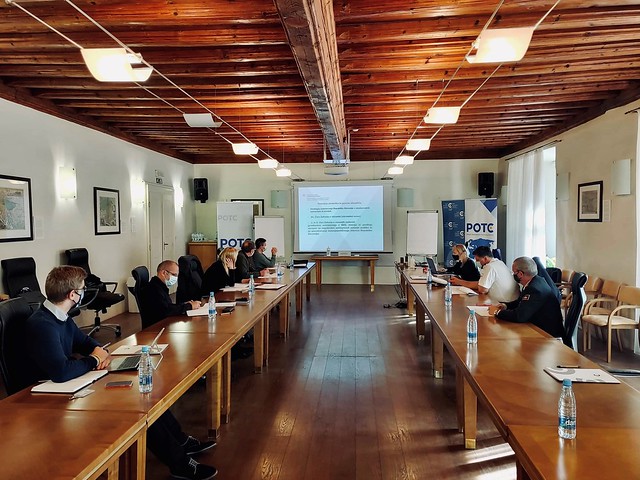
POTC, together with the Ministry of Defence, Ministry of Interior, Ministry of Foreign Affairs, Slovenian Police, Slovenian Armed Forces, Administration for Civil Protection and Disaster Relief, and Slovenian Red Cross is taking a comprehensive approach towards developing Community and People-Centered Approach training for CFS.
Today’s workshop was the first one in the series, to familiarize with the activities in the field of various stakeholders. It will set the basis for identifying the needs for civilian-military cooperation by involving all relevant stakeholders in the process.