Sustainable Housing Solutions: Ukrainian Municipalities Learn from Slovenian Good Practices
A five-day thematic cluster visit to Slovenia brought together representatives of nine Ukrainian hromadas and the Lviv Regional Military Administration with Slovenian housing experts, public institutions and municipalities to exchange knowledge, strengthen partnerships and develop practical strategies for addressing sustainable housing for communities and internally displaced persons (IDPs) in Ukraine.
From 6 to 10 July, the delegation participated in an intensive programme of workshops, policy discussions, study visits and strategy sessions as part of the Recovery and Reconstruction in Ukraine programme. The visit aimed to transform knowledge into concrete action by equipping Ukrainian local authorities with practical tools and policy approaches that can support long-term, resilient housing development.
The cluster visit was organised around the idea that today’s solutions can become tomorrow’s homes. Throughout the week, participants explored Slovenian experiences in housing policy, affordable housing provision, urban regeneration and participatory planning while discussing how these models could be adapted to the Ukrainian context.
Building a Strong Foundation for Housing Recovery
The programme began with introductory workshops where participants identified the main housing challenges facing their municipalities and exchanged experiences from previous cooperation activities. Particular attention was given to the housing situation in the Lviv region, the needs of internally displaced persons and the development of local housing strategies that respond to both immediate and long-term reconstruction priorities.
A key contribution came from the Ukrainian think tank CEDOS, which presented research on Ukraine’s rental housing market and the challenges surrounding rent subsidies for internally displaced persons. The discussion provided participants with valuable evidence for understanding existing policy gaps and identifying opportunities for future reforms.
Participants also learned about alternative housing models presented by the Institute for Studies of Housing and Space (IŠSP), including non-profit housing cooperatives and approaches that diversify housing providers while strengthening community resilience. Experts from MOBA Housing introduced innovative financing mechanisms for community-led and cooperative housing initiatives, demonstrating how long-term financial instruments can support affordable housing development beyond traditional banking systems.
Learning from Slovenia’s Housing System
During the visit, the Ukrainian delegation met with representatives of Slovenia’s key housing institutions and explored how national and local policies have evolved to increase the supply of affordable housing.
Sessions included presentations by representatives of the Ministry of environment and spatial planning of Slovenia, responsible for housing policy, the Housing Fund of the Republic of Slovenia and the Public Housing Fund of the City of Ljubljana. Discussions focused on recent reforms, financing mechanisms, public rental housing, strategic planning and the challenges of expanding non-profit housing in response to growing demand.
The delegation also visited Novo Brdo in Ljubljana, one of Slovenia’s flagship non-profit housing developments, where participants examined how quality architecture, community planning and social inclusion contribute to successful affordable housing projects.
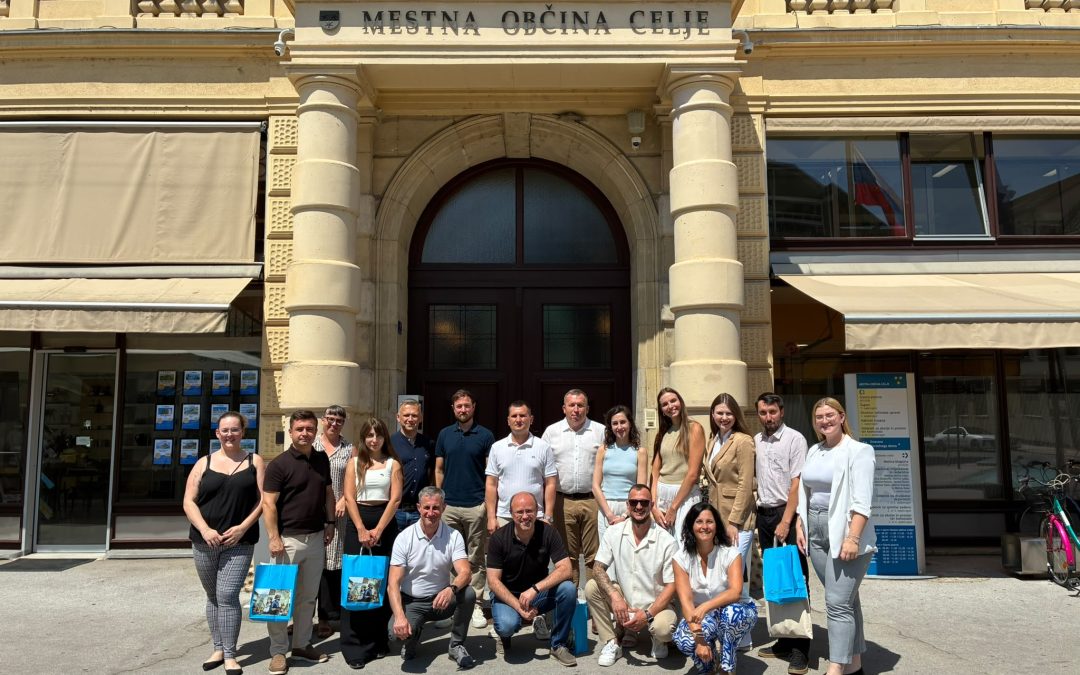
The programme continued in Celje, where local officials presented the municipality’s housing strategy and showcased examples of non-profit housing development, assisted living facilities and neighbourhood regeneration. Site visits and workshops demonstrated how municipalities can play an active role in improving housing conditions while creating more sustainable and inclusive urban environments.
From Knowledge Exchange to Strategic Action
Beyond expert presentations and field visits, participants took part in a full-day Strategy Lab led by Professor dr. Nenad Filipović of IEDC – Bled School of Management. The workshop focused on translating ideas into practical strategies, helping participants understand how to design, implement and monitor effective housing interventions capable of delivering measurable results.
Another important component of the programme was participatory urban design, where the Ukrainian delegation learned how involving residents and local stakeholders in planning processes can improve public spaces and strengthen communities alongside housing development.
Strengthening Slovenian–Ukrainian Partnerships
The thematic cluster visit created valuable opportunities for cooperation between Ukrainian municipalities and Slovenian research institutions, municipalities, housing organisations and civil society partners. Discussions extended beyond knowledge sharing to explore future joint projects, financing opportunities, pilot initiatives, capacity building and continued institutional collaboration.
The visit also established a strong foundation for the thematic housing cluster to continue supporting Ukrainian communities as they work towards sustainable, affordable and resilient housing solutions in line with Ukraine’s reconstruction priorities and evolving housing legislation.
The cluster visit brought together expertise from the Institute for Studies of Housing and Space (IŠSP), CEDOS, MOBA Housing, IPoP – Institute for Spatial Policies, Prostorož, IEDC – Bled School of Management, the Housing Fund of the Republic of Slovenia, the Public Housing Fund of the City of Ljubljana, the Municipality of Celje and other Slovenian partners, creating a comprehensive platform for policy dialogue and practical learning.
The activities were implemented by the Centre for European Perspective (CEP) in cooperation with U-LEAD with Europe and supported by the Ministry of Foreign and European Affairs of the Republic of Slovenia through the Slovenian Aid and Partnerships Programme.