20. 3. 2024 | Decentralisation, PR, Regional cooperation, Slovenian Development Assistance, U-LEAD: with Europe, Ukraine, Waste management
20 March 2024, Idrija – Today, we began the second three-week mentorship of 2024 in the municipality of Idrija under the auspices of the project ‘Post-conflict reconstruction in Ukraine’.
The event was opened by the Mayor of the Municipality of Idrija, Mr Tomaž Vencelj. He greeted the participants and expressed Idrija’s openness to cooperating with Pereschepinska municipality. He then presented Idrija through the video of the Idrija geopark and spoke of the possibilities for cooperation between the municipalities.
The following was the project presentation by Ms Jelka Klemenc, CEP’s project lead, who presented the project and its objectives.
On behalf of mentees from Pereschepinska, Mayor Tsvirkun presented the municipality, its challenges, possibilities, and expected outcomes of the mentorship visit.
The mentorship builds upon the needs expressed by Pereschepyne municipality, mainly the preservation of cultural heritage, waste management, and energy efficiency of public buildings, and will address topics crucial for the municipality’s further development, such as project management, project writing, and topics related to the EU enlargement process on the local level.
The Idrija municipality, with its rich heritage in cultural preservation, activities in the area of waste management, sustainability and zero waste, and the successful establishment of the Ljubevč waste collection centre, brings valuable experience that can be a boon to partners from Pereschepyne. Through presentations and site visits, mentees from Ukraine will gain insights into these practices and projects and explore project planning, preparation and management, and EU project funding.

The ‘Post-conflict reconstruction in Ukraine’ project is funded by the Slovenian Ministry of Foreign and European Affairs through the Slovenian Aid and Partnerships and implemented in partnership with ‘U-LEAD with Europe’. U-LEAD with Europe programme is a partnership of the Ukrainian government and the European Union, and its member states Germany, Sweden, Poland and Slovenia to support the establishment of multi-level governance that is transparent, accountable and responsive to the needs of the population of Ukraine.
7. 2. 2024 | PR, Regional cooperation, Slovenian Development Assistance, U-LEAD: with Europe, Ukraine
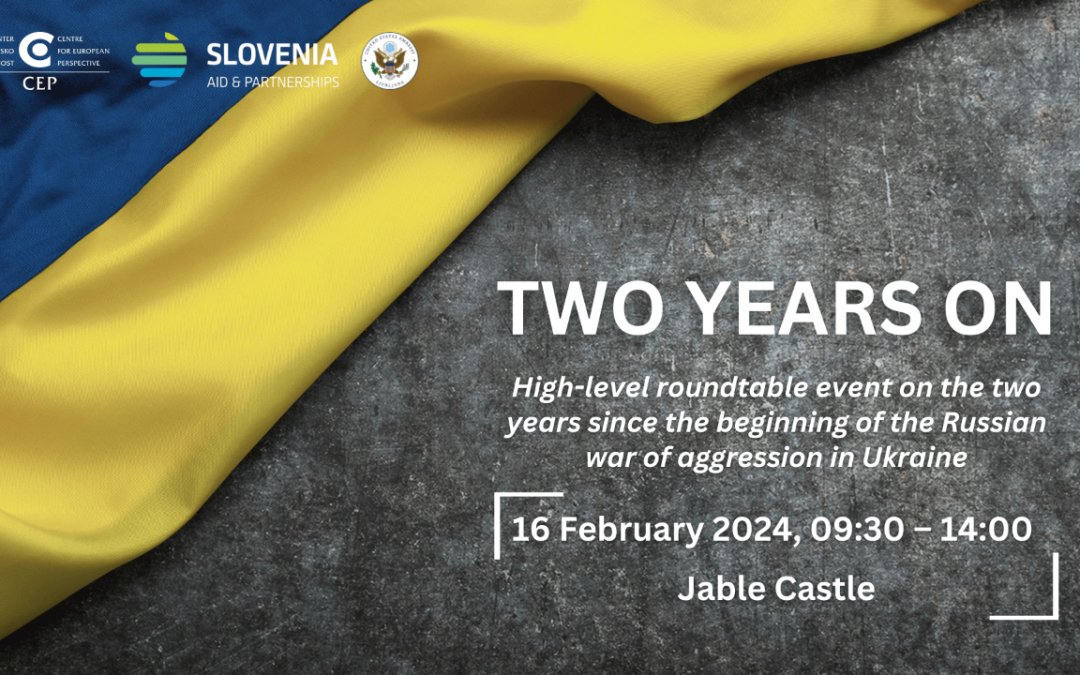
Centre for European Perspective cordially invites you to a roundtable discussion
TWO YEARS ON
on
Friday, 16 February 2024, 09:30 – 14:00 CET
As the second year since the beginning of Russia’s war of aggression against Ukraine comes to a close and the discussions on continued support for Ukraine intensify, it is necessary to highlight the unwavering determination of the Ukrainian people to continue with inclusive reforms, democratization and modernization, incl. an active approach in the state-led European integration processes.
Despite the still ongoing conflict, the recovery and rebuilding processes have already begun with many major achievements, but the post-war recovery process for Ukraine also means achieving democratic security – and here is where the local level comes in. Local and regional authorities are an important factor in the recovery process and a key guiding force for the reconstruction process. Slovenia and many other EU countries have recognized the role of local communities and are already transitioning from offering humanitarian and material aid to development projects. Capable and strong local communities will be able to accomplish the objectives of the decentralization reform and aid the transformation of Ukraine.
Another key stakeholder in the post-conflict recovery process is youth. Since the beginning of Russia’s invasion, youth has been on Ukrainian frontlines, both literally and figuratively, but they will need to play an integral part in the post-war reconstruction, helping to shape important initiatives and continue the democratization process.
Programme of the event
09:10 – 09:30 Arrivals
09:30 – 10:45 High-level roundtable
Welcome speech by Ms Nina Čepon, Executive Director, Centre for European Perspective
Opening address by H. E Mrs Tanja Fajon, Minister of Foreign and European Affairs, Ministry of Foreign and European Affairs of the Republic of Slovenia
Speakers:
-
- Mrs Oleksandra Azarkhina, Deputy Minister, Ministry for Communities, Territories and Infrastructure Development of Ukraine
- Dr Damir Črnčec, State Secretary, Ministry of Defence of the Republic of Slovenia
- H. E. Mr Andrii Taran, Ambassador of Ukraine to the Republic of Slovenia
- H. E. Mrs Jamie L. Harpootlian, United States Ambassador to the Republic of Slovenia
- Dr Klemen Grošelj, Member of the European Parliament for Slovenia
Moderator: Ms Nataša Briški, M.Sc., TV presenter, editor and journalist.
10:45 – 11:30 Coffee break
11:30 – 12:00 »Fireside Chat« / One-on-one with Mayor of a Ukrainian Municipality
Mr Iaroslav Tsvirkun, Mayor, Pereschepyne hromada, Ukraine
Moderated by Ms Nataša Briški, M.Sc., TV presenter, editor and journalist
12:00 – 13:00 Informal reception / Lunch buffet
13:10 – 14:00 About Ukraine from Ukraine’s future – the perspective of Ukrainian youth
Moderated by Mr Jernej Grahor, Project Manager, Centre for European Perspective
Register HERE.
Following the high-level roundtable discussion and fireside chat, you are kindly invited to join us at the lunch buffet at Jable Castle, which will be followed by a discussion with Ukrainian youth.
The event is supported by the U.S. Embassy in Ljubljana, alongside the Slovenian Aid and Partnerships project ‘Post-conflict reconstruction in Ukraine’, financed by the Ministry of Foreign and European Affairs of Slovenia.

5. 2. 2024 | Decentralisation, local self-government, PR, Regional cooperation, Slovenian Development Assistance, U-LEAD: with Europe
12 February, 10:00-11:30 CET
The war in Ukraine has shaken up the European Union’s approach to enlargement. Long seen as a purely technical process, the EU enlargement policy is now recognized as a geopolitical tool which will require a more strategic approach.
As Ukraine embarks on this journey, what is the process for joining the European Union, what implications does the Ukrainian path toward the EU have on the accession process of the Western Balkans, and which lessons can Ukraine take from the Balkans?
Joining us in a special webinar discussion was Mr Georg Ziegler, Adviser, Ukraine Service, Directorate-General for Neighbourhood and Enlargement Negotiations (NEAR), European Commission.
You can check out the recording of the session below or on our YouTube channel – here.
Georg Ziegler is an Advisor in the “Ukraine Service” of the European Commission in the Directorate General for Neighbourhood Policy and Enlargement Negotiations (NEAR). Before his current role, he was Deputy Head of the Support Group for Ukraine. During his career, he has worked on preparing some Western Balkan countries for EU accession and on the 5th enlargement of the EU by Central and Eastern European countries until 2004; he was also posted by the German Government at the Embassy in Warsaw from 1990-95.
The activities are taking place under the project ‘Post-conflict reconstruction in Ukraine’, funded by the Slovenian Ministry of Foreign and European Affairs through the Slovenian Aid and Partnerships and implemented in partnership with ‘U-LEAD with Europe’. U-LEAD with Europe programme is a partnership of the Ukrainian government and the European Union, and its member states Germany, Poland, Denmark and Slovenia, to support the establishment of multi-level governance that is transparent, accountable and responsive to the needs of the population of Ukraine.

26. 10. 2023 | Decentralisation, local self-government, PR, Regional cooperation, Slovenian Development Assistance, U-LEAD: with Europe
At the 12th Annual Forum of the EU Strategy for the Danube Region held under the Slovenian Presidency, CEP’s Executive Director, Ms Nina Čepon, contributed to the panel discussion titled ”Bottom-up recovery and transformation of Ukraine–Supporting Ukraine and Moldova on their way to the EU” on the 24th of October.
She shed light on CEP’s impactful collaboration with Ukrainian municipalities, a process initiated back in 2018 under the scope of the Programme ‘U-LEAD with Europe’ implemented by the German organization GIZ in Ukraine. The dedication to enhancing Ukrainian municipalities continues through our ongoing development project titled ‘Post-Conflict Reconstruction in Ukraine’ funded by the Slovenian Ministry of Foreign and European Affairs and implemented in partnership with ‘U-LEAD with Europe’.
This project remains committed to transferring knowledge tailored to specific needs and providing sustainable assistance to Ukrainian municipalities as they advance in their development, modernization and contribute to the Ukrainian path toward EU membership while dealing with the everyday challenges of wartime. Activities are focusing on topics such as green transition, civil protection and resilience, economic development, anti-corruption and transparency in local governance, and deliver an important skillset to raise their absorption capacities in terms of donor engagement, namely those of efficient planning, project appraisal and obtainment of external funding.
Čepon emphasised that Ukrainian municipalities are set to play a pivotal role in post-conflict reconstruction and development in Ukraine as they are forward-looking, and they strive toward economic development and other objectives despite being faced with their complex everyday circumstances at this time. Slovenia’s wealth of experience in modernization and the EU accession process promises to bring significant, concrete value.

12. 11. 2019 | Decentralisation, Economic development, local self-government, PR, Slovenian Development Assistance, U-LEAD: with Europe
The weather in Slovenia might not be the best these days, but our disposition sure is sunny, as Centre for European Perspective is again hosting International Study Visit within the U-LEAD programme. The event began on Tuesday, 12th of November and will continue throughout the week.
The topic of the visit is “Cooperation between Business and Local Communities”.
There are currently 19 local officials from Ukraine taking part in the study visit with the vast majority being heads of amalgamated hromadas.
The study visit began with a welcome speech by Ms Katja Geršak, Executive Director of CEP who warmly welcomed the participants and presented CEP team and the work of CEP in the U-LEAD project. She was followed by Ms Berta Mrak, the Head of the Department for Eastern Europe, South Caucasus, Central Asia and the Arctic at the Ministry of Foreign Affairs, Republic of Slovenia, who welcomed the group from Ukraine and gave an insight into work the Ministry does with Ukraine, bilateral relations between countries and the high-level visit from the Ministry of Foreign Affairs of Slovenia that occured last week in Kiev. She was followed Mr Andrii Borodenkov, First Secretary from the Embassy of Ukraine in Ljubljana, who expressed his pleasure at being able to greet the study group from Ukraine on a U-LEAD study visit to Slovenia. He shared a few examples of the work the Embassy does, spoke about especially about the cultural cooperation of the countries and examples of Slovenian and Ukrainian economic cooperation.
After a short warm-up session and introduction of participants held by Ms Meliha Muherina, Project Manager at CEP, the theoretical part of the visit begun.
First lecture of the day was given by Mr Gorazd Orešek, from SPIRIT Slovenia – Public Agency for Entrepreneurship, Internationalization, Foreign Investments and Technology, who spoke about SME support in Slovenia, attracting investments to the local environment and establishing conditions conducive for entrepreneurship in a local community, especially when speaking about industrial zones.
The following lecture was given by Ms Nina Seljak, from the Government Office for Development and European Cohesion Policy, who spoke about the results and good practices from cross-border projects Slovenia is involved in and how this practices could be transferred to Ukrainan local communities, when speaking about cross-border connections and projects.
The last speaker of the day was Ms Larisa Vodeb, who focused on the work of Chamber of Craft & Small Business of Slovenia and Enterprise Europe Network.
With the theoretical part done, we will move to ‘the field’ in the following days.
On Wednesday, the participants will visit the Municipality of Tolmin, where they will hear more about the development of the municipality, the influence large events and music festivals have on local community and historical ties between Slovenia and Ukraine. The historical ties will alse be explored with a visit to Javorca memorial church and First World War Museum in Kobarid. They will also meet with the Mayor of Tolmin, Mr Brežan.
Thursday will offer a brief respite from driving as we stay in the municipality of Brda. On a visit to the Municipality, the participants will hear more about the development of the municipality, local projects and development of the cross-border cooperation in the region. The participants will also have the opportunity to visit the cooperative Klet Goriška Brda, where we will be a bit spoiled with a presentation of the work and a degustation. On Friday, participants make a trip across Vipavska dolina and towards Kras to the Škocjan Caves Park, where they will be met with the Director of the UNESCO protected nature park, Mr Stojan Ščuka. The visit to the Park will end with the visit to the Škocjan Cave and certificate ceremony.
The visit is taking place in the framework of the multi-donor action U-LEAD established by the European Union and its Member States Denmark, Estonia, Germany, Poland and Sweden. It aims at contributing to the establishment of multilevel governance that is transparent, accountable and responsive to the needs of the population of Ukraine. U-LEAD with Europe is supporting the Ukrainian Government, represented by the Ministry of Communities and Territories Development of Ukraine (MinRegion) as a key political partner in the coordination and implementation of the decentralization and regional policy reforms. The Program carries out demand-driven and targeted trainings for officials at the national, regional and local level.