24. 4. 2023 | Macedonia - Finance, PR, Slovenian Development Assistance
Kliknite tukaj za branje prispevka v slovenskem jeziku.
To move forward on the path to the EU and achieve European standards in the field of financial investigations and procedures for confiscating proceeds of crime and assets of illegal origin, North Macedonia has relied on the knowledge and experience of Slovenia, which has been assisting North Macedonia in this area through international development cooperation and humanitarian aid programs since 2019.
In 2019, the institutions responsible for financial investigations in North Macedonia adopted the Common Guidelines for Financial Investigations based on the Slovenian experience. They further concluded that the Guidelines provide a good starting point for an efficient and effective approach to strategic and operational planning of financial investigations. In 2021-2022, the Macedonian institutions, with Slovenian experts’ support and cooperation, strengthened their capacity to put the Common Guidelines into practice in the framework of the project “Chapter 24 Assistance – Financial Investigations”. At the end of 2022, the Macedonian investigative and law enforcement authorities dealing with financial investigations took the initiative to strengthen financial investigation capacities in 2023-2024. With the development assistance of the Republic of Slovenia so far, they have achieved a significant mindset breakthrough and some progress towards European standards in the field of financial investigations. They are aware that they not only need to proceed with activities. They also need to accelerate their dynamics. Slovenia will continue to support them in this process over the next two years with development assistance.
A kick-off meeting and first consultations with representatives of the Public Prosecutor’s Office, the Financial Police, the Customs Administration, and the Ministry of the Interior will take place in North Macedonia between 8 and 10 May 2023. Representatives who have received training in the past period will also attend the consultations. The reunion of Macedonian investigators with Slovenian experts will be an opportunity to discuss how to apply theoretical and classroom knowledge appropriately in real-life situations and cases, considering the criteria applicable in the EU.

Activities are funded by the Ministry of Foreign and European Affairs of the Republic of Slovenia through its International Development Cooperation Programme and implemented in cooperation with the State Prosecution, Financial Administration, Ministry of the Interior, and the Police of the Republic of Slovenia.
Further information:
Andreja Dolničar Jeraj
Programme Director
Centre for European Perspective

28. 3. 2023 | PR, Regional cooperation, Transformative Power of Digital
The debate on “Digital Partnerships: How to Forge an Advanced European Future” has, in spite of some last-minute changes of the panellists, successfully taken place in Warsaw last week.
The debate touched upon the consequences of the Russian aggression on Ukraine for the CEE region and the rise of cyber threats since then, the steps taken towards transatlantic strategic digital partnership (such as TTC, transparency, cybersecurity, etc.), enhancing European sovereignty in the digital sphere and more.
Stay tuned for more debates on similar topics in the coming months. Until then, you are again welcome to watch the recording of the debate below.
We would like to thank our partners, Atlantic Council and Kosciuszko institute, for their organisational support. At the same time, our special thanks go to Ambassador Tadeusz Chomicki, Ambassador for Cyber & Tech Affairs, Security Policy Department, Ministry of Foreign Affairs of the Republic of Poland, Ewelina Kasprzyk, Program Director at the Kościuszko Institute, and Jagoda Zakrzewska, Public Policy CEE Manager at Google Poland, who joined the debate on stage. Last but not least, a big thanks to Aaron Korewa, Director of the Atlantic Council Warsaw Office, for moderating the debate in such extraordinary circumstances.

26. 3. 2023 | European Digital Diplomacy Exchange, PR, Strategic Communication
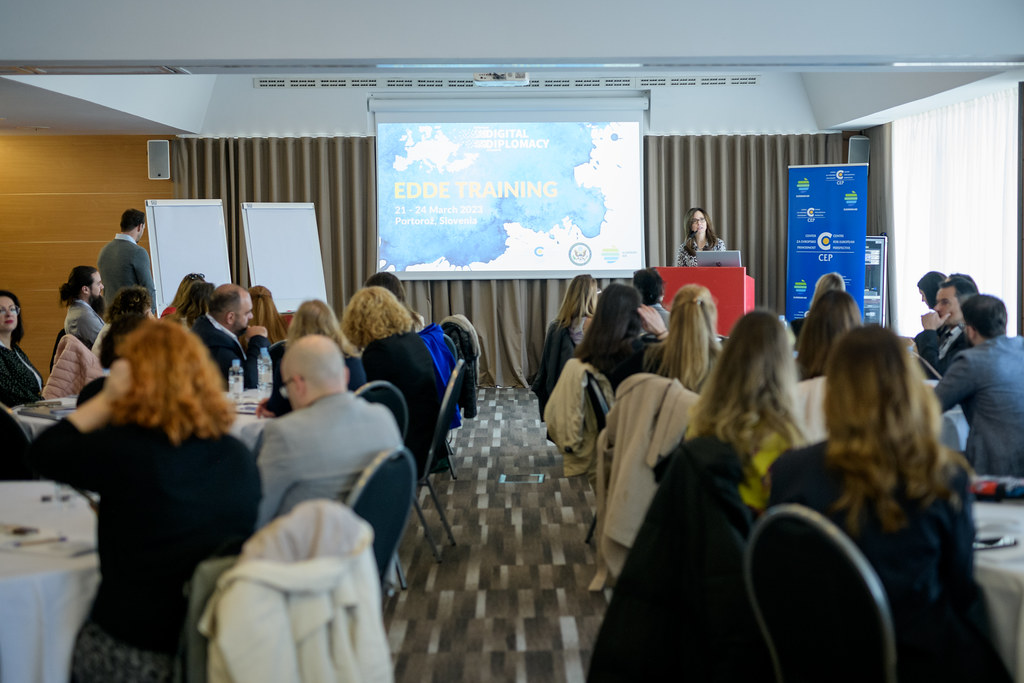
The rapid development of digital communication technology impacts our lives in myriad ways. It does not seem so far ago when we were faxing long press releases to journalists to where we are now when 280 characters can do the same job, occasionally with an even more significant impact. Digital communications and social media are transforming pillars of a democratic society. It is more important than ever for governments to understand their responsibilities and roles in ensuring that their institutions are prepared to adapt and adopt new practices to cement their place within this new digital information economy.
That is why representatives from 19 countries convened to ensure that they, together, are ready to rise to any and all resulting challenges. The participants from Albania, Bosnia and Herzegovina, Bulgaria, Canada, Czechia, Estonia, Georgia, Kosovo, Latvia, Lithuania, North Macedonia, Moldova, Montenegro, Romania, Serbia, Slovakia, Slovenia, and Ukraine joined us in Portorož for 4-day long training from March 21st to 24th within the scope of European Digital Diplomacy Exchange project.
The training titled »Turning Practice into Strategy, Structures, and Systems” focused on retrieving already obtained digital communication skills, as well as polishing and advancing them. Various international speakers coming from the US State Department, the Slovenian government, the Canadian Ministry of Foreign Affairs and NATO spoke to us about digital rhetoric, marketing public affairs, nation branding, the importance of the audience approach as well as social listening and performance analysis. Crisis communication was also addressed, as well as how to counter disinformation and design digital strategies and ways of cooperation within governments, ministries and embassies.
There were quite a few practical exercises during the training, through which participants put their theoretical knowledge into practice – by preparing a digital strategy that will be of help when establishing a national digital strategy. A very important part of the training was time to connect and network, and the participants made the most of it.
The project is a result of cooperation between the U.S. Department of State, the U.S. Embassy in Ljubljana, and the Centre for European Perspective.
 The project is partially financed by the Ministry of Foreign and European Affairs of the Republic of Slovenia in the scope of the program activities of international development cooperation.

20. 3. 2023 | PR, Transformative Power of Digital
CEP, Atlantic Council and the Kosciuszko Institute are delighted to invite you to a panel discussion
Digital Partnerships: How to Forge an Advanced European Future
Wednesday, March 22 | 11.30 CET
Register here to join via Zoom
While Covid exposed the EU’s vulnerabilities, the war in Ukraine heightened the urge to solve them – from infrastructure, cybersecurity, disinformation, and defence shortcomings. This especially holds true for the countries of Central and Eastern Europe (CEE), which bear the brunt of Russian cyberattacks and other malicious digital intents.
As outlined in two recent reports from the Atlantic Council and the Centre for European Perspective – “Strategic Partnership for a Secure and Digital Europe” and “Digital Sovereignty in Practice” – to address these issues and ensure European values are respected in the digital world, a like-minded and values-based partnership is a priority, and strong and stable transatlantic exchanges are indispensable. It is paramount that the countries of CEE deepen their cooperation within the region while at the same time strengthening their voice within the EU and with the US.
The panel will address the following questions:
What are the main digital challenges that CEE and the EU are facing now? What mechanisms for cooperation exist within the CEE, and how can such cooperation on digital issues be enhanced? Do any best practices exist? How do we shape a specific, action-oriented agenda for transatlantic digital cooperation to ensure a tangible strategic partnership around digital policy?
Joining us to address these questions are speakers:
- Dr Emilija Stojmenova Duh, Minister for Digital Transformation of the Republic of Slovenia
- Mr Janusz Cieszyński, Secretary of State and Government Plenipotentiary for Cyber Security of the Republic of Poland
- Marta Poslad, Director of Public Policy, Central and Eastern Europe at Google
- Ewelina Kasprzyk, Program Director at the Kościuszko Institute
You can join us live over Zoom by registering here or following our social media accounts as the video of the session will be published after the discussion.

17. 3. 2023 | EUCTI, PR
As an active European Union Civilian Training Initiative (EUCTI) Consortium partner, the Centre for European Perspective joined the EUCTI Partner and Planning meeting between 13 and 15 March in Brussels. As was the case during the last such meeting in November 2022, the project partners (alongside CEP: ACP from Austria, the Clingendael Institute from the Netherlands, CMC Finland, Egmont Institute from Belgium, FBA from Sweden, SSSA from Italy and ZIF Berlin) were joined by the representatives of relevant EU structures. Additionally, representatives of the European Security and Defence College (ESDC) and interested partners of the recently finished EUPCST project attended the meeting.
Even before the double P (Planning and Partner) meeting, CEP attended the European Union Civilian Training Group (EUCTG) meeting on 13 March in its capacity as the EU Civilian Coordinator for Training (CCT) and National Training Expert (NTE – together with Slovenian Police). As CCT, CEP prepared a Training Requirement Analysis on Communicational, Behavioral and Cultural Skills in 2021. One of the meeting topics was also the future of Foreign Policy Instrument-funded training projects, which corresponds with the EUCTI project.
The suggestions and insights from the EUCTG meeting represented a necessary basis for the discussion on the future of EUCTI, held during the double P meeting between 14 and 15 March. CEP actively participated in this discussion and expressed reiterated support for the project and a wish to remain an engaged partner in the next project phase.
In May, CEP will implement advanced Digital Communications training for European Advisory Mission in Ukraine (EUAM Ukraine). Details will follow soon.
For more information about EUCTI and the meeting, click on the EUCTI logo below.