7. 12. 2022 | POTC, PR
On December 5th POTC’s Program Council successfully concluded its 4th session with an agreement on an ambitious lineup of upcoming courses and trainings.
Klikni tukaj za branje prispevka v slovenskem jeziku. 
The session included an overview of this year’s activities, the proposed outline of activities in 2023, future financing, and recommendations for the programme ahead.
The Program Council expressed satisfaction with the work done by POTC in 2022. The Council Members shared their priorities regarding upcoming activities and also discussed ways of improving inter-departmental cooperation in order to support POTC’s future work and particularly the delivery of activities that require a greater deal of support from the official institutions.
The Program Council concluded with an official confirmation of the planned activities for 2023. The 2023 Work Programme will be published shortly.

6. 12. 2022 | PR
Yesterday, on 5 December 2022, we hosted a delegation of the Foreign Relations Committee of the Parliament of Georgia headed by its Chairperson, Prof Dr Nikoloz Samkharadze, for a discussion on the current situation in Georgia and the region.
Moderated by the Executive Director of CEP, Ms Katja Geršak, the stimulating discussion focused on the current state of affairs of Georgia, its Euro-Atlantic aspirations and the effects of the Russian aggression on Ukraine on Georgia.
During the discussion, Mr Samkharadze emphasised that in 2008 Georgia was the first victim of Russia’s aggression, and they warned the West that they will not be the last one. We can now see the story repeating in Ukraine. Russia still poses a substantial danger to Georgia’s sovereignty and statehood since it still hosts several thousand Russian soldiers on the occupied territories that can be mobilised at any moment.
Russia’s appetite for Georgia was not triggered by the talks of Georgia’s NATO accession but was present from Georgia’s independence onwards and has been manifested on several different occasions when the territorial integrity of Georgia was violated. Nonetheless, Georgia is a stabilising country in the Caucasus region and could further strengthen this role if it would be a member of NATO and the EU. The support of Euro-Atlantic integration is widespread – more than 80% of the population supports joining NATO and the EU; moreover, the integration is supported by all the political parties. Whereas “in reality, Russia has veto power over NATO accession”, there is no “reasonable explanation” why the EU did not grant EU Candidate status to Georgia. Mr Samkharadze and his colleagues see no other option than Georgia firmly embarking on the path of Euro-Atlantic integration.

5. 12. 2022 | European Digital Diplomacy Exchange, PR
Klikni tukaj za več o projektu v slovenščini.
On 28 and 29 November 2022, the Centre for European Perspective (CEP), in the scope of the project European Digital Diplomacy Exchange (EDDE), conducted a training in North Macedonia aimed at bolstering capacities of their strategic government communication capacities. The training brought together government communicators coming from different state institutions. Fully packed agenda aimed at strengthening their skills to be better prepared for the fast-paced and ever-changing digital communication environment.
At the beginning of the training, we were addressed by H.E. Ms Angela Agler, U.S. Ambassador to North Macedonia and Mr Bojan Maricikj, Deputy Prime Minister for European Affairs of the Republic of North Macedonia.
After the welcoming remarks and icebreakers, participants took a closer look at the digital future, the policy as a lifestyle, digital campaigns, and how to work with Influencers. All four theoretical sessions were followed by short practical follow-up sessions in which local representatives presented the practical application of the theory through case studies. Understanding, identifying and responding to disinformation and social media analytics sessions were the last two theoretical sessions of the training. On the other hand, the practical part, consisting of three sessions, allowed participants to enhance their photography, videography, and graphic design skills.
The project is a result of cooperation between the U.S. Department of State, the U.S. Embassy in Ljubljana, and the Centre for European Perspective.
The project is partially financed by the Ministry of Foreign Affairs of the Republic of Slovenia in the scope of the program activities of international development cooperation.

The project is partially financed by the Ministry of Foreign Affairs of the Republic of Slovenia in the scope of the international development cooperation program activities.

2. 12. 2022 | Danube, PR
With the Opening event held on 1 December 2022 at Brdo pri Kranju, Slovenia begins its year of the Presidency of the EU Strategy for the Danube Region (EUSDR). The event’s participants were welcomed by the State Secretary of the Ministry of Foreign Affairs, Mr Marko Štucin, who, in his opening address, emphasised Slovenia’s support for Ukraine – the country that presided over the Danube Strategy before Slovenia.
In his address, Mr Štucin encouraged further cooperation in macro-regions. He emphasised the unique role of EU macro-regions, which offer the possibility for all countries, both EU members and non-members, to participate equally.
Sławomir Tokarski, Director of the European Commission’s Directorate General for Regional and Urban Policy (DG REGIO), focused on the importance of continuing to facilitate the enlargement process in his address, commending the decision that Slovenia puts facilitation of enlargement as one of its focuses during the Presidency. Nataša Goršek Mencin, Deputy Head of the Representation of the European Commission in Slovenia, emphasised the importance of quick action and support of the EUSDR for Ukraine in the face of the Russian aggression against Ukraine and welcomed Slovenia’s decision to continue supporting Ukraine in its Presidency programme and support the empowerment of all actors in the Danube Strategy. The first part was concluded by Ms Nadija Afanasieva, representative of the Ukrainian National Coordination of the Danube Strategy. She thanked the TRIO Presidencies for their support and expressed her satisfaction that Slovenia will include the topics addressed by Ukraine during its EUSDR Presidency in its programme.
In the second part, Ms Petra Česen Čatar, Slovenian National Coordinator for the Macroregional Strategies at the Ministry of Foreign Affairs of Slovenia, presented the programme of the Slovenian Presidency and its institutional priorities. The thematic priorities of the Presidency were touched upon by Mr Jernej Grahor, representative of the Centre for European Perspective and coordinator of Priority Area 10, Mr Peter Volasko, representative of the Ministry of Education, Science and Sports of the Republic of Slovenia and Mr Franc Žepič, representative of the Ministry of Infrastructure of Republic of Slovenia and coordinator of Priority Area 1b.
The Slovenian EUSDR Presidency will focus on the future development of the Danube Region and on the empowered cooperation of all EUSDR participating countries. Given that the Danube Region is one of the most heterogeneous and diverse regions in Europe, with nine EU and five non-EU countries, the Slovenian Presidency will prioritise the involvement and capacity-building of key stakeholders participating in the EUSDR.
To act as a promoter and facilitator of macro-regional cooperation between all countries and all macro-regional strategies, the Slovenian EUSDR Presidency has the following institutional priorities:
- Empowering involvement in the EUSDR
- Improving the strategic governance of EUSDR and macro-regional strategies
- Youth involvement and its role in the EUSDR
- Embedding process – evaluation and further steps
Taking into account the acceleration of the green and digital transition that will steer the transformation of societies and affect cooperation and connectivity, and recognising the challenges to transport and energy security in the region, the thematic priorities of the Presidency will focus on the expected transformation of societies and the role of knowledge in such societies and professions of the future, as well as transport and energy challenges in the region.
The Opening event of the Slovenian Presidency of the EUSDR continued with an informal discussion among EUSDR National Coordinators and Priority Area Coordinators, focusing on empowering involvement, strengthening the ownership of countries in the EUSDR and unlocking the potential of macroregional cooperation for non-EU countries.
Slovenia will hold the Presidency of the EU Strategy for the Danube Region from 1 November 2022 to 31 October 2023, with the conclusion at the 12th EUSDR Annual Forum, which Slovenia will hold on 24 and 25 October 2023 in Brdo pri Kranju.

30. 11. 2022 | PR, Serbia - management of patrols
Klikni tukaj za več o projektu v slovenščini.
The Minister of Internal Affairs of the Republic of Serbia, Bratislav Gašić is in Slovenia today where he will meet with the Minister of Internal Affairs of the Republic of Slovenia mag. Tatjana Bobnar. They will discuss current issues in the field of internal affairs and strengthen bilateral cooperation as well as cooperation in the region. For 14 years, the Ministries have been cooperating within the framework of the Republic of Slovenia’s international development assistance, through which Slovenia has been providing assistance to Serbia in achieving the criteria for joining the EU.
One of the more visible projects in the field of development assistance is the strengthening of patrol management efficiency, which has been running since 2019. In the framework of the project, the Slovenian police provide assistance to the Serbian police in implementing a system for more efficient and coordinated work of police officers in the field, for their faster response to people in need, and for better responsiveness to the prevention of illegal migration. The system also contributes to the greater safety of police officers on duty and the overall safety of Serbian citizens. The goal of the project is a joint and coordinated fight against organized crime, prevention of illegal migration and timely assistance to citizens.
During the migrant crisis, the need for better border control and better containment of illegal migration appeared in the border area. At the time, the Serbian police did not yet have a system in place for the efficient management of patrols. The new system is a combination of Slovenian knowledge and experience as well as modern information and communication technology compliant with European standards and designed according to the needs of Serbian police officers. For the implementation of the system, the already existing Serbian resources have been used.
After the successful pilot project (2019-2020), the second phase of the project took place in the period 2021-2022. During this time, the system was successfully implemented in 98 organizational units of the Serbian police, in 14 out of 27 police directorates and in 5 out of 6 regional border police centres.
The new system provides a better insight into which patrols are available at what time, making their work more efficient. The system, at the same time, enables analysis of past work and better planning for future work. The quality of police work is measured as the time required for police to arrive to the location and take action from the time the call to the police was made. To shorten the response time of police units and for the action to be taken as flawlessly and as correctly as possible, it is extremely important for police units to have sufficient, good, fast, and accurate information on the ground when taking action.
The project period 2021-2022 is coming to an end. The last activity took place between 23 and 25 November in Kragujevac, where the final workshops were held. In Kragujevac, 94 leading representatives of the organizational units of the Serbian police using the new patrol management system gathered. The event was also attended by Slovenian colleagues who helped in developing and implementing the system. Igor Ciperle, deputy general director of the Police of the Republic of Slovenia, participated as a distinguished guest. As a sign of gratitude for all the help and cooperation in strengthening friendly ties between two important state institutions, he received a plaque from the Directorate of the Police of the Republic of Serbia.
The event ended with a ceremonial handover of a donation of computer equipment, received by the Ministry of Internal Affairs of the Republic of Serbia as part of the ‘Strengthening of Patrol Management Capacities project’, financed by the International Development Cooperation Program of the Republic of Slovenia 2021-2022.
The results of cooperation in the field of strengthening patrol management capacity have so far been extremely good. It is vital to continue with the work and include all police directorates in the system and implement activities to permanently preserve the achieved results.
The project Building capacities for management of patrols is part of the program activities of international development cooperation, financed by the Ministry of Foreign Affairs of the Republic of Slovenia and implemented in cooperation with the Ministry of the Interior and the Police of the Republic of Slovenia.
Further information:
Andreja Dolničar Jeraj
Programme Director
Centre for European Perspective
28. 11. 2022 | PR
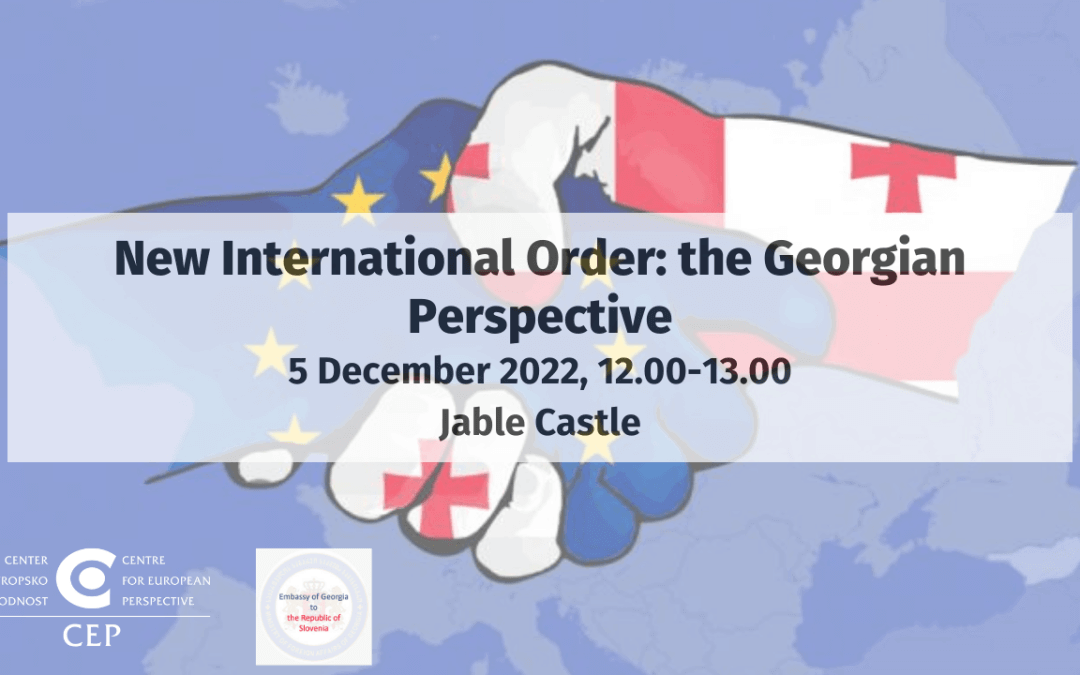
The Embassy of Georgia to the Republic of Slovenia and the Centre for European Perspective invite you to join an interactive moderated discussion with Mr Nikoloz Samkharadze, Chairperson of the Foreign Relations Committee of the Parliament of Georgia, that will take place on Monday, 5 December 2022, at 12.00 at Jable Castle.
The moderated discussion will focus on the current security challenges and Georgia’s Euro-Atlantic aspirations.
Georgia was the first to experience Russian aggressive and bellicose policies first-hand with full-scale Russian military aggression in 2008 and remains partly under Russian occupation. As such, it is also on the frontline of the hybrid war Russia wages, dealing with the onslaught of disinformation campaigns that threaten to further destabilize the country and the region.
What are the developments in the region? How will the security situation develop in Georgia, the region and Europe more broadly?
At the same time, Georgia’s commitment to European values was recognized on 23 June 2022, when the European Council took a truly historical decision by granting a European Perspective to Georgia, already a NATO aspirant country. Is the EU doing enough? What are the perspectives on EU enlargement?
Join us as we discuss this and more on 5 December 2022 at Jable Castle.
RSVP: We invite you to register your participation in the discussion via email at [email protected] until 3 December 2022.