7. 5. 2019 | Global Education Network Europe, PR, Slovenian Development Assistance, Youth
Click here to read more about the project in Slovenian language. 
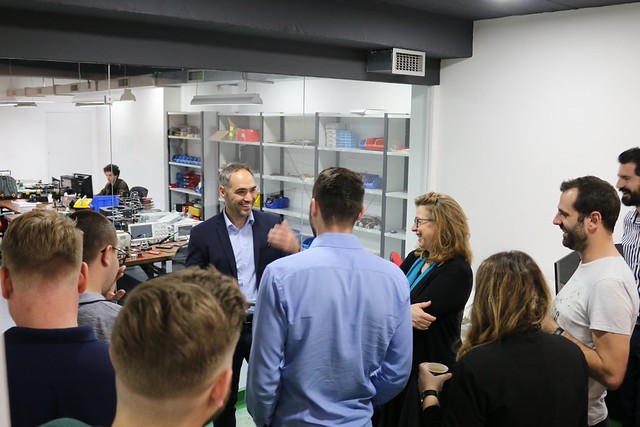
As part of the project ‘Global Responsibility for the Future’ on Friday, April 26, 2019, the SLOGA Platform conducted a global learning workshop for young entrepreneurs who are involved in the program of the youth entrepreneurship accelerator Ustvarjalnik. The topic of the workshop was fair trade.
Young entrepreneurs have learned the principles of fair trade and decent work, and what needs to be taken into account when planning and implementing an entrepreneurial idea so that they will not exploit people, harm nature or overuse natural resources.
The purpose of the global learning workshop combined with entrepreneurship was to invite young to start thinking wider about the impact of their product /service or components that are required to produce their product.
Through experiential activities the participants discussed the shortcomings of fast fashion and alternative methods of production – fair trade products and services – and were invited to form their ideas in line with principles of fair trade. In the discussion they examined how their products could be even more sustainable. SLOGA platform also offered young entrepreneurs the possibility of individual counselling, which some of the workshop participants have already used.
More and more young people in Slovenia are involved in business workshops and activities that encourage development of entrepreneurship. However, such activities devote little attention to the global dimension and sustainable development. The main purpose of those workshops is to provide, through the support and mentoring of representatives of NGOs, an opportunity for young people to acquire the skills needed to promote a sustainable lifestyle, including respect for human rights, gender equality, promoting the culture of peace and non-violence, citizenship of the world and to respect cultural diversity.
Participants of the workshop were as well acquainted with the possibility that their ideas will be competing for the award that will be granted to the most ethical idea at the end of the project.
The project is financed by the Global Education network Europe – GENE. The project is part of the CEP program activities co-financed by the Ministry of Foreign Affairs in the scope of Slovenia’s development cooperation.


Source: SLOGA Platform


3. 5. 2019 | Global Education Network Europe, PR
Click here to read more about the project in Slovenian language.
Centre for European Perspective (CEP) is part of the project ‘Global Responsibility for the Future’, as that will host a thematic weekend for young people in May. Youth entrepreneurship accelerator Ustvarjalnik, one of the project partners, will organize a weekend in the form of a train travel, where young people from 8th to 12th May 2019 will on the way from Ljubljana to Sofia develop their entrepreneurial ideas. Among them, there will be ‘Global responsibility for the future’ workshops’ participants, who will try to incorporate the dimensions of global learning and sustainable development into their entrepreneurial ideas.
Participants – more than 50 young travellers, will before the departure from the Ljubljana Railway Station, present their entrepreneurial ideas and form teams. Each team will have to develop its idea during the train journey and prepare a short presentation for investors. In doing so, trainers will be available on the train – business experts from the region, including a representative of a non-governmental organization from the field of global learning, who will help teams to turn ideas into reality. The event will conclude with public presentations – pitches of entrepreneurial ideas at the headquarters of LauncHub in Sofia. The local investors can financially support the most promising ideas.
Amongst the ideas CEP, together with partner NGOs, Forum for Equal Development, SLOGA and HUMANITAS, will select the globally most responsible entrepreneurial idea. The winning team will receive an invitation to participate at this year’s Bled Strategic Youth Forum. At the ceremonial closing event hosted by the President of the Republic of Slovenia, Mr Borut Pahor, in September 2019, the team will be awarded with special acknowledgment.
The project ‘Global Responsibility for the Future’ is financed by the Global Education network Europe – GENE. The project is part of the CEP program activities co-financed by the Ministry of Foreign Affairs in the framework of Slovenia’s development cooperation.

29. 4. 2019 | PR, WB6 Startup academy
Click here to read more about the project in Slovenian language.
We have been in Pristina, for our third edition of meetings for young entrepreneurs and start-ups from the Western Balkans within the project “WB6 Startup Academy” “Building the WB6 Unicorn”.
The first two workshops took place in Tirana and Nikšić in March, where young people became acquainted with the basic principles of searching for investors, preparation of business plans and taking care of the financial aspect of the business. The third event was focused on the art of selling and finding the most suitable and effective marketing tools that are very rapidly evolving and changing.
A group of 15 young entrepreneurs was supported by four experienced experts – Grega Potokar, ABC Accelerator, Slovenia; Selma Prodanovic, Brainswork, Austria; Adrian Zettl-Singh, TheGrowthbase, Austria; and Nedim Tarakčija, Balkan Leadership Academy, BiH. They have educated participants through a hands-on module, learning how to set up their sales process and implement different fast growth techniques (growth hacking) based on defined KPIs. Participants gained new insights on growth, importance of sales data collecting and analysis, Startup Marketing & Growth Hacking, Marketing Data Collection and other skills.
All the participants from all WB6 will join us in Slovenia this May, for DEMO Day organized in cooperation with Business Angels Slovenia, followed by participation at the PODIM Conference 2019.
We are thankful to the Slovenian Ministry of Foreign Affairs and GIZ regional office in Sarajevo for enabling this project and supporting innovative young entrepreneurs so they are able to strengthen their knowledge and get opportunities to realize their business ideas.

18. 4. 2019 | European Digital Diplomacy Exchange, PR
The first meeting of the European Digital Diplomacy Exchange (EDDE) project Steering Board took place in Brussels from 15 – 17 April 2019 in order to set the operational ground for the Steering Board, as well as to build the linkages and plans necessary to increase EU and NATO involvement.
Centre for European Perspective (CEP), together with U.S. Department of State continues to encourage intergovernmental network of government communicators that was formed within the project “Enhancing Digital Diplomacy Activities in Western Balkan and Eastern European Countries.” In order to ensure that digital development takes root locally in between program activities we established a Steering Board, consisting of representatives of the countries that are involved in the project, coming from the Western Balkans, Eastern Europe and the Baltc States.
The meeting gathered fourteen out of fifteen representatives in the Steering Board, chaired by Matt Jacobs from the U.S. Department of State and Ingrid Omahna from CEP. Besides numerous discussions about how to shape a system that can ultimately continue to develop and refine the work moving forward in a meaningful manner, this meeting was also the opportunity to meet with other partners. Rebecca Obstler, Principal Editor of NATO Communications Services at Public Diplomacy Division presented a NATO approach towards promoting the coherence among Alliance communications in a way that can be mutually amplifying. Steering Board members also met with EEAS StratCom representatives. Jurgis Vilčinskas, Deputy Head of StratCom Division at EEAS outlined the structure of the EEAS, their set of objectives and their way towards detecting, predicting and exposing disinformation and their narratives. Atlantic Council’s Digital Forensic Research Lab Director, Graham Brookie provided an overview of how the Atlantic Council identifies, exposes, and explains disinformation where and when it occurs using open source research.
At the end, the meeting ideas will manifest in a guiding document enshrined with guiding principles.


17. 4. 2019 | PR, WB6 Startup academy
Click here to read more about the project in Slovenian language.
The Center for European Perspective is with the support of the Ministry of Foreign Affairs of the Republic of Slovenia and in cooperation with the GIZ regional office in Sarajevo implementing a project that aims to empower innovative young entrepreneurs from all six Western Balkan countries to strengthen their knowledge, opportunities to realize your business idea.
Encouraging entrepreneurship among young people in the WB region has broader impacts, not only on the entrepreneurs involved in the program, but also more widely. Young people at the workshops are getting different knowledge, skills, acquaintances with leading international experts, get to know people from the region who are facing similar challenges, learn about the innovative environment of different countries and are constantly working on preparation of the presentation of their business idea – they will pitch in front of the investors at the last meeting – in May in Ljubljana and at the international conference PODIM in Maribor.
The first two workshops took place in Tirana and Nikšić in March, where young people became acquainted with the basic principles of investor search, preparation of business plans and taking care of the financial aspect of the business.
The upcoming workshop, the third in a row, will take place on April 24 and 25 in Pristina, where the community of startup companies is quite well developed and very strong. Most of the time it will be dedicated to the art of selling and finding the most suitable and effective marketing tools that are very rapidly evolving and changing. A group of 17 young entrepreneurs will be supported by four experienced experts – from Slovenia Grega Potokar from the ABC accelerator will be present and joined by Selma Prodanovic, Adrian Zettl-Singh and Nedim Tarakcija. All four have rich entrepreneurial experiences, they are in one way or another connected to the region and advocate the principle of broad cooperation.
Project is part of the activities that are through the Slovenia’s Development Cooperation financed by the Ministry of Foreign Affairs of Slovenia.

15. 4. 2019 | European Digital Diplomacy Exchange, PR
The European Digital Diplomacy Exchange project is hosting a three-day Steering Board Meeting in Brussels unfolding from Monday the 15 of April through Wednesday the 17 of April. The event represents a first of many activities, that will bring together representatives (Steering Board members) from countries already active in the EDDE project through past participation. The topics of discussion in this meeting will include an overlook of the past efforts and successes the project has had, while at the same time develop an effective vision on how to contribute to a future of the EDDE project that includes the common challenges digital communicators are addressing in their everyday work.
The program of the first meeting day was devoted to the establishment of firm common tasks and challenges tackled by the Steering Board members. The open discussion offered a safe space for everyone to contribute their best practices, work experience, digital challenges and other ideas, that will help to build the EDDE project in the future. The discussions will continue in the next two days, so to guarantee that the future work of the project is aligned and leaded by the needs of digital communicators from all countries and regions. The project therefore has additional value by offering guidance and assistance for common digital challenges digital diplomats face in their everyday profession. The participants will also be included in two guest presentations prepared by NATO and the European External Action Service, who are active in the field of digital diplomacy, strategic digital messaging campaigns and other digital tools that offer a great opportunity for future synergies with the EDDE project.