16. 11. 2018 | Danube, PR
FIRST NATIONAL DANUBE PARTICIPATION DAY IN SLOVENIA
The Danube region brings together 14 countries and some of them are very close to Slovenia (geographically, also culturally and historically) and some of the most important economically important ones, as well as some more remote countries, which makes the macroregions a good tool to get to know them more closely. These are – besides Slovenia – Austria, Bulgaria, Bosnia and Herzegovina, Croatia, Czech Republic, Hungary, (part) of Germany, (part) of Moldova, Montenegro, Romania, Serbia, Slovakia, and (part) of Ukraine.
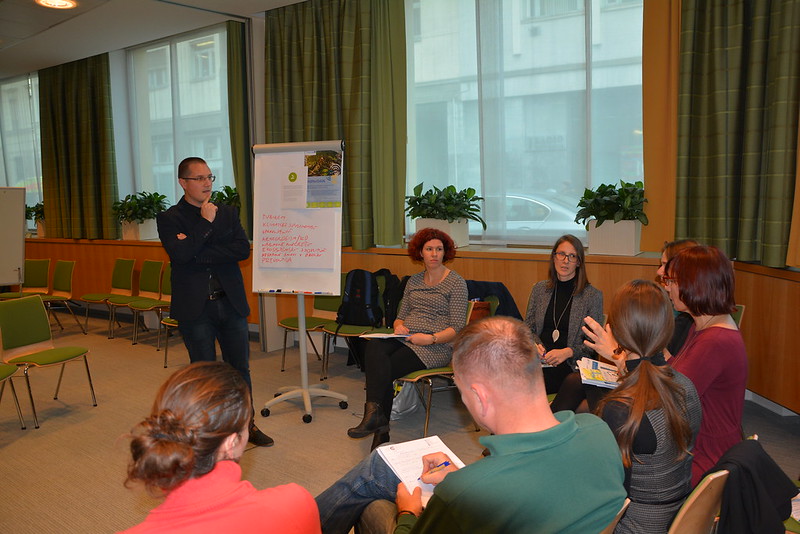
Topics in which Slovenian project partners are involved are very different. Because we are stronger together, we decided to organize an informal meeting for all of us who are active in the Danube Region. Thus, at the half-day event, we brought together projects from various transnational and cross-border programs, all involving Slovenian partners. We exchanged experiences on communication, reaching target groups, influencing policy making, discussing how the projects can work together, getting to know the EuroAccess online search tool and finding out about the role of the Danube Strategy Point that has just been established. At the end, the participants were divided in groups according to their filed of work and exchanged opportunities for cooperation with colleagues from the same field.
The Center for European Perspective as Coordinator of the Priority Area 10 – Institutional Capacity and Cooperation – EU Strategy for the Danube Region organized a meeting where about 60 participants from different fields were gathered – NGOs, institutions, ministries, agencies, private companies, municipalities, institutes, faculties and universities. They agreed that such networking event was indispensable and that it would be reasonable to repeat it sooner and even in greater number.
Click here to read more about the project in Slovenian language. 

8. 11. 2018 | Danube, PR
Do you know Danube macro region? And all the projects that Slovenian partners lead and co-create in the region? Danube is connecting a number of countries that are close to us (geographically, culturally and historically), but also some very important economic partners that are further away from us, which is why macro regions represent a good tool to get to know them better. The topics, on which Slovenian partners are working, are various and since we are stronger together, we believe we should get to know each other!
Centre for European Perspective as a coordinator of the PA 10 – Institutional Capacity and Cooperation of the EU Strategy for Danube region invites you to the 1st Danube National Day. We aim to gather everyone, working in the region in an informal environment and seek for synergies, share good practices and potentially make first steps towards our cooperation.
Danube National Day will take place on 15 November in City Hotel Ljubljana from 9.00 to 14.00. Find here the agenda (in Slovenian language).

6. 11. 2018 | PR
The European Union Global Strategy on Foreign and Security Policy (EUGS) has highlighted the need for the EU to further improve its civilian missions, by pursuing better communication, information-sharing, joint reporting, analysis and response planning between member state embassies, EU delegations, Commission services, EU Special Representatives and Common Security and Defence Policy (CSDP) missions.
The CIVILnEXt project supports the development of a solution addressing existing “fragmentation” and closing “gaps”, to provide civilian CSDP missions with the next generation of secure and cost-effective information systems. Fully informed of contributing initiatives in civilian CSDP and EU external action, the project will aim to develop solutions leveraging on the results extracted from projects funded by the EU. The common challenge in CIVILnEXt is to develop, test and validate a cost-effective and interoperable operation control platform (OCP) that will support the conduct of civilian CSDP missions. The OCP will improve coordination in EU external action through better information exchange, situational awareness and operation control in diverse theaters of operation.
Centre for European Perspective is a proud partner of the European Union’s Horizon 2020 Research and Innovation Programme. Learn more about the CIVILnEXt project in our new video below!
CIVILnEXt PCP project from CIVILnEXt on Vimeo.

6. 11. 2018 | PR
On 26 October, a round table discussion „Main Challenges for Small States in Contemporary International Relations – Small States and International Economic Relations“ took place in Zagreb, organized by the Institute for Development and International Relations (IRMO) and supported by Hanns Seidel Stiftung Zagreb.
The conference started with a welcome address by Aleksandra Markić Boban, Head of Project Office, Hanns Seidel Foundation Zagreb, and Dr. Sandro Knezović, Institute for Development and International Relations. The first panel addressed the challenges of Croatia in international economic relations, while the second panel focused on experience of neighbours.
In the latter panel, invited experts from the field of international politics and business discussed the political and economic challenges of small states in international relations and the position and perspectives of Croatia, Slovenia, Serbia and Portugal. They addressed their geopolitical position, coordination of state institutions and underdeveloped diplomatic networks at the European and global level, which were identified as key challenges of Croatia. Speakers agreed that globalization impacts relations immensely and that the consequences of the financial crisis still are present in the international relations of these countries. The EU and NATO should be the means and not the end-goals of the foreign policy of small countries in Europe.
Ivana Boštjančič Pulko of the Centre for European Perspective participated as a round table discussant and addressed the importance of the EU still being one of the leading economic and trading area of the world since the real power of the EU lies in its economy. Slovenian export industry presents the backbone of Slovenian economy and trade exchange between Slovenia and the EU amounts to almost 40 billion €, it is therefore important that the public opinion supports that strategic direction of the country but also remains open for trade exchange and investments from larger countries like Russia, China, the USA and others.

23. 10. 2018 | Bled Strategic Forum, PR
The eighth Belgrade Security Forum titled “Finding Answers Together to the New Normal” concluded on Friday, with the members of the Executive Board Sonja Licht, Suzana Grubješić and Sonja Stojanović Gajić agreeing that EU should change its approach to the Balkans, and vice versa, that the Balkans should change its approach to the Union.
The discussions have been followed by a delegation of the Bled Strategic Forum, which has for over a decade addressed the questions and challenges of development and integration of the Western Balkans. Such discussions need to be hosted both inside the WB6, in the region and at the European stage as a multi-level approach is needed to successfully lead the countries onto the European future.
“It is extremely important that we have managed to bring the global debate home”, said President of the Belgrade Fund for Political Excellence Sonja Licht, summing up the impressions from the Forum.
She emphasised that, during the three days of Forum, “great sessions” focused on Middle East, Asian Century and the fourth industrial revolution took place, and assessed that those topics may not be as important on a daily political level, but that they will determine our future. Her recommendation for Serbia is to open itself, to learn and do as much as possible to ensure that its education system and citizens follow the new trends, such as fourth industrial revolution, which brings new reality.
“We have to be ready for it, even as a small and relatively underdeveloped country. We can leap very high if we prepare ourselves on time”, remarked Licht.
Bled Strategic Forum and Belgrade Security Forum are already seeking for common grounds that will be addressed at future forums and other events throughout the year.

23. 10. 2018 | Bled Strategic Forum, PR, Youth
CEP Project Manager Sabina Carli moderated a discussion “New faces of Western Balkans politics: continuity or change?” in the framework of the 2018 edition of Balkan SAYS – Security Architecture Youth Seminar in Ljubljana, Slovenia in the beginning of October. A night-owl session, focusing on the young leaders for reform, development and growth hosted Mr Daniel Fazlić, Pro Plus; Mr Luka Nikolić, Centre for International Public Policy; Ms Ivana Martac, Balkan SAYS Participant; and Mr Emir Hasanović, Ministry of Defense of the Republic of Macedonia.
An inclusive format of discussion delved into the challenges of persistent economic weakness, corruption, high (youth) unemployment, brain drain, combined with growing public frustration with politics and politicians, and renewed nationalist rhetoric. The fact is that the issues will have to be addressed by current and future leaders of the Western Balkan countries. Therefore, the people chosen to be in the position to address these problems will need to possess the necessary qualities to effectively deal with them, via experience or simply via a new perspective.
The question of old or new faces is one that sees prominence through much of the world, and it is no different in the Western Balkan region. Some prefer to put their trust into the faces they know, whilst some would look to entrust this process to new faces who, while less experienced, do not come with the baggage of the past, and who could potentially provide a new outlook or vision for their country.
The panel identified crucial pending reforms but also looked at the bright sides and successes from the past and present. Among the most prominent ideas of the discussion were participation and engagement of young people in decision-making processes, in democratic processes and in grass-root organizations.
Euro-Atlantic Council of Slovenia, the organizer of the Balkan SAYS seminar, has been an important partner of this years Young Bled Strategic Forum and the Centre for European Perspective.