Bled Strategic Forum 2026

Bled Strategic Forum 2026

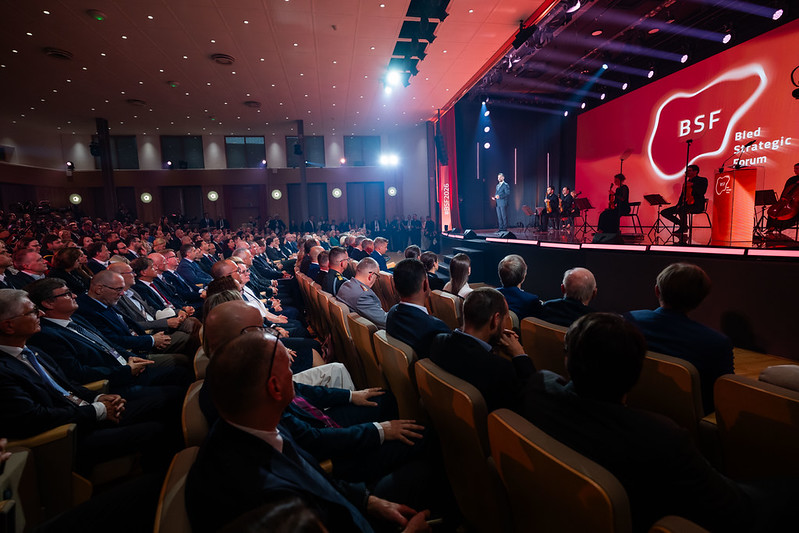
The 21st edition of the Bled Strategic Forum took place on 31 August and 1 September 2026. It brought together over 2,000 participants, 444 delegations, and 135 speakers to address the most pressing challenges facing our region and the world.

This year’s edition, themed “The Power to Shape the Future,” brought political leaders, diplomats, business executives, academics, and civil society representatives from across the world. The forum, which has evolved into a leading international conference in the region since its inception in 2006, served as a crucial platform for high-level strategic dialogue and cooperation. The Centre for European Perspective is proud to stand by the Ministry of Foreign and European Affairs of the Republic of Slovenia for 21 years as the main co-organiser.

The event was preceded by the CEP-organised Young Bled Strategic Forum (Young BSF), which took place in Kranjska Gora from 28 to 30 August 2026. This year we brought together 43 young emerging leaders aged 18 to 35 from around the world to explore questions of agency and resilience in a fragmented world.
Young BSF 2026: 43 Young Leaders, One Global Conversation

Young BSF 2026: 43 Young Leaders, One Global Conversation

Kranjska Gora, 28 August 2026

The international order is changing – and the next generation will have a say in what comes after it. From 28 to 30 August, 43 young professionals from around the world will gather in Kranjska Gora for the 15th edition of the Young Bled Strategic Forum (Young BSF).

Held under the theme After the Rupture: Agency and Resilience in a Fragmented World, this year’s Forum will explore how a new generation of diplomats, civil servants, researchers, entrepreneurs and civil society leaders can respond to an increasingly complex and contested international environment. Over three days, participants will explore some of the key challenges shaping today’s international environment, including democratic resilience, disinformation and emerging technologies, critical raw materials, and the future of the Euro-Atlantic order. Through interactive workshops and policy-oriented discussions, they will be encouraged not only to exchange perspectives, but also to develop concrete ideas and recommendations. The living lab for policy innovation will be one of the programme’s key highlights, offering participants a rare opportunity to contribute ideas and guidance to an ongoing political process linked to reconciliation and normalisation. In this way, Young BSF places young people not simply in the role of observers, but as active contributors to the debates and processes shaping the future.

The strength of Young BSF also lies in the broad network of partners behind it. More than 10 organisations and institutions from Slovenia and abroad support this year’s Forum through programme cooperation, expert contributions and financial support, helping create a diverse and ambitious programme for the next generation of leaders.

Following the programme in Kranjska Gora, Young BSF participants will join the Bled Strategic Forum on 31 August and 1 September, bringing their perspectives and ideas into the wider international conversation in Bled.

Young Bled Strategic Forum is organised by the Centre for European Perspective (CEP) in cooperation with the Bled Strategic Forum.

Septembrsko usposabljanje o mednarodnem humanitarnem in kazenskem pravu

Septembrsko usposabljanje o mednarodnem humanitarnem in kazenskem pravu

Click here to read this article in English.

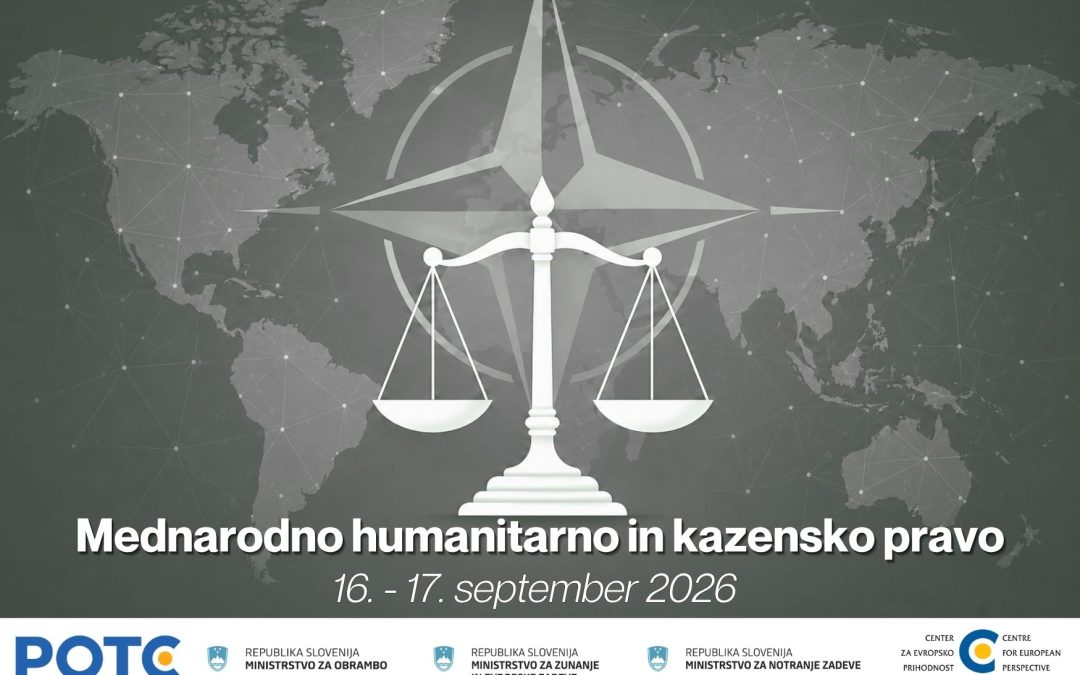
Med 16. in 17. septembrom 2026 bo POTC v sodelovanju s Sektorjem za pravne zadeve Generalštaba Slovenske vojske na gradu Jable organiziral usposabljanje »Mednarodno humanitarno in kazensko pravo«. Usposabljanje je namenjeno kot platforma za strokovno razpravo, izmenjavo izkušenj ter poglobljen vpogled v aktualne izzive mednarodnega humanitarnega in kazenskega prava. 

Usposabljanje je namenjeno pravnim svetovalcem in drugim strokovnjakom s področja mednarodnega humanitarnega in kazenskega prava. Tudi letošnja izvedba bo skozi predavanja in razprave naslovila aktualna pravna vprašanja ter ponudila priložnost za izmenjavo pogledov in dobrih praks. 

Letošnje usposabljanje bo obravnavalo naslednje teme: 

  • odstop od Konvencije o prepovedi protipehotnih min in Konvencije o kasetnem strelivu ter obveznosti držav zaveznic, 
  • 5. člen Severnoatlantske pogodbe, 
  • študija primera Venezuela–Iran, 
  • poveljniška odgovornost kot institut mednarodnega kazenskega prava.

Za več informacij o usposabljanju in še več nas lahko spremljate na družbenih omrežjih:

LinkedIn • X • Facebook • Bluesky

Peace Operations Training Centre (POTC) of the Republic of Slovenia

EUTI Training – Call for Applications: Training of Trainers (ToT): Communication & Conduct

EUTI Training – Call for Applications: Training of Trainers (ToT): Communication & Conduct

EUTI Training – Call for Applications: Training of Trainers (ToT): Communication & Conduct

The Centre for European Perspective (CEP) and the Peace Operations Training Centre (POTC), under the auspices of EUTI – European Union Training Initiative, will hold the Training of Trainers (ToT): Communication & Conduct.

The call for applications is now open.

This course is designed to equip participants, eg. trainers, to transfer expertise and knowledge to their target groups. It focuses heavily on inclusive communication and non-exclusionary communication approaches, systematically identifying and neutralizing hidden barriers that can marginalize participants. As such, it serves as a vital tool to ensure proper preparedness of peace operations personnel and the effective dissemination of updated peacekeeping standards.

  • Training dates: 7–9 September 2026
  • Training location: Jable Castle, Loka pri Mengšu, Slovenia
  • Target Group: Primarily police and civilian trainers and instructors involved in preparing personnel for national and international missions and operations. Also open to military personnel, mission staff, and professionals who regularly facilitate workshops or group processes.
  • Capacity: 20 participants.
  • Priority: Given to participants from EU Member States.

More information—including the full training agenda, detailed module breakdown, specific course learning outcomes, and logistics (travel and accommodation arrangements)—is available in the call for applications.

Application

Interested candidates must apply using the Application Form by 8 August 2026

New Research Paper: Integrating Artificial Intelligence in EU Civilian CSDP Missions

New Research Paper: Integrating Artificial Intelligence in EU Civilian CSDP Missions

Within the European Union Training Initiative (EUTI), a new research paper exploring the opportunities, structural risks, and regulatory implications of embedding Artificial Intelligence (AI) into EU Civilian Common Security and Defence Policy (CSDP) missions has been published.

Drafted by Dr. Francesco Paolo Levantino and Dr. Marta Stroppa from the Sant’Anna School of Advanced Studies (SSSA) within the framework of the EUTI Working Group on Innovation, the paper aims to contribute to current discussions on the responsible, effective, and human rights-compliant use of AI in civilian crisis management, in line with relevant EU and international legal and policy frameworks.

Shifting from Reactive to Anticipatory Crisis Management

As geopolitical instability, hybrid threats, and human rights violations intensify globally, civilian crisis management faces operational pressure. The paper outlines how AI systems can support a transition from reactive responses to a more proactive and adaptive framework.

Some of the insights from the Paper:

  • The authors examine how Generative AI (GenAI) can move training beyond generic case studies. By utilizing frameworks like the BOPPPS model, instructors can leverage AI to instantly build role-specific scenario “injections”.
  • Across the live mission lifecycle, AI can significantly improve situational awareness through satellite imagery and computer vision, reduce cognitive overload for human decision-makers, and optimize smart logistics or personnel matching.
  • A core focus of the analysis is dedicated to technical limitations. The paper notes that fragile crisis environments often suffer from incomplete or biased datasets, warning that uncritical reliance on AI can trigger automation bias, deskilling, or create contextually plausible but factually flawed hallucinations.
  • The integration of technological innovation must not occur in a normative vacuum. The paper highlights that under the EU AI Act, systems used to evaluate learning outcomes or guide vocational pathways in training environments are classified as High-Risk, legally mandating strict human oversight, logging, and data governance.

Actionable Recommendations

The publication concludes with seven foundational benchmarks aimed at guiding the European External Action Service (EEAS), the Civilian Planning and Conduct Capability (CivOpsHQ), and member states as they design official official EU operational strategies:

  1. Embed AI initiatives logically within existing CSDP training and operational policies.
  2. Utilize the EU AI Act, GDPR, and EUDPR as strict baseline quality benchmarks even where their direct application isn’t strictly mandatory.
  3. Conduct thorough, use-case-specific impact assessments (such as Fundamental Rights Impact Assessments) prior to any deployment.
  4. Prioritize comprehensive AI literacy across all personnel lines to preserve and reinforce meaningful human judgment over automated systems.

Read the full paper to explore the complete findings and policy recommendations: