1st Regional Roundtable on UN Peace Operations

1st Regional Roundtable on UN Peace Operations

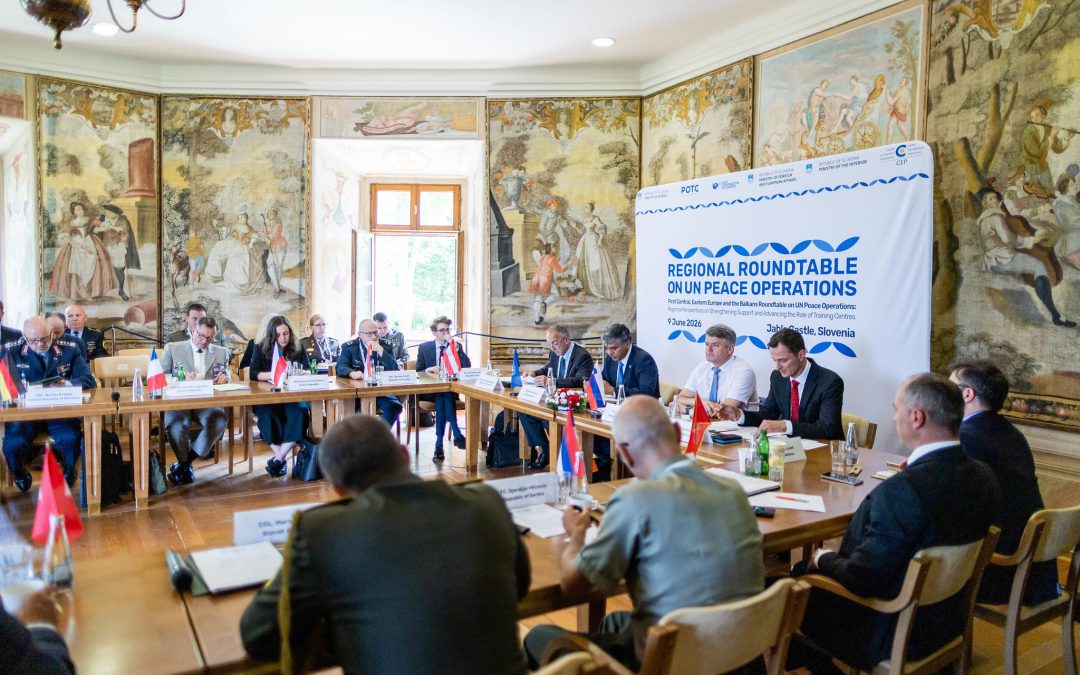
“The First Central, Eastern Europe and the Balkans Roundtable on UN Peace Operations: Regional Perspectives on Strengthening Support and Advancing the Role of Training Centres” (hereinafter referred to as the Regional Roundtable on UN Peace Operations) took place at Jable Castle on 9 June.  

This international intergovernmental event focused on the future of regional engagement in United Nations peace operations. It was organised by the Ministry of Defence of the Republic of Slovenia and the Peace Operations Training Centre (POTC), in cooperation with the Light Coordination Mechanism (LCM) in the Integrated Training Service (ITS) of the UN Department of Peace Operations (DPO).   

With this event, Slovenia initiated a regional process, expanded in a “regional-plus” format, aimed at fostering regional cooperation in peace operations, developing the role of training centres, and strengthening cooperation with the UN and partner institutions. The event brought together representatives of participating regional Member States, observer Member States with speaking roles, the United Nations, partner institutions, and academia with the aim of strengthening regional cooperation, improving operational preparedness, and developing capabilities and training, including the evolving role of peacekeeping training centres. Peace operations are a key tool for conflict prevention, civilian protection, and post-conflict stabilisation.  

As the first meeting of its kind in the region, the event also followed the 2025 UN Peacekeeping Ministerial in Berlin and recent mission developments, including  the upcoming closure of the UN Interim Force in Lebanon (UNIFIL) at the end of 2026, the event provided a timely platform to reflect on future priorities and lessons learned. Peace operations remain one of the most important tools of the international community for conflict prevention, the protection of civilians, and post-conflict stabilisation, but require continuous adaptation. They involve military, police, and civilian units that monitor ceasefires, protect civilians, and assist in rebuilding institutions and the rule of law. They reduce violence, prevent the spillover of conflicts, and create the necessary conditions for long-term peace and development.   

To ensure the successful and effective implementation of peace operations, countries must provide sufficient personnel, material, and financial resources, which remains an ever-present challenge in planning and executing these operations. Despite the current focus of many European nations on the war in Ukraine and their commitments within NATO, alongside Slovenia’s active participation in EU CSDP missions and operations, maintaining readiness and participating in United Nations peace operations remain a vital dimension of Slovenia’s approach to international security cooperation and multilateral crisis management.  

Countries in the region, including Slovenia, regularly face considerations regarding which UN missions to participate in, in what manner, with which units, and what or how much to contribute.  During its mandate as a non-permanent member of the UN Security Council (2024–2025), Slovenia actively contributed to discussions on the future of peace operations.  

Regional cooperation and the key role of training centres 

As emphasised by mag. Aljoša Selan, Acting Director General of the Defence Policy Directorate at the Ministry of Defence of the Republic of Slovenia, future peacekeepers will require competencies that extend beyond traditional military skills. They will need to operate in complex information environments, understand emerging technologies, support the protection of civilians, engage with local populations, and contribute to integrated approaches involving military, police, and civilian actors. Training institutions, such as the Slovenian POTC, which was co-established, and is co-funded, and co-managed by the Ministry of Defence, the Ministry of Foreign and European Affairs, and the Ministry of Interior of Slovenia, and operates within the Center for European Perspective, therefore play a particularly important role in ensuring that personnel remain prepared for future operational requirements. 

Strengthening training, education, and professional networks is the primary answer to maintaining readiness, expertise, and influence during a period when traditional operational opportunities are becoming less frequent.  Furthermore, the Slovenian representative, Mr Selan, stressed that Slovenia does not see regional cooperation as an option, but as a necessity. It should develop along three main lines: first, closer links between peace operations training centres; second, joint training activities, exercises, and personnel exchanges; and third, a more coordinated regional approach within the United Nations system.   

The Head of POTC, Samo Selimović, added that when connecting these centres, this refers to highly concrete forms of interstate cooperation. This includes trainer exchanges, opening training courses to personnel from other nations, and the collaboration of centres in preserving and transferring skills, knowledge, and practical experience from complex missions, such as UNIFIL. 

Overall, the roundtable participants agreed that regional cooperation should primarily focus on fostering information sharing and lessons learned (e.g. from MINUSMA and UNIFIL), while also building partnerships on peacekeeping training, capacity building, and co-deployments. They emphasized that UN peacekeeping must be adaptable, shifting toward flexible, scalable models that rely on interoperability and preparedness. They also highlighted the importance of realistic mandates, noting that overbroad or unfunded “Christmas tree mandates” present a serious issue. At the same time, they concluded that investment in training is one of the most cost-effective forms of support to UN peace operations, as maintaining readiness today is less costly than rebuilding capabilities tomorrow.  
 

Razpis za delovno mesto: Projektni asistent

Razpis za delovno mesto: Projektni asistent

Ustanova – Center za evropsko prihodnost (CEP) razpisuje delovno mesto:  PROJEKTNI ASISTENT – M/Ž 

Projektni asistent opravlja naslednje naloge: pomoč pri pripravi projektov, samostojno oblikovanje manj zahtevnih gradiv, informacij, poročil in drugih gradiv, podpora pri izvajanju projektov ter druge naloge v skladu z navodili. 

Na razpisano delovno mesto bo imenovan kandidat, ki izpolnjuje naslednje pogoje: 

  • državljanstvo države članice Evropske unije, 
  • visokošolska izobrazba 2. stopnje oz. univerzitetna (prejšnja) družboslovne smeri, jezikoslovja, novinarstva, ekonomije, ipd., 
  • poznavanje področja mednarodnih odnosov in EU politik, 
  • vozniški izpit B kategorije, 
  • tekoče ustno in pisno znanje angleškega jezika (C1/C2), 
  • znanje jezika ciljnih regij (B/C/M/S, ukrajinski jezik) na ravni B2, 
  • usposobljenost za delo z računalnikom (delo s urejevalniki besedil, delo s preglednicami, delo z bazami podatkov, poznavanje računalniških omrežij, poznavanje operacijskih sistemov), 

*Razgovor bo vključeval pisni test angleškega jezika, ki ga bomo ocenili glede na kriterije, ki bodo predstavljeni kandidatu. 

Prednost bodo imeli kandidati: 

  • z relevantnimi izkušnjami delovanja v mednarodnem okolju, 
  • s poznavanjem projektnega menedžmenta, 
  • z izkušnjami organiziranja mednarodnih dogodkov, 
  • s poznavanjem ciljev politik razvojnega sodelovanja RS, akterjev in ciljnih regij, 
  • z organizacijskimi in komunikacijskimi sposobnostmi, 
  • z izkušnjami sodelovanja z vladnim, nevladnim in/ali EU strukturami, 
  • s sposobnostjo samostojnega komuniciranja in predstavljanja, 
  • s samoiniciativnostjo in timsko naravnanostjo. 

 Delo na razpisanem delovnem mestu okvirno obsega naslednje naloge: 

  • podpora pri načrtovanju projektov, ki izpolnjujejo potrebe držav v razvoju, 
  • pomoč pri pripravi in izvedbi mednarodnih in drugih projektnih aktivnosti, 
  • pomoč pri pripravi poročil, analiz, projektnih predlogov in prispevkov za javnosti, 
  • koordinacija in sodelovanje z mednarodnimi partnerji, 
  • podpora vodji sektorja pri načrtovanju in koordinaciji dela, 
  • komunikacija s slovenskimi in tujimi udeleženci projektnih aktivnosti, 
  • sodelovanje s slovenskimi in tujimi strokovnjaki, 
  • ostala dela in naloge po navodilih nadrejenega. 

 Izbrani kandidat/ka bo delo opravljal/a na sedežu CEP, Grajska cesta 1, 1234 Mengeš. Trajanje zaposlitve: 6 mesecev z možnostjo dolgoročnega sodelovanja. 

 Kandidat mora ob prijavi predložiti: 

  • življenjepis in motivacijsko pismo iz katerih mora biti razvidno, da kandidat izpolnjuje pogoje. 

Kandidati naj pošljejo prijavo z ustreznimi dokazili po elektronski pošti na naslov:  [email protected] z jasno oznako »Prijava na razpis za delovno mesto Projektni asistent«. 

Rok za prijavo poteče dne 15. junija 2026 ob 23:59. uri. Upoštevane bodo vse prijave, ki bodo pravočasno prispele na zgoraj navedeni elektronski naslov. 

Izbrani kandidat/ka bo o izbiri obveščen/a v roku 15 dni po odločitvi o izboru. Razpis je objavljen tudi na spletni strani Zavoda RS za zaposlovanje. 

Vsi izrazi v zgornjem besedilu, ki se nanašajo na osebe in so zapisani v moški slovnični obliki, so uporabljeni kot nevtralni za ženski in moški spol. 

EUTI Training: EU Human Rights and Due Diligence Policy (HRDDP)

EUTI Training: EU Human Rights and Due Diligence Policy (HRDDP)

Training dates: 8–10 June 2026

Training location: Barsey by Warwick, Brussels, Belgium

Participants: field practitioners from 11 CSDP civilian missions and 5 CSDP military missions, alongside representatives from EEAS Headquarters (CivOpsHQ, MPCC, EUMS, PCMD, and EPF).

Background and Core Objectives

The 2022 Strategic Compass for Security and Defence, alongside the 2023 Civilian CSDP Compact, strongly reinforces the European Union’s commitment to systematically mainstreaming human rights and ensuring strict compliance with International Human Rights Law (IHRL) and International Humanitarian Law (IHL). Following the adoption of the EU Human Rights and International Humanitarian Law Due Diligence Policy (EU HRDDP) in February 2024 and the issuance of its Implementation Handbook in June 2025, the European External Action Service (EEAS) requested renewed support to operationalize these guidelines in the field.

To address high staff turnover and policy implementation challenges identified in recent mission assessment reports, this 3-day training activity was organized by the Egmont Institute in the scope of EUTI.

The program was designed as a direct, highly practical follow-up to the March 2026 training on “Mainstreaming Human Rights into Civilian CSDP Crisis Management Missions” conducted by Scuola Superiore Sant’Anna (SSSA). It focused on the following core objectives:

  • Operationalizing the HRDDP: Translating the policy framework into concrete, field-level practices across the core phases of risk management: Identification, Assessment, Mitigation, and Monitoring.
  • Civilian-Military Synergy: Promoting a balanced framework for both civilian and military CSDP missions, as well as European Peace Facility (EPF) personnel, handling both lethal and non-lethal assistance.
  • Risk Mitigation Mastery: Equipping key advisors and operations officers to manage critical risks, particularly regarding Conflict-Related Sexual Violence (CRSV), Sexual and Gender-Based Violence (SGBV), violations of children’s rights, and the “do no harm” principle when engaging with civil society organizations (CSOs).

On the first day, participants benefited from the shared knowledge and diverse perspectives of senior experts from prominent international institutions, including OHCHR, EEAS, DCAF, the Belgian Royal Military Academy, ICRC, and OSRSG CAAC.

EUTI training: Team & Conflict Management in Peace Operations – Working in and Leading Multicultural Teams

EUTI training: Team & Conflict Management in Peace Operations – Working in and Leading Multicultural Teams

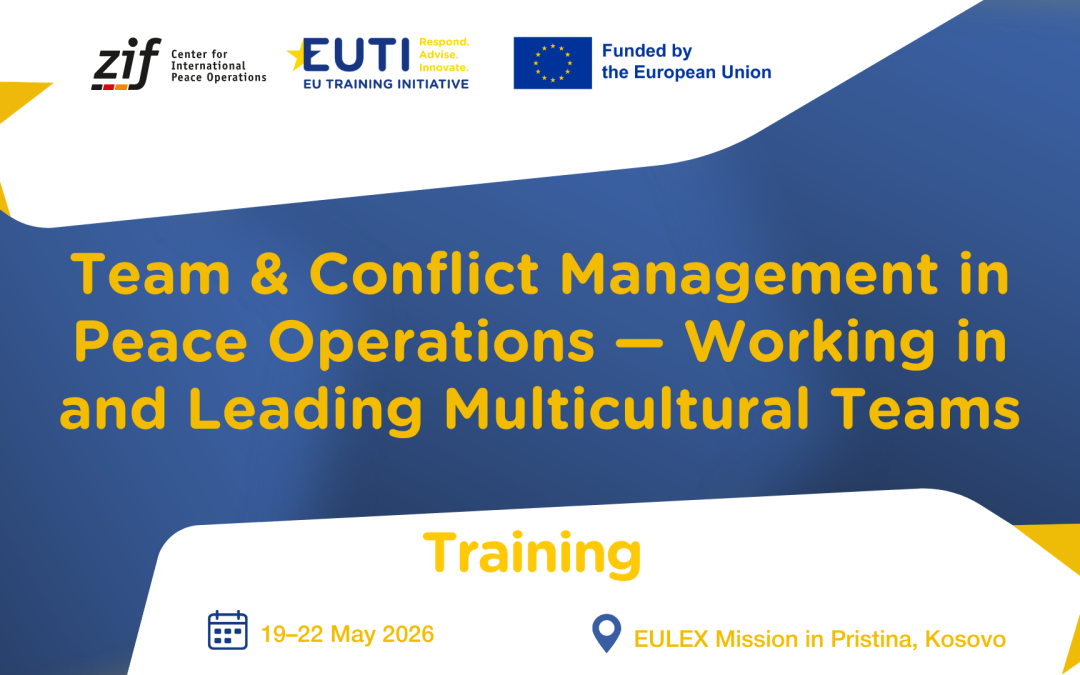
From 19 to 22 May 2026 in Pristina, Kosovo, the Center for International Peace Operations (ZIF), under the auspices of EUTI – European Union Training Initiative, successfully conducted “Team & Conflict Management in Peace Operations – Working in and Leading Multicultural Teams” training for select members of EULEX Mission in Pristina, Kosovo. The intensive program was designed to strengthen internal collaboration and leadership within civilian crisis management.

Training dates: 19–22 May 2026

Training location: EULEX Mission in Pristina, Kosovo

Participants: 11 mid-level managers and team leaders with supervisory or coordination responsibilities within EULEX Kosovo.

Background and core objectives

A mission’s working performance and ability to deliver on its mandate depends entirely on the ability of its members to collaborate trustfully and effectively. Civilian crisis management missions, such as EULEX Kosovo, operate within complex environments characterized by high workloads, stress, diverse multidisciplinary teams, complex reporting structures, and time pressure. Within this high-pressure context, interpersonal tensions and conflicts are inevitable, and if left unaddressed, they can negatively affect trust, team performance, and overall mission outcomes.

To address these challenges, this course actively developed effective teamwork by enabling mission staff—especially at the mid-management level—to constructively manage interpersonal conflicts, strengthen trust, and build cohesive, motivated teams. The program focused on the following core premises and objectives:


  • Navigating Team Dynamics: Equiping mid-level managers to play a key role in shaping team dynamics, establishing psychological safety, and building trust.
  • Harnessing Conflict Productively: Treating conflict as an inherent, potentially constructive aspect of teamwork that can be resolved timely to leverage diverse perspectives and individual strengths.
  • Adaptive Leadership: Developing adaptive, culturally sensitive, and emotionally intelligent leadership approaches to successfully guide highly diverse, multicultural teams.
  • Practical Application: Combining conceptual inputs with an experiential learning approach directly tailored to the operational realities of EULEX.

Ekipa Blejskega strateškega foruma išče študentske okrepitve

Ekipa Blejskega strateškega foruma išče študentske okrepitve

Ekipa Blejskega strateškega foruma (BSF) v svoje vrste ponovno vabi študentske okrepitve, ki bodo postale ključni del razširjene ekipe pri organizaciji največjega in najpomembnejšega zunanjepolitičnega dogodka v Republiki Sloveniji.

Letošnja mednarodna konferenca, ki bo potekala 31. avgusta in 1. septembra 2026 na Bledu, bo pod naslovom ‘Choosing The Future’ v ospredje postavila aktivno vlogo posameznikov in držav pri sooblikovanju prihodnosti.

Za glavno organizacijo foruma sicer skrbi ustaljena, a majhna ekipa, ki pa v času dogodka zaradi izjemnega organizacijskega zalogaja potrebuje pomoč. Študenti z operativnim delom in neposrednim stikom z gosti odigrajo neprecenljivo vlogo pri uspehu celotnega foruma, hkrati pa dobijo edinstven vpogled v zakulisje mednarodne politike.

Kaj pričakujemo od kandidatov?

  • Odgovornost, organiziranost in željo po pridobivanju novih izkušenj.
  • Urejen študentski status do konca septembra 2026.
  • Zaželene (niso pa pogoj) predhodne izkušnje pri organizaciji dogodkov.

Področja dela vključujejo: delo na odprtju v Festivalni dvorani, pomoč v medijskem centru ali PR ekipi, sprejem delegacij na letališču Jožeta Pučnika, logistično podporo v dvoranah, delo na bilateralnih srečanjih in na akreditacijskem pultu.

Kaj ponujamo?

  • Možnost sodelovanja na glavnem zunanjepolitičnem dogodku v Sloveniji ter odlično priložnost za nova poznanstva.
  • Delo, plačano po urni postavki 7,73 € neto.
  • Organizirano prehrano in prevoz iz Ljubljane do Bleda.
  • Možnost priznanja dela kot obvezne prakse v okviru formalnega izobraževanja.
  • Možnost pridobitve priporočila vodstva v primeru dobro opravljenega dela.

Potek dela: Glavnina dela bo potekala v ponedeljek, 31. avgusta, in v torek, 1. septembra, del ekipe pa bo vključen že med vikendom (29. in 30. avgusta) ter v času priprav. Predpriprave bodo vključevale en spletni koordinacijski sestanek in krajše spletno varnostno izobraževanje.

Vse zainteresirane študente vabimo, da se prijavi preko spletnega obrazca najkasneje do vključno nedelje, 7. junija 2026. Ob prijavi je potrebno priložiti življenjepis (CV) in kratko motivacijsko pismo (do 300 besed). V primeru velikega števila prijav bodo med 8. in 12. junijem potekali kratki, 10-minutni spletni razgovori.

Za dodatna vprašanja se lahko obrnete na: [email protected]