28. 9. 2020 | European Digital Diplomacy Exchange, PR
European Digital Diplomacy Exchange Steering Board and Symposium on Government Communication during COVID-19 Pandemic begins virtually
Click here to read more about the project in Slovenian language. 
The Centre for European Perspective, together with the U.S. Department of State and the Ministry of Foreign Affairs of Slovenia organized a Steering Board meeting and Symposium on Government Communication during COVID-19 pandemic. The event has been hosted via Zoom, taking place from Monday, 28 September to Friday, 2 October 2020.
DAY 1
At the beginning, participants were addressed by Matt Jacobs from the U.S. Department of State and Project Coordinator Ingrid Omahna from the Centre for European Perspective.
The day commenced after the introductory remarks, with a lecture by Tom Fletcher, Former British Ambassador and Downing Street Foreign Policy Advisor and author of the book “The Naked Diplomat: Understanding Power and Politics in the Digital Age”. He presented a lecture about the state of diplomacy before and after 2020, explained current trends, and pointed out 10 crucial questions to consider in order to survive as a diplomat in the future.
Ivana Boštjančič Pulko from Information Security Administration of the Republic of Slovenia continued with a session about “Essentials for Trainers”. The sharing of experience and knowledge is at the very core of the EDDE network, and as participants openly discussed with Mrs. Pulko, there is a dividing line between a good and bad trainer. Mrs. Pulko covered the theoretical essentials of a good trainer, tips and tricks that can help trainers be more confident and advise on how to engage their audience. Guest participants were engaged in an open discussion, that included their questions, challenges and a topic very close to the overall Steering board and Symposium subject, namely how can trainers adapt to the new COVID reality.
The day concluded with the EDDE Steering Board meeting where the next steps of the project were discussed.
DAY 2
The second day started with a lecture by prof. Corneliu Bjola, Associate Professor of Diplomatic Studies from the University of Oxford. Participants dived deep into The Digital “Dark Side” of the COVID-19 Pandemic with a focus on 5G conspiracy theory. The participants learnt the basics of conspiracy theories, how to detect and counter them effectively and what kind of impact they have on the public health system during the current pandemic.
The second session of the second day focused on the Cases of Disinformation during the COVID-19 pandemic in the Czech Republic. A lecture was given by Veronika Krátka Špalková, Analyst of the Kremlin Watch Program from European Values Center for Security Policy. She focused on the Czech disinformation environment and held a detailed presentation of the context, waves and cases of disinformation during the COVID-19 pandemic.
The third and last session of the day included a presentation by Jakub Kalensky and Andy Carvin, both working at the capacity of Senior Fellow at the Digital Forensic Research Lab within the Atlantic Council. They presented an overview of Disinformation in the new COVID reality. As they suggested, times of crisis have always presented an opportunity/void in which disinformation can flourish, with the current pandemic being no different. The Atlantic Council is working closely from the initial stages of the COVID-19 pandemic and has researched, analyzed, and exposed various harmful narratives worldwide.
DAY 3
The third day of the event started with a session by Bernd Spainer from Communications Policy & Public Diplomacy Division of the European External Action Service. Lecture focused on Strategic Communication during COVID-19 at the EU level. The next presenter was Elina Lange- Ionatamišviili, from NATO StratCom Centre of Excelence, who presented the role of StratComs during COVID-19 emergency, the issue of “infodemic” and its impact on the society in a broader sense. Last but not least, Christ Smith from EUR Stratcom Team of U.S. Department of State, talked about the role of StratCom during the COVID-19 Emergency from the U.S. Perspective.
DAY 4
The fourth day was dedicated to social media and their active role in digital diplomacy. The first session was held by Matthias Lüfkens, Author of Twiplomacy and Managing Director at Burson Cohn & Wolfe. Matthias explained how governments and world leaders reacted to COVID-19 on Twitter. The day closed with a group activity session about the next steps of the EDDE project.
On the last day, the Steering Board members provided an overview of how different governments have responded in relation to COVID-19.
This valuable event would not have been possible without the support of the U.S. Department of State and the Ministry of Foreign Affairs of the Republic of Slovenia within the Official Development Cooperation instrument.


21. 9. 2020 | European Digital Diplomacy Exchange, PR
Click here to read more about the project in Slovenian language.
The Centre for European Perspective, together with the U.S. Department of State and the Ministry of Foreign Affairs of Slovenia is organizing a Steering Board meeting and Symposium on Government Communication during COVID-19. The Steering Board Meeting & Symposium, hosted via Zoom, will start on Monday, 28. September, and will finish on Friday, 2. October 2020.
The COVID-19 pandemic pushed the world in the grip of a crisis that stands unprecedented in living memory. Challenged with uncertainty about the development of the virus and its impact on society, governments and other institutions are under enormous pressure to communicate and introduce policy initiatives under extraordinary circumstances, accompanied by an “infodemic”, with flooding misinformation and disinformation.
This symposium aims to provide an overview of how governments have responded in relation to COVID-19 and to reveal the digital dark side of the pandemic. The event will consist of several engaging sessions with different stakeholders, ranging from government structures to non-government organizations, think-tanks, academia, and tech companies.
 The project is a result of a joint cooperation between the U.S. Department of State, the U.S. Embassy in Ljubljana, the Ministry of Foreign Affairs of the Republic of Slovenia in the scope of the International Development Cooperation and the Centre for European Perspective.

4. 3. 2020 | European Digital Diplomacy Exchange, PR
The Centre for European Perspective (CEP), together with the U.S. Department of State, and the support from the Moldovan State Chancellery and the Ministry of Health, Labour and Social Protection of the Republic of Moldova, is organizing a two-day training for Moldovan government communicators within the scope of “European Digital Diplomacy Exchange (EDDE)” project. The training will take place on 5 – 6 March in Government House in Chișinău.
Today’s public sphere is shaped by the proliferation of digital communication channels that are constantly bringing new challenges for governments. Government communicators are required to be active on social networks, but this role is too often taken for granted. In order to ensure successful communication, they constantly need to expand their knowledge, experience, different abilities and skills.
This training will cover a range of topics from public relations and public diplomacy theory to the practical application of digital tools, conducted by experienced public and private sector communicators in this emerging media environment.

16. 12. 2019 | European Digital Diplomacy Exchange, PR
Nowadays, everyone has a powerful video camera in a pocket: a smartphone. With a little practice, tools, tips, government communicators have all they need at their fingertips. The Centre for European Perspective (CEP) in cooperation with the United States Department of State, therefore conducted a training on Smartphone Videography between 10 and 12 December 2019 in Bled, Slovenia.
The training attracted more than 30 government communicators coming from different ministries of Albania, Bosnia and Herzegovina, Bulgaria, Montenegro, North Macedonia, Kosovo, Romania, Serbia, Georgia, Ukraine and Slovenia.
Since video is undoubtedly one of the most engaging and effective tools to communicate with audiences at the time, the participants were introduced to the world of smartphone filmmaking. After a course with Boštjan Romih they became confident and engaging public speakers, digital storytellers after a session with Charlelie Jourdan and effective communicators during the crisis after the lecture from Matt Jacobs. For the finals, they learned about the digital convergence with Matej Praprotnik and media strategies in Bosnia and Herzegovina with Admir Malagic on the first day.
On the second day, film director and CEO of Studio Production House Dražen Štader guided participants through the process of smartphone video production, including the needed equipment, video-techniques and editing of video products. U.S. Embassy Ljubljana Public Affairs Officer, J.B. Leedy presented best practices in smartphone photography, while Ingrid Omahna focused on visual communication design. Andy Carvin from the Digital Forensic Research Lab of the Atlantic Council and Nina Pejič, Researcher at Faculty of Social Sciences of the University in Ljubljana talked about the emerging threats in the digital space.
On the last day, participants divided into 6 teams needed to put the gained knowledge into practice. They became a team of government communicators for the Ministry of Citizen Protection of a country called Sloland that is challenged with a huge influx of refugees from a neighboring country called Gotan. They were tasked to launch a 3-day digital campaign to communicate the benefits of immigration and push back against anti-immigrant and anti-refugee rhetoric, which they completed with excellence.
European Digital Diplomacy Exchange project that started off in 2017 on the initiative of the U.S. Department of State, is committed to increasing members’ collective capacities to effectively operate within the digital information space. The strong relationships fostered over the courses of the project have precipitated a network of dedicated professionals who are committed to ensuring governments are operating ahead of the digital curve, and therefore able to better communicate with their citizens, better listen to their citizens, and both embrace and protect their role within the context of this new, democratized, digital information environment.


10. 12. 2019 | European Digital Diplomacy Exchange, PR
The Centre for European Perspective, together with the U.S. Department of State is organizing a three-day training that is tailor made for government communicators, public officers and digital diplomats alike. The training will take place between Tuesday 10th of December and Thursday 12th of December at Bled, Slovenia.
The modern information and media sphere form an information highway, that has unveiled both opportunities and pressing challenges for all the stakeholders that work to protect information integrity. Technological advancement and innovation have made it significantly easier for individuals to participate in the information flow, a significant contribution to the democratic dialogue. The same opportunities are unfortunately also available to harmful narratives, that may use amplification tools to mis- and dis-inform. Governments are therefore uniquely challenged, to proactively and re-actively inform their citizens and cooperate with their audience in a dialogue of equal voices. Government communicators, who effectively safeguard information integrity through their every day work as a result need to poses an unique skillet of abilities and knowledge to be effective and address the challenges with a stronger voice.
For this purpose, a fifth iteration of the training, taking place between 10th and 12st June 2019 at Bled, Slovenia, will join the forces of government communicators from Albania, Bosnia and Herzegovina, Bulgaria, Georgia, Kosovo, North Macedonia, Moldova, Montenegro, Romania, Serbia, Slovenia and Ukraine. The training will cover a range of topics from public relations and public diplomacy theory to practical application of digital tools. Participants will also gain valuable knowledge on the practical application of smartphones, technology, that presents a world of opportunities at the touch of our fingertips.
The project is a result of a joint cooperation between the U.S. Department of State, the U.S. Embassy in Ljubljana and the Centre for European Perspective.

11. 10. 2019 | European Digital Diplomacy Exchange, PR
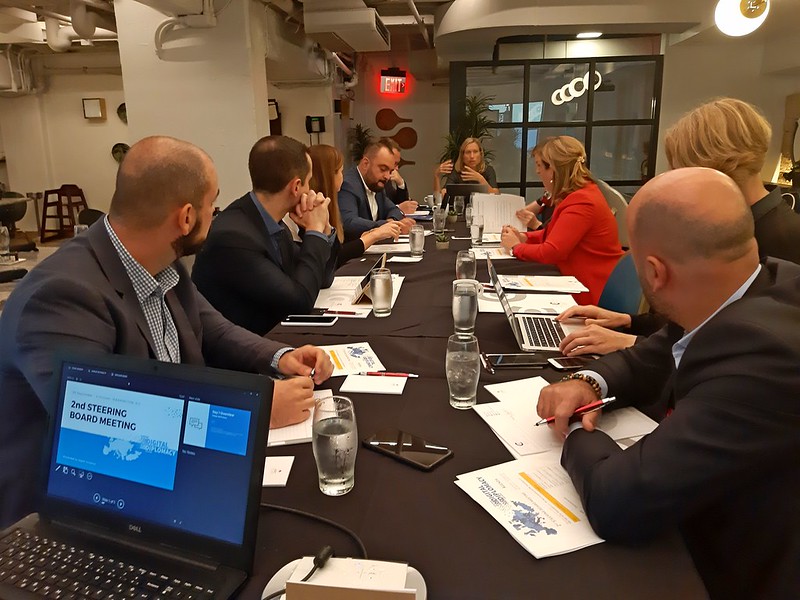
The second meeting of the European Digital Diplomacy Exchange (EDDE) project Steering Board took place in Washington D.C. from 30th September to 4th October 2019 in order to review the project efforts within the current year, address future challenges with an outlook to the sustainability of the project and to build beneficial partnerships with institutions, who are experts in the field of digital diplomacy and countering disinformation.
The first day of the meeting was an opportunity for the Steering Board to review the efforts within the EDDE project that were implemented in the current year, discuss trends and opportunities within the profession and most importantly, to find solutions for challenges ahead of the project. The group was then included in a presentation and open discussion with Mr. Samaruddin Stewart, Media Technologist, who presented the use of Google tools in the context of media reporting, a practical skill set that can also be of high value for governmental communicators within their everyday profession. The official program of the day concluded with a guided tour of the U.S. capital, the home of the United States Congress and the seat of the legislative branch of the U.S. federal government, which offered an interesting background and historical overview of Washington D.C. as the political epicentre of the United States of America.
The second day of the meeting took place within the U.S. Department of state, with presentations and open discussions from various offices within the institution. Their line of work tackles the topics of governmental communication, transparency building through the communication with audiences, efforts of countering disinformation and many other skillsets that offer motivation and inspiration for the EDDE project, but also an opportunity for joint cooperation in the future. The program continued with an evening reception at the Embassy of Slovenia in the United States of America. The guests were addressed by Mr. Ambassador Stanislav Vidovič and Ms Katja Geršak, CEP Executive director.
Wednesday presented the third day of the Steering board meeting with the continuation of fruitful meetings. The morning session took place within the Atlantic Council, a prominent think thank in the field of international relations who shared their experience of digital communication strategies, success stories of their communication campaigns, proactive resilience building against disinformation and other activities. The afternoon session included an open discussion with Professor Steven Livingston who is cooperating with the George Washington University School od Media and Public Affairs. The research of their team addresses disinformation campaigns present online and on multiple social media platforms, researching narratives from different aspects, all bringing to a better understanding of the phenomenon.
After successful meetings with governmental communicators, representatives of think tanks and Accademia, a cooperation with tech companies who actively shape the information environment of today, was a systematic next step for the study visit. The Washington D.C. Facebook outpost hosted the Steering Board on Thursday. The EDDE representatives were informed on new technological advancements and content activities, that are enforced by Facebook to secure a safe space where free speech with equal opportunities can take place. Governments and their digital efforts present an important link in the information landscape, that is why close cooperation with tech companies as Facebook is also imperative in the effort to secure transparent communication between governmental outreach and their audience, leading to more efficient and engaging policy making. With the rise of misinformation and disinformation campaigns, safeguarding the integrity of information is also becoming a high-stake objective, a challenge that can only be addressed by the common needs and strengths of the audiences, governments, tech companies, think thanks, academia and other stakeholders.
Friday marked the fifth and final day of the Steering Board meeting with close attention to the achievements and skillsets gained during the Washington study visit. The sharing of best practices, future EDDE activities planned and ideas to address common challenges have offered a strong base for future cooperation in activities taking place within the EDDE project.
The project is organised as a joint cooperation between the U.S. Department of State, the U.S. Embassy in Ljubljana and the Centre for European Perspective. The activities are only a part of a series of events that will take place in the year 2019, building on past experience and motivation to contribute to the rapidly changing field of digital diplomacy.