3. 10. 2019 | European Digital Diplomacy Exchange, PR
Washington, 2. oktobra – V Washingtonu poteka drugo zasedanje upravnega odbora Evropske izmenjave aktivnosti digitalne diplomacije v ZDA. Gre za projekt, namenjen regiji Zahodnega Balkana in Vzhodne Evrope pri zoperstavljanju dezinformacijam, ki ga izvaja Center za evropsko perspektivo (CEP) s pomočjo slovenskega zunanjega ministrstva in State Departmenta.
Ob robu zasedanja, ki poteka od 30. septembra do 4. oktobra, sta slovenski veleposlanik v ZDA Stanislav Vidovič in direktorica CEP Katja Geršak v torek v prostorih veleposlaništva v Washingtonu pripravila sprejem za člane upravnega odbora.
Upravni odbor se bo v Washingtonu sestal tudi z različnimi think-tanki in akademskimi institucijami, tehnološkimi podjetji in državnimi organi z namenom ustvarjanja produktivnih partnerstev.
State Department, CEP in MZZ so skozi projekt Evropska izmenjava aktivnosti digitalne diplomacije uspeli vzpostaviti mrežo vladnih komunikatorjev iz držav Zahodnega Balkana in Vzhodne Evrope, ki skozi različna usposabljanja krepijo strateško komuniciranje za učinkovito delovanje v informacijskem prostoru.
V zadnjih dveh letih se je usposabljanj udeležilo več kot 240 ljudi iz Albanije, Bosne in Hercegovine, Črne gore, Severne Makedonije, Kosova, Srbije, Gruzije, Moldavije in Ukrajine. Projekt je pritegnil tudi zanimanje komunikatorjev iz Estonije, Latvije, Litve, Češke, Slovaške, Slovenije, Bolgarije in Romunije.
V zadnjem času je iskanje učinkovitega protistrupa za dezinformacije postalo osrednje prizadevanje odločevalcev, novinarjev in akademikov po celem svetu. Januarja lani je Evropska komisija ustanovila skupino strokovnjakov na visoki ravni (HLEG) z namenom svetovanja o političnih pobudah za preprečevanje lažnih novic in dezinformacij, ki se širijo po spletu.
Dezinformacije je HLEG opredelil kot “vse oblike napačnih, netočnih ali zavajajočih informacij, ki so oblikovane, predstavljene ali širjene z namenom škoditi javnosti ali za dobiček.” Slovar slovenskega knjižnega jezika definira pojem dezinformacije kot napačne informacije, zlasti namerne.
Na informacijsko vojno slabo pripravljene institucije in organe odločanja so ob številnih priložnostih presenetili državni in nedržavni akterji, ki lažne informacije vsakodnevno širijo preko tradicionalnih in družbenih medijev. Še večja težava se pojavlja v tranzicijskih državah Zahodnega Balkana in Vzhodne Evrope, kjer dezinformacije zavirajo družbeno-politični napredek držav v smeri demokracije in krepijo protievropska in protiameriška čustva.
Vir: STA

30. 9. 2019 | European Digital Diplomacy Exchange, PR
in the scope of the project European Digital Diplomacy Exchange we are organizing the second Steering Board meeting that will be held from 30th September to 4th October 2019 in Washington D.C., United States.
The meeting will be the opportunity for the Steering Board members to discuss with public- and private sector entities. Importantly, it will seek to cement relationships between tech firms, think thanks, and others that can continue to sustain and support the network. This component will therefore include meetings with various Department of State entities, as well as several think tanks actively engaged in digital communications, and various tech companies with an eye toward developing the familiarity necessary to produce productive public-private partnerships.
The project is organised as a joint cooperation between the U.S. Department of State, the U.S. Embassy in Ljubljana and the Centre for European Perspective. The activities are only a part of a series of events that will take place in the year 2019, building on past experience and motivation to contribute to the rapidly changing field of digital diplomacy.

26. 6. 2019 | European Digital Diplomacy Exchange, PR
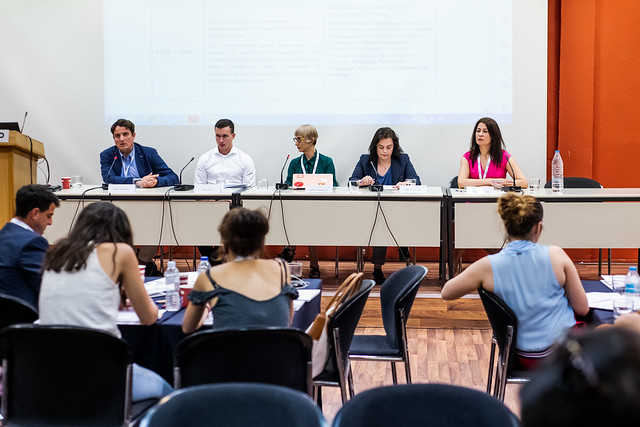
The Centre for European Perspective, together with the U.S. Department of State and the U.S. Embassies in Greece and North Macedonia, co-hosted a workshop entitled “Empowering Journalists to Address Disinformation in Greece & North Macedonia” in Thessaloniki, from 24 – 26 June 2019.
Developments in the last few years have transformed the communications landscape, raising questions about the quality, impact and credibility of journalism. At the same time, agents of disinformation are using anonymous online spaces to seed rumors and false content aiming to reach professional news outlets and multiply their effect. How can journalists protect themselves from being manipulated?
The workshop gathered 40 journalists from Athens-Macedonian News Agency (AMNA), North Macedonia’s Media and Information Agency (MIA), private media outlets, as well as academics and representatives from civil society to discuss how to address the disinformation challenges faced by both countries and multisector approaches to combating it.
The project is a result of a joint cooperation between the U.S. Department of State, the U.S. Embassies in Greece and North Macedonia, the U.S. Agency for Global Media (USAGM), along with the Athens-Macedonian News Agency (AMNA), and the Centre for European Perspective.

23. 6. 2019 | European Digital Diplomacy Exchange, PR
Click here to read more about the project in Slovenian language. 
Bohinj and Bled were the settings of the European Digital Diplomacy training this week, bringing together government communicators from Albania, Bosnia and Herzegovina, Bulgaria, Estonia, Georgia, Kosovo, Latvia, Lithuania, North Macedonia, Moldova, Montenegro, Romania, Serbia, Slovenia, and Ukraine. The event was prepared as a joint effort between the U.S. Department of State, Ministry of Foreign Affairs of the Republic of Slovenia within the framework of the Official Development Cooperation, the U.S. Embassy in Slovenia and Centre for European Perspective. Activities of the three-day training enforced the participants to join forces, ideas, and best practices to bridge challenges in the field and build a strong network for the future of the project.
On Wednesday morning, the participants were addressed by CEP Executive Director Katja Geršak, Public Affairs Officer Jean B. Leedy from the U.S. Embassy in Slovenia and Miriam Možgan, Head of Public Relations Office within the Slovenian Ministry of Foreign Affairs. The training was then set off by Matt Jacobs from the U.S. Department of State and Centre for European Perspective’s very own Project Coordinator Ingrid Omahna, who have been supporting and coordinating the project from the very beginning.
The first day of the training was devoted to a series of discussions, workshops, and lectures that covered the communication sphere of governmental institutions and the ever-growing threat of misinformation/disinformation. The digital revolution has yielded a unique opportunity for individuals and communities alike to stay informed and engage within their audiences. At the same time, digital innovation is proving the importance of communication activities governments and other state institutions have to undertake in order to build on the engagement of their communities. Digital platforms, social media and other methods of digital data transmission, therefore open the door to transparent and more effective politics with engaging policies that can more closely listen to the needs of communities affected by them.
The sharing of ideas and best practices among peers working at the same capacities have always been in the heart of the overall EDDE project, so to better address the challenges that occur in their profession. Being no different for the training in Bohinj, the afternoon of the first day continued with a presentation of successful digital campaigns. Jane Lazevski working as a Special Adviser to the Minister in the Ministry of Foreign Affairs of the Republic of North Macedonia presented a successful digital campaign from North Macedonia meanwhile Nataša Adlešič Barba working for the Ministry of Foreign Affairs of the Republic of Slovenia presented the most recent Slovenian successful digital campaigns within the scope of Official Development Cooperation. The participants were also engaged in a lecture on how to address disinformation so to preserve information integrity. The debate based on the participant’s experiences and challenges continued within a Night Owl Session on identification and responses to misinformation.
The second day of the training moved the participants to the ambient of Lake Bled, where the event was hosted by the IEDC Bled School of Management. Participants were divided into two smaller groups who sequentially cooperated in interactive lectures. The first pair of workshops covered Photography training (led by the experienced journalist Uroš Hočevar) and Infographic and Design Training (led by Ingrid Omahna). Both of the workshops covered practical aspects and skills, which can help public officers build on better and more effective visual material for their campaigns and digital efforts. The afternoon session engaged participants in a discussion on analytics (prepared by Paolo Ganino working at the European External Action Service) and Matt Jacobs on the topic of social listening. Both the presentations covered many useful aspects on how to better engage with their audiences and secure digital campaigns that more effectively resonate within communities. The evening program continued in Bohinj, where the participants once more engaged in a Night Owl Session, this time on the topic of Policy as Lifestyle.
All of the lectures, infographic and design training, debates, photography training, exchange of experiences and best practices were brought to a practical test on Friday, when the participants were faced with a digital challenge. A hands-on simulation based on a descriptive storyline challenged the groups of participants to prepare a specific digital campaign for their imaginary country Frakya. All of the groups were innovative and successful in their efforts to build visually appealing campaigns and content with creative solutions for the task in question. The evening continued with closing remarks and a certificate ceremony.


18. 6. 2019 | European Digital Diplomacy Exchange, PR
ANNOUNCEMENT: European Digital Diplomacy Exchange Training
The Centre for European Perspective, together with the U.S. Department of State and the Ministry of Foreign Affairs of Slovenia is organizing a three-day training designed to enhance the digital press and public diplomacy capacities of government communicators.
Governments have been uniquely challenged by the proliferation of digital communication channels. On one hand, they have never had as much access to domestic and foreign publics – access that they can use to understand and inform their audiences. On the other, the proliferation and democratization of the digital media space has increased their narrative competition, and opened them up to a number of consequential challenges, including proactively destructive counter-narratives and disinformation. Governments that are active on social networks therefore require new knowledge and experience, different abilities and skills that are necessary to effectively operate within the information space.
For this purpose, a fourth iteration of the training, taking place between 19th and 21st June 2019 in Bohinj, Slovenia, will recruit government communicators from Albania, Bosnia and Herzegovina, Bulgaria, Czechia, Estonia, Georgia, Kosovo, Latvia, Lithuania, North Macedonia, Moldova, Montenegro, Romania, Serbia, Slovakia, Slovenia and Ukraine. The training will cover a range of topics from public relations and public diplomacy theory to practical application of digital tools.
The project is a result of a joint cooperation between the U.S. Department of State, the U.S. Embassy in Ljubljana, the Ministry of Foreign Affairs of the Republic of Slovenia in the scope of the International Development Cooperation and the Centre for European Perspective.
Click here to read more about the project in Slovenian language.

18. 4. 2019 | European Digital Diplomacy Exchange, PR
The first meeting of the European Digital Diplomacy Exchange (EDDE) project Steering Board took place in Brussels from 15 – 17 April 2019 in order to set the operational ground for the Steering Board, as well as to build the linkages and plans necessary to increase EU and NATO involvement.
Centre for European Perspective (CEP), together with U.S. Department of State continues to encourage intergovernmental network of government communicators that was formed within the project “Enhancing Digital Diplomacy Activities in Western Balkan and Eastern European Countries.” In order to ensure that digital development takes root locally in between program activities we established a Steering Board, consisting of representatives of the countries that are involved in the project, coming from the Western Balkans, Eastern Europe and the Baltc States.
The meeting gathered fourteen out of fifteen representatives in the Steering Board, chaired by Matt Jacobs from the U.S. Department of State and Ingrid Omahna from CEP. Besides numerous discussions about how to shape a system that can ultimately continue to develop and refine the work moving forward in a meaningful manner, this meeting was also the opportunity to meet with other partners. Rebecca Obstler, Principal Editor of NATO Communications Services at Public Diplomacy Division presented a NATO approach towards promoting the coherence among Alliance communications in a way that can be mutually amplifying. Steering Board members also met with EEAS StratCom representatives. Jurgis Vilčinskas, Deputy Head of StratCom Division at EEAS outlined the structure of the EEAS, their set of objectives and their way towards detecting, predicting and exposing disinformation and their narratives. Atlantic Council’s Digital Forensic Research Lab Director, Graham Brookie provided an overview of how the Atlantic Council identifies, exposes, and explains disinformation where and when it occurs using open source research.
At the end, the meeting ideas will manifest in a guiding document enshrined with guiding principles.