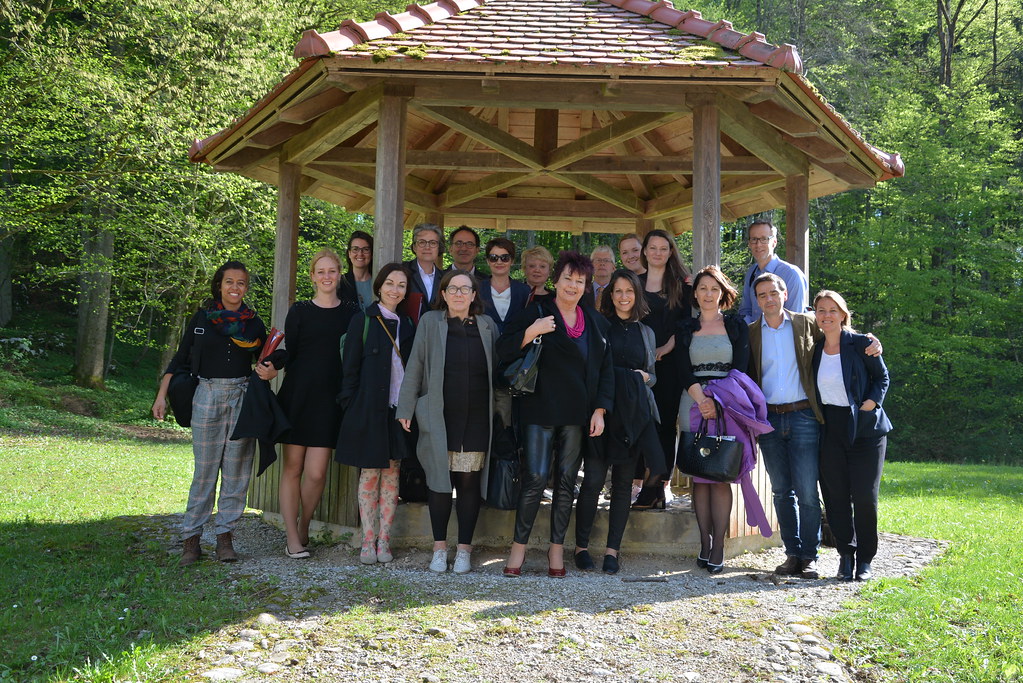
Steering Board of the “Readiness Of Slovenian E-Invoicing” (ROSE) Action published a comprehensive manual for the upgraded Slovenian national eInvoicing standard eSLOG 2.0. The manual is available in Slovenian and English language and serves the software solution and service providers who will now be able to integrate the new eSLOG into their solutions. The upgraded standard is compatible with the European Standard and in accordance with the e-Invoicing Directive 2014/55/EU.
Dušan Zupančič of the Chamber of Commerce and Industry of Slovenia, who is among the partners of the Action, explains: “In the framework of the ROSE Action we prepared a new version of the eSLOG standard 2.0, which complies with the European standard EN 16931. The final step was reached last week with the publishing of the manual that enables understanding, implementation and use of eSLOG in the software solutions.”
All solutions developed in the framework of ROSE Action will be presented at the final conference “eInvoices as important factor of business digitalization” on Friday, 25 May 2018 in Portorož. Additional details about the conference are available here:http://bit.ly/ROSEkonferenca.
The developments were presented at the 11th Steering Board meeting of the ROSE Action, a Connecting European Facility Action, co-financed by the European Union and implemented by the Public Payments Administration of the Republic of Slovenia, Chamber of Commerce and Industry of Slovenia, ZZI d.o.o.,Mojdenar IT d.o.o. and Centre for European Perspective.
The outcomes of the“Back on the Agenda: EU Enlargement and Western Balkans” project are now available online. The report includes policy recommendations prepared by the four discussion groups:
PARTICIPATION
SOCIAL AFFAIRS
DEMOCRATIZATION
RECONCILIATION
Read the report here:
A two-day event brought together representatives of young generation and civil society for a Visegrad cafe discussion, policy boot-camp and public debate with the national and EU decision-makers.
The event was organized by the Centre for European Perspective (Slovenia) with the support of the International Visegrad Fund and in cooperation with the Institute for Foreign Affairs and Trade (IFAT) (Hungary), EUROPEUM Institute for European Policy (Czechia), Slovak Foreign Affairs Association (SFPA) and Polish Institute of International Affairs (PISM).
Bled Strategic Forum, jointly organized by the Ministry of Foreign Affairs and Centre for European Perspective, is a strategic partner of the Eurasian Economic Summit, organized by Marmara Group Foundation that takes place annually in Turkey. The 21st Eurasian Economic Summit on 11-12 April 2018 brought together 41 countries which were represented by Presidents, Prime Ministers, Speakers of the Parliaments, Ministers, Members of the Parliaments, business people, academicians and religious leaders.
Bled Strategic Forum was represented by CEP’s Project Manager Sabina Carli, who participated in an interactive session “Academicians, politicians and religious leaders discuss the future with the young generation” with Prof. Dr. Ali BARDAKOĞLU, President of Religious Affairs of the Republic of Turkey (2003-2010), Archbishop BARTHOLOMEW, Ecumenical Patriarch of Istanbul, Mirko ŠAROVIĆ, Minister of Foreign Trade and Economic Relations, Yusuf ÇETİN, Patriarchal Vicar of the Syriac Orthodox Church of Istanbul, Isak HALEVA, Chief Rabbi of Turkey, Orhan ÇANLI, Syriac Catholic Deputy Patriarch of Turkey, Merdan BAYRAMDURDIYEV, Deputy Minister of Finance and Economy of Turkmenistan, Prof. Dr. Şener OKTİK, Head of Research and Technological Development of Şişecam Group, Sergiu CELAC, Ambassador – Honorary President of New Strategy Center Prince RADU, Prince of Romania, Ismail ALIJI, Foreign Policy Adviser of the President of Macedonia, Director of Political Research, Institute of Strategy and Development, Ardian HOXHA, Superintendent of the American School of Kosovo, Dr. Nikola GJORGON, Foreign Policy Adviser of the President of Macedonia and Karlis BUKOVSKIS, Deputy Director at the Latvian Institute of International Affairs. They discussed the role of science and technology in today’s and future life and agreed that all spheres of life are influenced by technology, yet all of them also need to get involved for sustainable future in which technology can play a very positive role if we use it smartly.
302 international and 761 domestic participants attended the 21st Eurasian Economic Summit. Former President of Turkey H.E. Abdullah Gül, Deputy Prime Minister H.E. Mehmet Şimşek, Minister of Economy H.E. Nihat Zeybekçi, former Deputy Prime Minister and MP H.E. Tuğrul Türkeş, Governor of Istanbul Hon. Vasip Şahin and Istanbul Metropolitan Mayor Mevlut Uysal attended the summit that started with the opening speech of the Prime Minister of the Republic of Turkey H.E. Binali Yıldırım, while international participants included presidents, foreign ministers and other ministers from across Europe and Asia.
Digital Diplomacy Bootcamp 2.0 organised by the Centre for European Perspective and supported by the U.S. Department of State took place in Bled and Ljubljana from 10 to 13 April 2018. A 4-day training »Enhancing Digital Diplomacy Activities in the Western Balkans and Eastern Europe” brought together over 70 PR representatives, communication officers and digital diplomats from Albania, Bosnia and Herzegovina, Georgia, Kosovo, Macedonia, Moldova, Montenegro, Serbia, Ukraine and Slovenia.
See what can be found in the digital diplomat’s toolbox:
In the framework of the “IECEU – Improving Effectiveness of Capabilities in EU Conflict Prevention” project a new article has been published by CEP’s project manager Ivana Boštjančič Pulko. The paper “(In)effective Planning Capacity of CSDP Mission: Comparative Analysis of EULEX Kosovo and EUFOR Althea” evaluates the planning capacity of two Common Security and Defence (CSDP) missions (EULEX Kosovo and EUFOR Althea) in order to assess the e ectiveness of CSDP planning process. Both missions su er due to partial interests within the EU and low po- sitioning of CSDP on political agendas of the member states. Compared to NATO, EU missions’ political control is more much detailed once the mission is deployed. CSDP planning architec- ture has been considerably reformed since the inception of the rst missions in 2003, however the supervision by the member states is still present in all phases of restructuring and imple- mentation. EULEX planning process includes a well elaborated lessons learnt process, however the implementation of the ndings on the operational level is rather weak whereas EUFOR Althea pro ted mostly from the access to NATO planning assets. CSDP missions are political missions and their e ectiveness seems to be of secondary importance to the EU member states.
Trafficking in human beings (THB) is a complex phenomenon that is highly dependent on regional and local economic, social as well as cultural factors. Priority Area 10 is playing an active role in facilitating a discussion among experts, municipalities, cities and non-governmental organizations. Only common efforts can result in tangible steps for combating human trafficking and exploitation.
On April 18th 2018 around 30 experts, practitioners, academics, representatives of municipalities, civil society organizations, international organizations and others interested in the topic of combating human trafficking from nine countries from Danube Region and wider gathered in Slovenia.
They dedicated lively discussion and exchange of views on opportunities for strengthening the role of municipalities and cities in preventing and combating human trafficking and exploitation. They have touched upon various angles of this highly multifaced problem that has rarely only national effect – most often regional approach is bringing the most results. Round table was moderated by Ms Helga Konrad that is currently serving as a director of the Regional Implementation Initiative on preventing and combating human trafficking in Vienna. With her vast experiences on all policy levels she steered discussion towards practical and concrete answers, proposals and actions.
Slovene national coordinator for combating trafficking in human beings (THB) Mr Sandi Čurin expressed his satisfaction that discussion on combating THB moved from expert to political level. Within Brdo process regional ministers and national coordinators of the THB accepted joined declaration where they agreed that comprehensive and coordinated approach both at national level and within regional initiatives is crucial. This was similarly emphasized by Ms Tetiana Rudenko from OSCE Office of the Special Representative and Co-ordinator for Combating Trafficking in Human Beings. In their action plan they focus on prevention, prosecution, protection and co-ordination and partnerships.
For this reason, they have organized among others a training with extensive simulation on Combating Human Trafficking Along Migration Routes that brought many challenges in multi-level cooperation on the surface. Ms Alexandra Malangone shared some details from the simulation that is providing a safe environment for extensive learning for practitioners with various backgrounds that have to work together.
Mr Mike Dottridge presented his suggestions for improved and quicker identification of children being abused and/or exploited on the street and how municipalities could play more important role. One of the most effective preventive actions would surely be discouragement of the demand which is responsibility of us all not only public institutions. Mr Philipp Schwertmann completely agreed, as he is striving to inform migrants and others about their labor rights which are often crucially connected to countering the THB. One of his suggestion was to introduce a due diligence in supply chain, which could be efficiently used as well by municipalities in cities that are many times large investors. Mr Stefano Volpicelli shared his experiences from some Italian cities and Malta, where they proved that if there is political will than many barriers can be minimized. In shared cases municipality majors played an important coordinative role that was at the same time the main machine for designing the cooperation mechanism that was effective and well accepted by the local population.
Additionally, practices from cities of Barcelona, Vienna and Ljubljana were shared together with come concrete and valuable insights by the present civil society organizations and academics. Some of the final conclusions called for creative thinking (out of the box) when designing the anti-trafficking policies, great patience and understating when working with victims, better coordination of multi-level actors as well as for instant removal of various administrative barriers that prevent actors on the ground to be more efficient as well as victim-centered.



.JPG)