In order to support the endeavor of the countries of the Western Balkans, the Centre for European Perspective (CEP) has been engaged in the entrepreneurial programmes for the last five years and its main objective is empowerment of young entrepreneurs from Bosnia and Herzegovina and Kosovo. Empowerment is understood in many layers – support in development of their idea, networking with colleagues from the region and wider, introducing them and their ideas to investors from all over the world as well as enable them to connect with peers from all across their country. The ultimate goal is to unite them in an informal setting that offers framework for cooperation, discussion and shaping of national policies. Encouraging young ones to contribute their perception of the world to the national policy process is essential for brighter future in their homeland.
Programme started in beginning of the year with two workshops in Sarajevo and Pristina and continued with online challenge where entrepreneurs needed to present their idea, team and business plans. Workshops were well visited which resulted in high number of submitted applications – 75 from Kosovo and 34 from Bosnia and Herzegovina. A selection committee selected best 10 ideas from each country and invited two people from each to come in May to Slovenia. Their transport, accommodation and meals were organized, along with ticket for PODIM conference.
CEP prepared an intensive and interesting programme which included meetup with Ambassadors from their countries, representatives of Slovene Ministry of Foreign Affairs, responsible for the Western Balkan policies, pitches in front of experienced investors, discussion with start-up mentors and experts for entrepreneurship development. On 15 and 16 May 2018 the group of young and promising entrepreneurs moved to Maribor to participate in the biggest networking event for start-ups in the Alps-Adriatic Region, to take part in the PODIM Challenge pitching competition and to meet PODIM investors and blue-chip partners.
Programme in Maribor involved a number of intriguing lectures, panels and round-table discussions on business, business development, investments, artificial intelligence, virtual reality, block chain technology and ICOs and other topics that are of high interest to the young entrepreneurs. As part of the programme, PODIM Challenge TOP 20 took place in which the best 20 start-ups attending the conference pitched their ideas in front of an expert jury – and there was as well one start-up from Bosnia and Herzegovina among them – Meerkiddo.
Youngsters concluded their visit with bunch of positive stories, new contacts and connections, and even new ideas for their future developments. They have promised to stay in touch, support each other and in return for great opportunity, share their expertise with new start-ups that are yet to emerge in their local surroundings.
Programme is part of the Centre for European Perspective’s activities that are supported by the Ministry of Foreign Affairs as Slovenia’s Development Cooperation.
List of the selected BiH and Kosovo selected start-ups
Evaluation of the programme of BiH participant – start-up Meerkiddo
Some tips and hints from Dr Jernej Pintar, Technology Park of Ljubljana
At the margins of high-level inter-sectorial workshop dedicated to financial investigations, on 18 May 2018 the Minister of Interior of the Republic of Macedonia Oliver Spasovski received the following Slovenian delegation: Mr Darko Majhenič, the Director of National Bureau of Investigation, Mr Harij Furlan, Head of the Group of state prosecutors for the prosecution of organized crime at the Office of the State Prosecutor General of the Republic of Slovenia, and Ms Andreja Dolničar Jeraj, Programme Director at the Centre for European Perspective who lead the delegation. The Head of Sector for IPA and Community Programmes Mr Sasko Kocev and Advisor to the Minister MrVeton Kranlievski also joined the meeting.
They discussed outcomes of the workshop and experiences of Slovenia with changes made to the legislation and implementation of financial investigations. Since the Ministry of Interior leads the project on Macedonian side, it was suggested Minister Spasovski would host autumn inter-sectorial meeting and consider future activities for cooperation in the next programming period.
Project is part of CEP’s program activities financed by the Ministry of Foreign Affairs of the Republic of Slovenia in the framework of Slovenia’s Development Cooperation.
Conference eINVOICING – CRUCIAL FACTOR OF BUSINESS DIGITALIZATION Slovenia made a decisive step by implementing eInvoices in the EU standard.
25 May 2018, Grand Hotel Bernardin – Portorož
The conference aims to present new opportunities in eBusiness and connectivity on the EU’s Single Digital Market in accordance with the goals of the EU Directive on eInvoicing in Public Procurement 2014/55/EU, such as elimination of market and trade barriers that are a result of different national rules and technical standards and implementation of the European eInvoice standard EN 16931. With the approaches, standards and tools for their inclusion in the business processes, we can ensure faster transfer of goods and procurement process and improve the money flows.
The partners of the ROSE Action – Readiness of Slovenian eInvoicing will present the solutions for simple electronic commerce within the EU. New upgraded standard eSlog 2.0, national database of eInvoice recipients and other solutions for eInvoicing will be presented.
Integral solutions for e-commerce contribute to efficient business environment and better business and digital comparative advantage of Slovenia.
The reason for joining us are the new solutions and tools, useful advices and examples of good practices from the Slovenian market.
The conference is organized in the framework of the ROSE Action – Readiness of Slovenian eInvoicing and is free of charge for all participants. Registration is mandatory.
Introductory remarks Dr. Nejc Brezovar, State Secretary, Ministry of Public Administration
National Forum for eInvoices Jorgo Bertalanič, Public Payments Administration
State of eInvoicing in Slovenia Dušan Zupančič, Chamber of Commerce and Industry of Slovenia, Association for Informatics and Telecommunications
Implementation of eInvoicing in Croatia Andreja Kajtaz, Sector for Commercial Digital Solutions, FINA – Financial Agency
10:30 – 10:45 – Break
10:45 – 12:15
ROSE Action and Development of e-SLOG 2.0 Dušan Zupančič, Chamber of Commerce and Industry of Slovenia, Association for Informatics and Telecommunications
e-SLOG 2.0 Alan Ružič, ZZI d.o.o.
National Database of eInvoice Recipients Dr. Rok Bojanc, ZZI d.o.o.
eVozlišče – Receipt of eInvoice in EU Standard Darinka Arh Pilih, Public Payments Administration
Future of the ROSE Action Andreja Dolničar Jeraj, Centre for European Perspective
12:15 – 13:15 Lunch
13:15 – 14:15
User Experience – good practice example (incoming invoices) Martina Lovrečič, Luka Koper d.d.
User Experience – good practice example (outgoing invoices) guest speaker(TBC)
User Experience – good practice example (supply chain) Zoran Lemut, Kemofarmacija d.d.
14:15 – 15:15
Round Table Discussion mag. Aleksandra Miklavčič, Director General,Public Payments Administration
Dušan Zupančič, Director, Chamber of Commerce and Industry of Slovenia, Association for Informatics and Telecommunications
Aleksander Bastl, President of the ERP Section,Association for Informatics and Telecommunications Tomaž Okorn, Board Member,Chamber of Accounting Services
Darja Murkovič Žigart, Director, Sector for Informatics, Pošta Slovenije d.o.o.
“Teamwork in financial investigations and upgraded possibilities to seize property and assets of criminals is improving effectiveness of law enforcement in fight against organised and other crime,” was an emphasis of participants of high-level inter-sectorial workshop which was successfully implemented from 14 to 18 May 2018 in the Republic of Macedonia in the framework of the development assistance of the Republic of Slovenia to the Republic of Macedonia. The participation involved Public Prosecution, Financial Police Administration, Financial Intelligence Office, Public Revenue Office, Customs Administration and the Ministry of Interior, the lead partner on Macedonian side. The programme of the workshop was very concrete and directed at improved inter-sectorial cooperation by discussing various cases and approaches to the subject area. It was noted by Slovenian and well as Macedonian representatives, it was valuable to have such opportunity to exchange experiences with each other.
The workshop is part of a two-year project “Support to Macedonia in accession to the EU in the Chapter 24 – financial investigations” (2017 – 2018) as part of the program activities implemented in the cooperation with the State Prosecution Office for Organised Crime and Corruption and Ministry of Interior/ Police of the Republic of Slovenia and financed by the Ministry of Foreign Affairs of the Republic of Slovenia in the framework of Slovenia’s Development Cooperation.
Project is part of CEP’s program activities financed by the Ministry of Foreign Affairs of the Republic of Slovenia in the framework of Slovenia’s Development Cooperation.
CEP has been a proud member of ENTRi project since 2011 and has in its framework organised the following types of capacity building activities:
– pre-deployment trainings for Kosovo
– mission management courses
– hostile environment and awareness training courses
– training-of-trainers (ToT).
In the ENTRi framework, CEP is leading te working groups on Evaluation and Training of Trainers. it is the co-author of the following products:
– eLearning module on intercultural competence in civilian crisis management (https://www.cep.si/675-2/)
– ToT package (http://www.entriforccm.eu/package/)
– ENTRi evaluation framework (to be published soon).
Check the video if you would like to know more about the project!
The Civil Society Forum of the Western Balkans in its conclusions on the issues of economic stability in the region emphasise: “The per capita income of the Western Balkan countries is just 27 percent of the EU15 average. Over 50% of youth population is unemployed, with one country reporting the youth unemployment rate of 63 percent, the Europe’s highest. Women participation in the active labour market starts at 30 percent.
The small and medium enterprises and social enterprises provide less than 30 % of total employment. The economic hardships, poverty or a lack of jobs, lack of opportunities and future prospects result in sizeable migration that drains the region of its most educated and skilled residents.
The governments of the Western Balkans have so far rather failed to find solutions for development of the human capital, mobilizing youth entrepreneurship and supporting SMEs for the new economy.
A new growth model is needed to reach the digital frontier. It should be based on innovation and entrepreneurial spirit of the new millennial generation. The process should begin with a serious policy discussion on (youth) entrepreneurship, the digital frontier, ecosystem and infrastructure, and conditions required to move key sectors towards a digital economy.”
In order to support the endeavour of the countries of the Western Balkans, the Centre for European Perspective has been engaged in the entrepreneurial programmes for the last five years, bringing together young entrepreneurs from Bosnia and Herzegovina, Kosovo in the first years of the programme, from the Danube macroregion in the past two years and from all the countries of the Western Balkans in this year.
Over 50 participants are gathering at Jable Castle today for a breakfast with the Ambassadors of their countries in Ljubljana and for a short discussion with members of Slovene start-up environment, together with representatives of the Ministry of Foreign Affairs, responsible for the Western Balkan policies.
The event at Jable Castle started with a breakfast with Ambassadors and embassy representatives, attended by the representatives of Albania, Bosnia and Herzegovina, Kosovo, Macedonia, Montenegro and Serbia. Participants were also greeted by Ms Nataša Adlešič Barba of the Ministry of Foreign Affairs and Dr Gorazd Justinek, CEP’s Executive Director.
In the discussion with Technology Park Ljubljana’s representative Dr Jernej Pintar, Entrepreneurship Development Expert, illustrated the CEOs of the TOP10 start-ups at the park: “Modest, creative, smart and super hard-working. Just like you.” He emphasized funding opportunities, coworking spaces and investors. Yet Dr Pintar exposed the most important aspect of entrepreneurship in a country – the community. He gave a group three advises: “Firstly, sales – technology, development are only one leg. It’s story-telling, it’s talking to your customers, it’s selling. Secondly, develop your team. Seek for energy, intelligence and integrity. And finally, learn how to make mistakes.”
Dr Aleš Pustovrh, co-founder of the ABC Accelerator, presented the accelerator and their programmes but also discussed how to remove barriers to success with the entrepreneurs. Besides the finances, networking opportunities and know-how, he emphasized business skills.
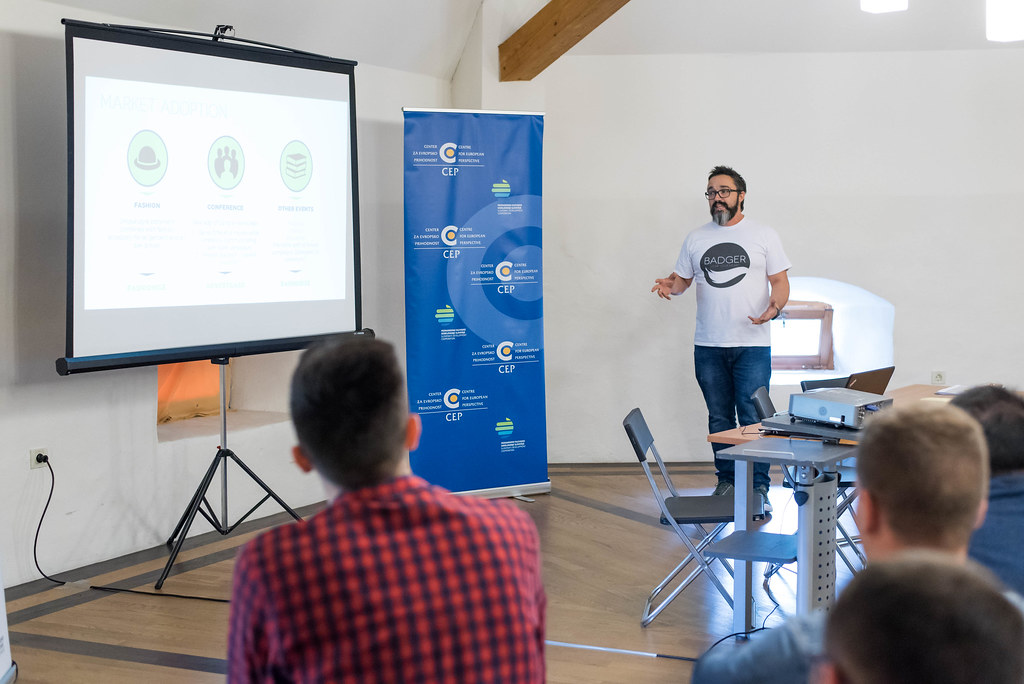
Five start-ups – Solar Data Collector, Jamatu, blablaDev, Happy Feet and The Badger – pitched in front of a jury consisting of Dr Aleš Pustovrh, Dr Gorazd Justinek, Jose Antonio Morales, Lincoln Island Initiatives and Dr Jernej Pintar.
Mr Peter Grk and Ms Alenka Košir from the Ministry of Foreign Affairs presented the Positive Agenda for Youth and led a discussion with the participants on the topic of economic development of the Balkans, employment prospects, entrepreneurial policies, youth initiatives and the challenges of start-upers in the Western Balkans.
On 15 and 16 May 2018 the group of young and promising entrepreneurs moved to Maribor, Slovenia to participate in the biggest networking event for start-ups in the Alps-Adriatic Region, to take part in the PODIM Challenge pitching competition and to meet PODIM investors and blue-chip partners.
The programme in Maribor involved a number of intriguing lectures, panels and round-table discussions on business, business development, investments, artificial intelligence, virtual reality, block chain technology and ICOs and other topics that are of high interest to the young entrepreneurs. As part of the programme, PODIM Challenge TOP 20 took place in which the best 20 start-ups attending the conference pitched their ideas in front of an expert jury. Meerkiddo (BiH), Integromat (Czechia), Agremo (Serbia), Aeriu (Hungary) and Flawless App (Ukraine) were selected among our participants.
Centre for European Perspective also actively participated in one of the discussions, focusing on Europe’s tech Ecosystem. Dr Gorazd Justinek, CEP’s Executive Director presented our Start:up Balkan initiative and discussed business development with Mr Fabio Pianesi, EIT Digital, Mr Jure Mikuž, South Central Ventures, Dr Aleš Pustovrh, ABC Accelerator, Mr Matej Rus, Start:up Slovenia, Minister Boris Koprivnikar, Ministry of Public Administration, and Mr Jakob Gajšek, ABC Accelerator.
With the final ceremony in Maribor, Centre for European Perspective also concluded the Start:up Balkan tour and selected the winning start-up that will get a chance to travel to London for a business-boosting visit in a global start-up hub. The winner is Meerkiddo from Bosnia and Herzegovina, that created a parental control app that helps parents supervise their children using a mobile phone.
Project is part of CEP’s program activities financed by the Ministry of Foreign Affairs of the Republic of Slovenia in the framework of Slovenia’s Development Cooperation.



 Project is part of CEP’s program activities financed by the Ministry of Foreign Affairs of the Republic of Slovenia in the framework of Slovenia’s Development Cooperation.