13. 10. 2017 | European Digital Diplomacy Exchange, PR
Centre for European Perspective is joining forces with the Ministry of Foreign Affairs of the Republic of Slovenia and the United States Embassy in Slovenia in order to implement a new development project »Enhancing Digital Diplomacy Activities in the Western Balkan and Eastern European Countries” that will address public relations services of the ministries of foreign affairs from Albania, Bosnia and Herzegovina, Georgia, Kosovo, Macedonia, Moldova, Montenegro, Serbia and Ukraine.
The project encompasses a digital diplomacy training course, advanced public relations training and further activities of the alumni network, supported by high-quality supporting materials. Bringing together digital engagement experts from the Department of State, academic or private sector as well as experts of the Ministry of Foreign Affairs of Slovenia, the programme will strengthen the capacities of the selected countries to plan, coordinate and prepare digital campaigns through various digital communication tools.
On digital diplomacy
Just like about five centuries ago printing press brought a vast rise in literacy, today’s digital information technologies are changing the way of collecting and transmitting data. We live in a time where hasty revolutionary innovations, rapid technological changes, ubiquitous connectivity, the availability to process the large amounts of data, algorithmic management and digital literacy, are becoming an inevitable reality.
Global mass communications and advances in new information and telecommunication technologies are presenting a new challenge to the traditional way of conducting international relations. Increased availability, accessibility and speed of the transmission of large quantities of information to the global audience in real time is causing more and more complex management of state affairs. The environment of diplomacy is importantly changing. As digital diplomacy information technologies influence the interconnection of international actors, they enable the possibility of bypassing traditional authorities in accessing the information and consequently impact the speed of decision-making processes. While the mode of conducting diplomacy is changing, it is forced to communicate with many new actors in the international stage through new means of communication. Confronted with a time pressure it still has to remain credible, responsive and transparent.
New challenges for the traditional institutions
Unlike traditional diplomacy, digital diplomacy allows anyone, everyone, anywhere, anytime to have a voice. Individuals are no longer just passive receivers of information, but can correspond directly and horizontally. They actively respond, comment, influence, and form public opinion. Since one-way communication no longer exists, their support is crucial in gaining support for the successful shaping and implementation of policies. In order to achieve the credibility of the implemented policies, the broadest segments of the population must be involved in the decision-making process.
Read the news in Slovene language here.


12. 10. 2017 | IECEU, PR
CEP representative Ivana Boštjančič Pulko joined Belgrade Security Forum, titled “Building a Common Future in the Age of Uncertainty”, held in Belgrade between October 11th and 13th, where more than 100 speakers have joined in various sessions, plenary panels, round tables and break out events to discuss how can we build a common future in an age characterized by uncertainty?
Ms Boštjančič Pulko participated as a speaker on a panel “The EU as a crisis management actor: CSDP in neighbourhood” that analyzed the EU missions in Kosovo, Bosnia and Herzegovina, Somalia, and the Occupied Palestinian Territories, in order to discuss the issues of local ownership in peacekeeping missions, planning capacity of CSDP missions, missing elements in the EU missions, as well as how the EU missions might aid and abet authoritarianism.
Ms Boštjančič Pulko focused her presentation on Evaluating Planning Capacity of CSDP Missions: the Case of EULEX Kosovo and EUFOR Althea, where she presented a catalogue of lessons learnt and identified best practices in CSDP planning process. The findings are based on interviews conducted in Kosovo and Bosnia and Herzegovina in 2016 in the framework of a H2020 project ‘Improving the Effectiveness of Capabilities in EU Conflict Prevention – IECEU’. The findings list that both missions suffer because CSDP is low on political agendas of EU member states, there are too many partial interests within EU member states hampering effective planning, decision making in CSDP is generally too long, ‘Brussels’ lacks proper situational awareness on the ground, clearly set goals and exit strategy are missing and the EU does not have an overall preferred strategy for both countries. There are at least four phases led by four different bodies in the case of EULEX planning process but there is a well elaborated analysis and lessons learned process, only the implementation of the findings on the operational level is rather weak. The planning capacity of EUFOR Althea profited greatly from the access to NATO planning assets, structures, and capabilities under Berlin Plus, along with infrastructure on the ground, provided by SFOR. In principle, a clear military command structure, a solid reporting system, and the availability of NATO assets provide a very good basis for real-time situational awareness.
Ms Boštjančič Pulko explained the reasons behind choosing to compare two missions in the Balkans.

“Personally I wanted to research EU’s engagement in the Balkans, also because it is part of a comprehensive approach with by the EU towards the region. As an initial thought you might think that a military and civilian mission are completely, or at least largely, incomparable but through research we actually came up with quite a lot of similarities, even though there are specific characteristics, belonging to each of them. Also, both missions were planned at a time where Balkan’s future mattered a lot to the EU, EU was somehow at its peak related to CSDP when planning the mission, very ambitious, very optimistic, both Balkans missions were somehow a testing ground for the EU, because of its proximity and what can they achieve through CSDP. With the latest EU missions, becoming smaller in size and relevance, it’s challenging to compare the two of the long lasting and most ambitions CSDP missions to date, also with an executive mandate. When comparing the CSDP model to the NATO and UN models, it is immediately clear that there is a much more extensive political approval process in CSDP.”

9. 10. 2017 | PR
Ivana Boštjančič Pulko, Centre for European Perspective – CEP; Johanna Suhonen and Kari Sainio, Finnish Defence Forces International Centre, have published an article in Contemporary Military Challenges, an interdisciplinary scientific and technical publication published by Slovenian Armed Forces.
Article, “Assessing the planning and implemention of EU mission and operation: Case Study of EUFOR Althea in Bosnia and Herzegovina” focuses on Planning capacity, assessed from the perspective of EUFOR Althea’s initial mandate, namely the operational planning and capacity-building and training of the Armed Forces of Bosnia and Herzegovina and support to the BiH authorities in maintaining a safe and secure environment. Additionally, EUFOR Althea’s engagement in Security Sector Reform and defence reform is covered. Research on EUFOR Althea’s planning capacity strived to encompass strategic and operational planning and its implications for the management and implementation of the operation, the lessons learned and the operation’s situational awareness.
You can access the publication here.

9. 10. 2017 | Montenegro - finance, PR, Slovenian Development Assistance
In the framework of the project “Assistance to Montenegro in negotiations on accession to the EU-2016” CEP provides technical assistance to the Central bank of Montenegro. Two-day advisory workshop (17–18 October 2017) will be carried out in Podgorica by Slovenian experts of the Bank of Slovenia.
The workshop will focus on the banking supervision and regulation, in particular on the methodology for banking supervision and the instructions for the supervision bodies.
The project is part of the CEP program activities financed by the Ministry of Foreign Affairs in the scope of international development cooperation.
Read the news about it in Slovene language here.

4. 10. 2017 | PR
The eighth Slovenian Development Days, organised by the igrationinistry of Foreign Affairs started today in Ljubljana. Two-day event was opened with a series of discussions on future implementation of development cooperation and humanitarian assistance at the Faculty of Social Sciences, University of Ljubljana.
This years’ Development Days were opened by Prof Dr Monika Kalin Golob, Dean of the Faculty of Social Sciences, Karl Erjavec, Minister of Foreign Affairs of the Republic of Slovenia, and Sabina R. Stadler, Director General for Multilateral Affairs, Development Cooperation and International Law at the Ministry of Foreign Affairs of the Republic of Slovenia. Representatives from the Ministry stressed the importance of the new Resolution on International Development Cooperation and Humanitarian Aid of the Republic of Slovenia, which will serve as a basis for future strategies and laws leading to enhanced and more focus development and humanitarian aid projects.
Representatives of the Centre for European Perspective participated at the presentation of the new strategic and legal frameworks for international development cooperation and humanitarian assistance delivered by Andrej Logar, State Secretary at the Ministry of Foreign Affairs of the Republic of Slovenia, and the presentation of the OECD DAC Peer Review conclusions on Slovenian development cooperation and humanitarian assistance by Charlotte Petri Gornitzka, Chair of the Development Assistance Committee at OECD. Petri Gornitzka congratulated Slovenia on successful cooperation with OECD through the Peer Review process. She stressed the importance of peer reviews for the future cooperation and direction of development aid, while the recommendations are to be used as a baseline for Slovenia’s future strategies on the topic. Petri Gornitzka presented 17 conclusions and recommendations resulting from the Peer Review. On one side she presented topics where Slovenia has showed progress, namely in reforming the institutional system, building development expertise, broadening stakeholders ownership, active advocacy, commitment to gender equality, as well as using comparative advantages. On the other side, Slovenia still has work to do in the field of defining strategic directions of approaching poverty reduction in the middle income countries, as well as working on thematic and geographical focus of its development aid; in reviewing business model to enhance impact of bilateral programme; Slovenia should consider the helpfulness of multilateral organisations in achieving strategic aims; make Framework Programme a comprehensive, whole-of-government tool; mainstreaming gender and environment across development co-operation; defining the nature of strategic partnerships with NGOs and private sector; improving transparency about international development; encouraging stakeholders to integrate evaluation and building knowledge and experience in fragile contexts.
Since the first Peer Review of the OECD Development Assistance Committee (DAC) was carried out in Slovenia at the beginning of 2017 with the aim of reviewing the implementation of the development cooperation and humanitarian assistance commitments this year’s Slovenian Development Days hosted a panel discussion, moderated by Dr Boštjan Udovič of Faculty of Social Sciences. The panellists Andrej Logar, Charlotte Petri Gornitzka, Marjeta Jager, DEVCO Deputy Director General at the European Commission, Lotta Karlsson, Director for Administrative and Legal Development Cooperation Matters, Ministry for Foreign Affairs of Finland, and Albin Keuc, Director of SLOGA Platform, addressed the opportunities and challenges of development cooperation, deriving from the recommendations of the Peer Review that provide orientations for future work, and indicates the priorities and challenges of Slovenia’s development cooperation and humanitarian assistance. Special emphasis was given on the importance of cooperation between all stakeholders, development agencies, ministries, NGOs and companies.
A project titled “Global for local – local for global” was presented, where students of Faculty of Social Sciences and Faculty of Education, under the leadership of two mentors, prof. dr. Maja Bučar and Ms Adriana Aralica, SLOGA, were enhancing young people’s awareness about sustainable development through the prism of migration and disseminating sustainable development goals together with the Agenda for sustainable development 2030. A multidisciplinary group of students prepared 10 sets of contents on the objectives of sustainable development through the prism of migration and verified them with the implementation of workshops in Ljubljana. Prepared contents are intended for teaching staff to support them in addressing sustainable development and the migration in the classroom.
A special workshop, moderated by Dr Melita Gabrič, Acting Head of the Department for Development Cooperation and Humanitarian Assistance, was carried out on the topic of DAC Peer Review recommendations and their implementation, focusing on interministerial cooperation, improvements of the Policy Coherence for Development (PCD) and mainstreaming of the cross-cutting issues (gender equality and environment).
An insight of children and youngsters was contributed through the opening of the exhibition “Europe at School”. The exhibition presents the awarded works created for the competition ‘The World I Want to Live In’ by children and young people from elementary and secondary schools who participated in four categories: art, writing, photo and video.
The second day of the event will focus on the role of the Slovenian private sector in development cooperation, integration of Slovenian companies and investments.

3. 10. 2017 | PR
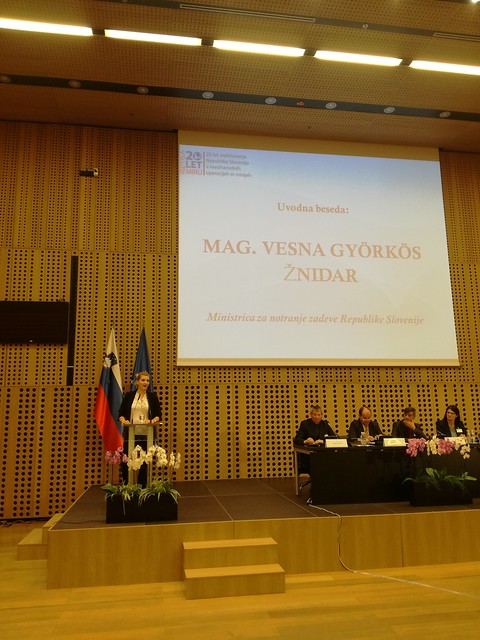
Among a series of events marking the 20th anniversary of Slovenia’s participation in international operations and missions (IOM) Centre for European Perspectives today participates at the inter-ministerial conference entitled 20 Years in the Service of Peace at the Brdo Congress Centre. CEP’s project manager Ivana Boštjančič Pulko addressed the panel entitled “Slovenian Police and 20 Years of Commitment to International Security”.
The two-day inter-ministerial conference organised by the Ministry of Defence, Ministry of the Interior and Ministry of Foreign Affairs started on 2 of October 2017. Today’s first panel entitled “Slovenian Police and 20 Years of Commitment to International Security” was opened by Vesna Györkös Žnidar, Minister of the Interior of the Republic of Slovenia, and continued with a discussion moderated by Mr Vladimir Pocek, Head of International Police Operations Division, Service of the Director General of the Police.
Ivana Boštjančič Pulko contributed an insight into the importance of civilian contribution to peacekeeping and conflict prevention. She emphasized that it is necessary that civilians deployed to the missions are equipped with the necessary skills and knowledge before their deployment and that training should be specifically emphasized in terms of improving the effectiveness of the missions. She explicitly thanked the Slovenian Police and the Armed Forces for offering extensive support in CEP training activities, preparing the international civilians to be deployed to the civilian peacekeeping missions.
CEP has been offering various types of certified trainings in the last decade and this field is gaining its importance especially through recognising the concept of ‘duty of care’ by the seconding authorities. She furthermore underlined that various countries follow different approaches related to secondments of civilians, for example Germany seconds approximately one civilian per seven military personnel, or Finland one to five, whereas this ratio in Slovenia stands for over 20 military secondments per one civilian, those being primarily police officers in EU missions.
CEP has been also researching the effectiveness of EU missions and operations in the last years, partnering with various think tanks and universities though various projects and plans to further strengthen its analytical part related to peacekeeping and conflict prevention.
The panel was addressed by panellists Anton Pozvek, Secretary General of Sever Association, Boris Kankaraš, Head of Port Security Department at Port of Koper, Ernest Salkič, President of the Association of Peacekeepers in Peacekeeping Missions, Edo Behlič, Senior Police Inspector at the Police Directorate Ljubljana, Robert Urek, Senior Police Inspector at the International Police Operations Division and Assist. Prof. Maja Garb from Faculty of Social Sciences as well. They focused on police perspective of peacekeeping and discussed the history of Slovenian contribution to civilian missions as well as development of the national civilian peacekeeping platform and its challenges.
This year Slovenia marks 20th anniversary of its first deployment to an international peacekeeping mission. That first secondment was to the Operation ALBA in Albania in 1997, under the auspices of the Organisation for Security and Cooperation in Europe (OSCE) – the first international organisation Slovenia joined as an independent state 25 years ago.
Republic of Slovenia has in the past 20 years continuously upgraded and enhanced its participation in the efforts for international peace and security with military and civilian capabilities, and has established itself as a reliable member of the international community committed to solidarity and international peace and ready to take on an active role in joint efforts to support security and stability in different crisis areas. The Republic of Slovenia has so far deployed over 5,300 members of the Slovenian Armed Forces and civilian functional experts to a total of 25 international operations and missions under the auspices of the United Nations, the European Union, NATO and other international organisations, or within bilateral relations or coalitions. As part of international stabilisation efforts, 174 members of the Police have also participated in 16 international civilian missions, and three representatives of the Ministry of Foreign Affairs have taken part in three international missions. It should be noted that a considerable proportion of these participants were deployed several times, which is why the total number of deployments to international operations and missions exceeds 13,500. About 345 members of the Slovenian Armed Forces and civilian functional experts, 12 police officers and a representative of the Ministry of Foreign Affairs are currently active under the auspices of NATO, the EU and the UN, and within other frameworks.

Access for more information about the event here: https://www.20letmom.si/en/
Check out our Photo Gallery here: