Conclusion of the Mentorship Visit of Zarichne Municipality to Slovenska Bistrica

Conclusion of the Mentorship Visit of Zarichne Municipality to Slovenska Bistrica

Over the past two weeks, Slovenska Bistrica hosted representatives of Zarichne Municipality as part of a mentorship visit within the Recovery and Reconstruction in Ukraine programme. The visit was organised by the Centre for European Perspective under the auspices of Bridges of Trust.

The mentorship programme enabled the Ukrainian delegation to gain first-hand insight into best practices of Slovenian local governance, public services, and local economic development. The focus was on practical solutions and transferable approaches that can support the preparation and implementation of development projects in Zarichne Municipality.

During their stay, the delegation visited several institutions and companies in Slovenska Bistrica:

  • Komunala Slovenska Bistrica – presentations on digitalisation of public services, sustainable utility management, and innovative approaches to citizen engagement;

  • Impol d.o.o. – an overview of modern aluminium production, advanced manufacturing processes, and the role of industry in local economic resilience;

  • Slovenska Bistrica Agricultural Cooperative – insights into cooperative organisation, support mechanisms for local farmers, and strengthening local food systems;

  • Dom dr. Jožeta Potrča Poljčane – examples of good practices in social care, senior inclusion, and community-based services.

These visits were complemented by in-depth discussions with practitioners, allowing participants to reflect on how similar models could be adapted to the Ukrainian local context.

In addition to field visits, the programme included targeted workshops on project planning, funding opportunities, and implementation strategies. Through guided sessions, participants developed concrete ideas for future cooperation between Slovenska Bistrica and Zarichne, with an emphasis on sustainable local development and post-war recovery needs.

The mentorship visit concluded with the formal signing of a cooperation agreement by the mayors Bohdan Kvachuk (Zarichne) and Dr Ivan Žagar (Slovenska Bistrica). The agreement confirms a shared commitment to continued knowledge exchange, joint initiatives, and long-term municipal partnership, marking an important step toward stronger international cooperation at the local level.

The activities were supported by the Ministry of Foreign and European Affairs of Slovenia within the framework of Slovenian Aid, and implemented in cooperation with U-LEAD with Europe.

IMG-20251129-WA0016

First set of workshops in Montenegro successfully concluded

First set of workshops in Montenegro successfully concluded

Our programme in Montenegro has come to a close after intensive workshops with police units and prosecutors across the country. Sessions were held in Bijelo Polje, followed by workshops in Podgorica for the central and southern regions.

Yesterday, we also held a focused session with the working group preparing the Standard Operating Procedures (SOP) for the Montenegrin police, an important step toward strengthening institutional processes.

Participants explored key elements of effective financial investigations, including:
🔹 the Slovenian legislative framework (ZOPNI) and prosecutorial leadership
🔹 early identification of financial elements in police work
🔹 practical case-based insights and police–prosecution cooperation
🔹 challenges in practice and priorities for 2026

The activities were carried out within the project “Strengthening capacities in the field of financial investigations in Montenegro (2025/2026)”, implemented with the support of the Slovenian Ministry of Foreign and European Affairs, in cooperation with the Slovenian Police and the Slovenian Ministry of Interior.

IMG-20251127-WA0037

INVITATION: Security Radar 2025 Europe: Lost in Geopolitics? Numbers that shape politics and public perceptions

INVITATION: Security Radar 2025 Europe: Lost in Geopolitics? Numbers that shape politics and public perceptions

Join us on Tuesday, December 2, 2025, for an event co-organised by CEP in cooperation with Friedrich Ebert Stiftung, the Euro-Atlantic Council of Slovenia, and the Faculty of Social Sciences, University of Ljubljana. The programme will begin with a presentation of FES’s Security Radar, followed by a discussion exploring security policy and public perceptions of security in Slovenia.

How have security perceptions changed in countries in- and outside of NATO since the Russian invasion of Ukraine in 2022? This is the core question of the “Security Radar”, a multi-annual research project, which is regularly presented at the Munich Security conference. The aim of the Security Radar is to provide a realistic picture of public perception regarding current geopolitical challenges and security threats. It also surveys what political responses people in Europe and beyond consider necessary in relation to the war and other urgent issues in the realm of European security.

In scope of our discussion round, we want to explore how the changing trends in security perception are reflected in Slovenia: Has the public mood changed towards more readiness to defend NATO territory, or are Slovenians still more relucted that other citizens of NATO member states for example looking at increased defence spending? We will discuss Slovenia’s (perhaps) special position in the newly emerging NATO defence architecture with high-ranking experts form the field of foreign and security policy – and together with you!

AGENDA

5:00 PM – 5:15 PM Opening Remarks

  • Sonja Schirmbeck, Director of the FES for Croatia and Slovenia
  • Iztok Prezelj, Head of Defense Research Centre at the Faculty of Social Sciences UL and President of the Euro-Atlantic Council of Slovenia

5:15 PM – 5:45 PM Presentation of the Security radar 2025 

  • Christos Katsioulis, Director of the FES Regional Office for International Cooperation and Peace

5:45 PM – 6:30 PM Discussion with: 

  • Neva Grašič, State Secretary at Ministry of Foreign and European Affairs
  • H.E. Sylvia Groneick, Ambassador of Germany to Slovenia
  • Jelena Juvan, Head of Chair of Defense Studies Faculty of Social Sciences UL and Vice-president of the Euro-Atlantic Council of Slovenia
  • Moderator: Magdalena Rakovec, Centre for European Perspective

VENUE

Faculty of Social Sciences, Kardeljeva ploščad 5, Lecture hall 3

EUTI Participates in ESDC’s Annual Training and Education Conference

EUTI Participates in ESDC’s Annual Training and Education Conference

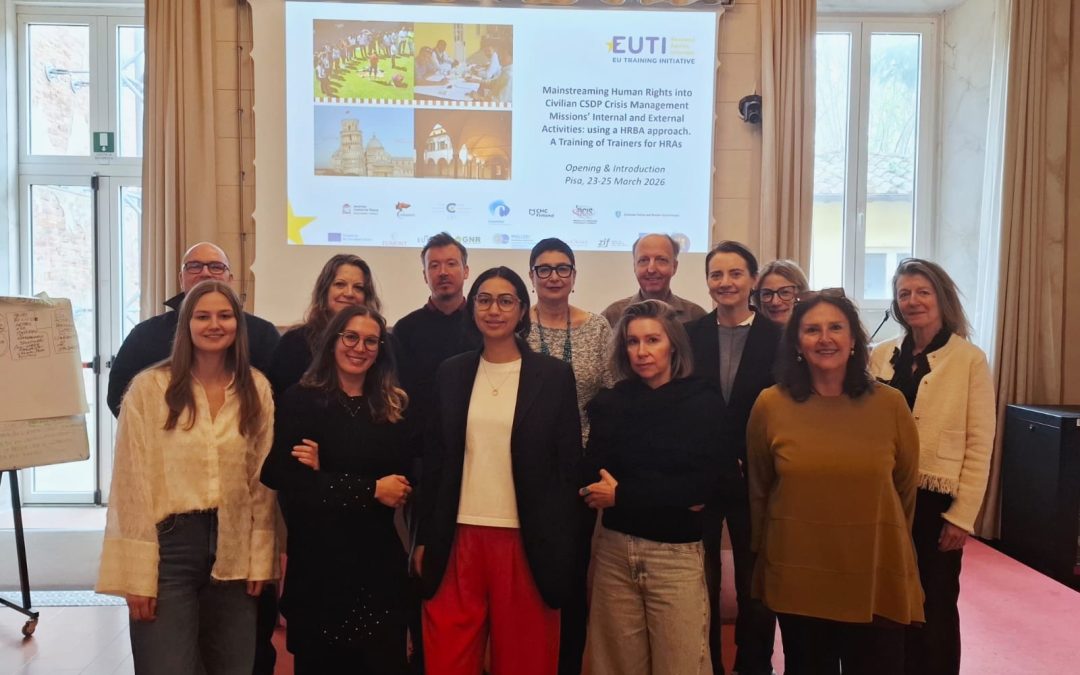
The Centre for European Perspective and the European Union Training Initiative took part in the European Security and Defence College’s Annual Training and Education Conference, held over two days at the historic Egmont Palace in Brussels.

This year’s conference focused on practical and innovative ways to enhance the effectiveness of the training cycle within the EU’s Common Security and Defence Policy. Participants worked through each key stage of the EU training loop — Training Needs, Standardisation & Adaptation, Innovation & Methodology, and Evaluation & Uptake — through a series of appetiser discussions and targeted breakout groups.

Representatives of the Centre for European Perspective and the European Union Training Initiative contributed to the appetiser discussion on Standardisation & Adaptation and led one of the breakout groups within this segment. Their session explored the crucial balance between standardised curricula and the necessary flexibility or adjustability of training formats. The discussion highlighted the importance of aligning training with real operational contexts while maintaining coherence across the broader EU framework.

Beyond the working sessions, the conference served as an excellent platform to exchange best practices, discuss emerging needs, and strengthen cooperation with partners from across Europe. The atmosphere encouraged open dialogue and the sharing of forward-looking ideas that will contribute to further improving training standards at the EU level.

The Centre for European Perspective and the European Union Training Initiative extend their appreciation to the European Security and Defence College for organising a well-structured and engaging conference, and for fostering a community dedicated to enhancing the quality and impact of EU training.

VABILO: Slovenija v svetu prelomnic: od inovacij do varnosti

VABILO: Slovenija v svetu prelomnic: od inovacij do varnosti

Kaj pomeni varnost v času naraščajočih globalnih pritiskov in hitrih tehnoloških sprememb, ko gospodarstvo ostaja ključni steber stabilnosti?

Kako lahko Slovenija krepi odpornost ob kibernetskih grožnjah, političnih napetostih, energetski odvisnosti in hitro spreminjajoči se industriji?

Kaj je potrebno, da se sodelovanje med državo, gospodarstvom, raziskovalci in lokalnimi skupnostmi razvije v učinkovit sistem skupne varnosti?

Vabimo vas na okroglo mizo o tem, kako lahko Slovenija razvije gospodarstvo, ki poleg konkurenčnosti krepi tudi nacionalno odpornost. Dotaknili se bomo vloge inovacij, strateških industrij in lokalnih okolij pri soustvarjanju varnosti ter pomena sodelovanja med institucijami, podjetji in skupnostmi. Razprava bo ponudila vpogled v vlogo gospodarstva pri krepitvi stabilnosti, raziskovalnega okolja kot vira novih rešitev ter lokalnih skupnosti kot prvega odzivnega stebra v krizah.

📅 Torek, 2. december 2025

🕒 09.00

📍 Katapult, Gabrsko 12, Trbovlje

Teme razprave bodo med drugim:

  • Kako lahko Slovenija poveže nacionalne strateške cilje z odpornostjo lokalnih okolij in skupnosti?
  • Na katerih področjih lahko sodelovanje med gospodarstvom, državo in družbo okrepi varnost ter obrambno pripravljenost države?
  • Kako lahko nove socialne strukture in oblike skupnostnega delovanja prispevajo k večji družbeni odpornosti in zaupanju?
  • Kako lahko Slovenija v okviru Evropske unije in drugih zavezništev ohranja ravnotežje med sodelovanjem in strateško samostojnostjo?

Okroglo mizo organizirata Center za evropsko prihodnost in podjetje Dewesoft.

V razpravi bodo sodelovali:

  • Matjaž Han, minister za gospodarstvo, turizem in šport RS
  • Boštjan Pavlin, državni sekretar na ministrstvu za obrambo RS
  • Jure Knez, soustanovitelj in predsednik Dewesoft

Moderatorka: Sonja Šmuc, namestnica predsednika za strateške projekte pri Dewesoft

Okrogla miza bo potekala v slovenskem jeziku.

Po končani razpravi sledi pogostitev in prijetno druženje.

Vstop je prost do zapolnitve mest. Lepo prosimo za potrditev udeležbe preko povezave.


EDDE training in Montenegro strengthens strategic communication for citizen engagement

EDDE training in Montenegro strengthens strategic communication for citizen engagement

EDDE training in Montenegro strengthens strategic communication for citizen engagement

European Digital Diplomacy Exchange (EDDE)   

(18. – 21. November 2025, Bar, Montenegro)   

From 18 to 21 November 2025, the European Digital Diplomacy Exchange (EDDE) project hosted a four-day training titled “Empowering Citizens Through Strategic Communication” in Bar, Montenegro. The event brought together government communicators and strategic communication experts to explore how digital technologies are reshaping democracy, trust and citizen participation. The training was organised in cooperation between the Ministry of Foreign and European Affairs of Slovenia and the Centre for European Perspective (CEP) as part of Slovenia’s Development Cooperation and Humanitarian Aid programme.

Over four days, participants took part in an intensive programme combining lectures, debates, practical exercises and peer exchanges. Through case-based exercises such as developing a “national selfie,” designing visuals to complement key messages, and simulating responses to a disinformation crisis participants translated theory into practice and strengthened their skills for day-to-day communication work.

The first full working day introduced participants to the foundations of digital public affairs and public diplomacy, focusing on how institutions can use digital channels to strengthen dialogue with citizens. The programme then moved into an icebreaker designed to build group cohesion, followed by a lecture on placing citizens at the center of democratic engagement. The afternoon featured a structured debate on trust-building in communications, grounded in academic pre-readings, and concluded with an interactive dialogue with Meta on the relationship between platforms, public audiences and public policy in the modern information environment.

The second day explored national identity and reputational strategy through the concept of the “national selfie.” Participants began with a recap and a brief energizer before diving into a lecture on brand affinity and national self-presentation. They then worked in country groups to develop their own “national selfies,” followed by a plenary discussion linking the exercise to evolving ideas around reputational security. In the afternoon, attention shifted to narrative strategy, with a lecture on policy storytelling and an applied exercise where participants practiced framing complex or unpopular policies in clear, persuasive ways.The highlight of the day was undoubtedly the session “Evening Country Spotlights: Sharing Communication Practices,” where participants presented their strategic communication best practices and national experiences, complemented by a cultural touch as they brought traditional foods from their home countries.

The third day focused on digital expression and multimedia strategy. After the morning recap, participants examined digital rhetoric and the persuasive power of language in online communication. This was followed by a practical session on how multimedia elements enhance strategic messaging, culminating in an exercise where participants designed visuals tailored to specific messages. The afternoon turned to the role of artificial intelligence in government communications, opening a discussion on both its opportunities and its potential challenges for public administration institutions communication practices. A structured debate followed, where participants reflected on recent research and explored how evolving AI capabilities may shape public communication environments and the ways institutions engage with citizens.

The final day concentrated on disinformation resilience. Participants examined contemporary techniques used by harmful actors in adversarial information operations and discussed communication strategies for countering them. They then worked through a crisis simulation exercise requiring real-time responses to a disinformation scenario, testing both their analytical and messaging skills. The training concluded with a plenary on lessons learned, an evaluation session and the closing ceremony, marking the end of an intensive and highly collaborative four-day programme.

The EDDE training in Bar underscored that empowering citizens lies at the heart of democratic resilience, as meaningful dialogue between institutions and the public enables stronger communication, greater trust and the co-creation of more sustainable, people-centred policies. By fostering international cooperation and peer learning, the programme equips government communicators with the tools, analytical frameworks and networks necessary to better support this citizen engagement. Strengthening institutional communication capacities is therefore not an end in itself, but a means to ensure that democratic institutions become more transparent, inclusive and responsive, while enhancing their ability to effectively counter Foreign Information Manipulation and Interference (FIMI).

The implemented activities are supported and funded by the Ministry of Foreign and European Affairs of Slovenia in the scope of the Development Cooperation and Humanitarian Aid programme and implemented by the Centre for European Perspective.

Usposabljanje EDDE v Črni Gori krepi strateško komuniciranje za večje vključevanje državljanov

Evropska izmenjava aktivnosti digitalne diplomacije  

(17. – 21. November 2025, Bar, Montenegro)  

Med 18. in 21. novembrom 2025 je v mestu Bar v Črni Gori potekalo štiridnevno usposabljanje v okviru projekta Evropska izmenjava aktivnosti digitalne diplomacije-European Digital Diplomacy Exchange (EDDE) z naslovom »Opolnomočenje državljanov skozi strateško komuniciranje«. Dogodek je združil vladne komunikatorje in strokovnjake za strateško komuniciranje, ki so raziskovali, kako digitalne tehnologije preoblikujejo demokracijo, zaupanje ter sodelovanje državljanov. Usposabljanje je bilo organizirano v sodelovanju Ministrstva za zunanje in evropske zadeve Republike Slovenije ter Centrom za evropsko prihodnost (CEP) v okviru programa mednarodnega razvojnega sodelovanja in humanitarne pomoči.

V štirih dneh so udeleženci sodelovali v intenzivnem programu, ki je združeval predavanja, razprave, praktične vaje in izmenjavo izkušenj. Skozi praktično zasnovane naloge kot so priprava “nacionalnega selfija”, oblikovanje vizualnih sporočil ter simulacije odzivanja na krizne situacije, povezane z dezinformacijami so udeleženci teoretična znanja prenesli v prakso ter okrepili svoje kompetence za vsakodnevno delo na področju strateškega komuniciranja.

Prvi delovni dan je udeležencem predstavil temelje digitalnega javnega komuniciranja in javne diplomacije, s poudarkom na tem, kako lahko institucije z uporabo digitalnih medijev in družbenih omrežij izboljšajo dialog z državljani. Program se je nato nadaljeval z uvodno skupinsko dejavnostjo, namenjeno spoznavanju in gradnji sodelovanja, sledilo pa je predavanje o tem, kako državljane dejansko vključiti kot ključne sogovornike in partnerje v demokratičnih procesih. Popoldne je bilo namenjeno strukturirani razpravi o krepitvi zaupanja v javni komunikaciji, ki je izhajala iz vnaprej prebranih akademskih prispevkov, dan pa se je zaključil z interaktivnim pogovorom s predstavnikom družbe Meta o odnosu med platformami, javnostmi in oblikovanjem javnih politik v sodobnem informacijskem prostoru.

Drugi dan je bil posvečen raziskovanju nacionalne identitete in strategije ugleda skozi koncept »nacionalnega selfija«. Udeleženci so začeli s povzetkom prejšnjega dne in kratko uvodno aktivnostjo za lažji prehod v delovni ritem, nato pa prisluhnili predavanju o povezovanju javnosti z blagovno znamko države in nacionalni samoprezentaciji. V nadaljevanju so v skupinah po državah oblikovali svoje »nacionalne selfije« ter razpravljali o njihovih elementih v okviru plenarnega dela, ki je koncept povezal s sodobnim razumevanjem reputacijske varnosti. Popoldne se je osredotočilo na razvoj narativov, in sicer prek predavanja o pripovedovanju politik ter praktične vaje, v kateri so udeleženci vadili oblikovanje jasnih in prepričljivih razlag zahtevnih ali manj priljubljenih politik. Vrhunec dneva je bil nedvomno večerni dogodek »Country Spotlights«, na katerem so udeleženci predstavili svoje najboljše strateške komunikacijske prakse in nacionalne izkušnje, dogodek pa je dopolnila tudi kulturna nota s tradicionalnimi jedmi iz njihovih držav.

Tretji dan je bil namenjen digitalnemu izražanju in multimedijskim strategijam. Po jutranjem pregledu ključnih poudarkov so udeleženci preučevali digitalno retoriko in prepričevalno moč jezika v spletnem komuniciranju. Sledilo je praktično delo o tem, kako multimedijski elementi krepijo strateška sporočila, ki se je zaključilo z vajo oblikovanja grafik, prilagojenih posameznim sporočilom. Popoldanski del je bil posvečen vlogi umetne inteligence v vladnem komuniciranju, kjer so udeleženci razpravljali o priložnostih in izzivih, ki jih ta prinaša za delo v institucijah javne administracije. Dan se je zaključil s strukturirano razpravo o ugotovitvah nedavnih raziskav ter o tem, kako razvijajoče se zmožnosti umetne inteligence spreminjajo javno komunikacijsko okolje in načine, kako institucije stopajo v stik z državljani.

Zadnji dan se je osredotočil na odpornost proti dezinformacijam. Udeleženci so preučevali sodobne tehnike, ki so s strani zlonamernih akterjev uporabljane za širjenje zavajajočih in škodljivih vsebin, ter razpravljali o komunikacijskih pristopih za njihovo učinkovito obvladovanje. Nato so izvedli simulacijo kriznega odzivanja, v kateri so morali v realnem času pripraviti odzive na dezinformacijski scenarij ter pri tem preizkusiti svoje analitične in komunikacijske veščine. Program se je zaključil s plenarno razpravo o ključnih naukih, časom namenjenem evalvaciji ter zaključno slovesnostjo, ki je zaokrožila intenziven in zelo sodelovalen štiridnevni program.

Usposabljanje EDDE v Baru je poudarilo, da je opolnomočenje državljanov temelj demokratične odpornosti, saj konstruktiven dialog med institucijami in javnostjo omogoča močnejše komuniciranje, večje zaupanje ter sooblikovanje bolj trajnostnih politik, ki postavljajo v središče državljana. S spodbujanjem mednarodnega sodelovanja in učenja med vrstniki program, vladnim komunikatorjim, zagotavlja orodja, analitične okvire in mrežo strokovnjakov, ki so potrebni za učinkovitejšo podporo vključevanju državljanov. Krepitev institucionalnih komunikacijskih zmogljivosti zato ni cilj sama po sebi, temveč sredstvo za to, da postanejo demokratične institucije bolj transparentne, vključujoče in odzivne, hkrati pa bolje pripravljene na učinkovito naslavljanje manipulacij in tujih posegov v informacijski prostor (Foreign Information Manipulation and Interference -FIMI).

Izvedene aktivnosti so podprte in financirane s strani Ministrstva za zunanje in evropske zadeve Republike Slovenije v okviru programa mednarodnega razvojnega sodelovanja in humanitarne pomoči, izvaja pa jih Center za evropsko prihodnost.