Each EDDE event is something special and this one was not an exception, particularly because it was done in a hybrid version – virtually and on the spot at Jable castle – together with the Diplomatic Academy of Slovenian Ministry of Foreign Affairs. Despite having a positive nervousness before the start everything went well and the whole training turned out to be a success.
In two days, 50 Slovenian diplomats, ambassadors, and embassy officials had a chance to listen and to participate in a variety of lectures about Digital Diplomacy.
The training was launched by the introductory remarks by Ingrid Omahna, European Digital Diplomacy Exchange Project Coordinator from Centre for European Perspective (CEP), Lean B. Leedy, from the U.S. Embassy in Slovenia, Katja Geršak, CEP Executive Director, and Miriam Možgan, From the Diplomatic Academy of Slovenian Ministry of Foreign Affairs.
After the introductory remarks, we dived straight into the matter by a lecture about the Digital Future and Why You and Your Boss Should Care about it. When basics were covered, we continued with lectures about Developing Effective Messaging Campaigns, how to use Visual Essentials, and concluded the day with an overview of Twiplomacy at the Slovenian Ministry of Foreign Affairs.
The second day was kicked off with a Showcase of best practices for communicating during the COVID-19 emergency, by the representative of the Government office of Estonia. How to Counter Disinformation and Propaganda in the Digital Age lecture followed and focused on the examination of contemporary disinformation practices. The training was concluded by two lectures – how the media landscape changed in the last decade, tips and tricks on how Slovenia and small countries can present themselves, and how to use Influencers to break out of the habit of using social media as a monologue. The training ended with concluding remarks by Susan Falatko from the U.S. Embassy in Slovenia.
Training wouldn’t be possible without the support of the U.S. Department of State, U.S. Embassy in Ljubljana, Diplomatic Academy of Slovenian Ministry Of Foreign Affairs, Slovenian Ministry of Foreign Affairs, and Centre for European Perspective.
We are also very thankful to the amazing Kraftart team for the flawless execution of the technical aspect of the training.
We are back in action. This time we will organize training for the Diplomatic Academy of the Slovenian Ministry of Foreign Affairs. Due to the ongoing COVID-19 situation in Slovenia and abroad, we were forced to move the training to virtual space – the ZOOM platform. The training will take place on Tuesday, March 30, and Wednesday, March 31, 2021.
The fully packed two-day training will cover a variety of topics such as the digital media information landscape, visual essentials, messaging campaigns, crisis communication, countering disinformation and propaganda, influencer marketing, lessons learned from the last decade, etc.
The training will be organized by the Centre for European Perspective, together with the U.S. Department of State.
Peacekeeping operations have changed over time. Since the nature and mandate of operations have transformed, we can say that they have become more complex. A significant difference can also be seen in the type of participants, which have altered from international to national actors, and from military to civilian actors.
The NATO Summit in Washington in 1999, defined the concept of civil-military cooperation for the first time. This cooperation has also been one of the seven strategic goals of NATO’s long-term programs until 2025. The concept was developed by all countries and can be implemented by members of the military with civilian knowledge or with the participation of civilian experts without military knowledge.
In Slovenia, this concept is called “civilian functional experts” or CFS. CFS are specially trained professionals in a variety of fields that link the military and civilian environment. Their main task is to establish good relations with the local population, as well as with civilian, non-governmental, governmental, international, and other organizations in the field of peacekeeping missions. At the same time, they work in their field with the aim of stabilizing, restoring, or developing the civilian environment. CFS must have a good knowledge of both civilian and military thinking and action and are specially trained for this. Through their work, CFS make an important contribution to the overall military objective of the operation, which is to ensure a secure and stable environment while creating better conditions for the stabilization and reconstruction of society and the state.
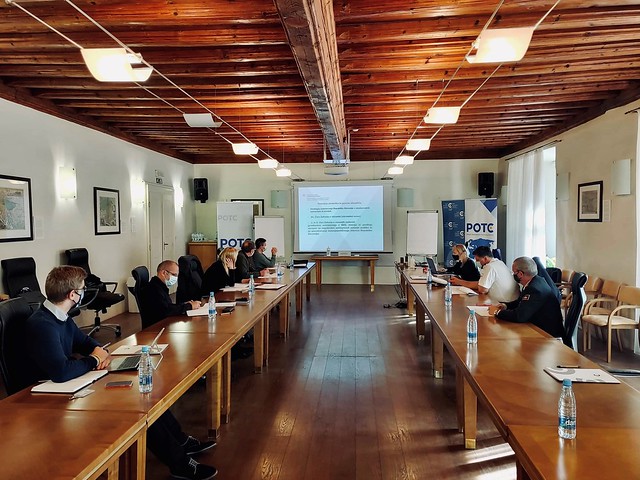
POTC, together with the Ministry of Defence, Ministry of Interior, Ministry of Foreign Affairs, Slovenian Police, Slovenian Armed Forces, Administration for Civil Protection and Disaster Relief, and Slovenian Red Cross is taking a comprehensive approach towards developing Community and People-Centered Approach training for CFS.
Today’s workshop was the first one in the series, to familiarize with the activities in the field of various stakeholders. It will set the basis for identifying the needs for civilian-military cooperation by involving all relevant stakeholders in the process.
[Webinar]: Radicalization and Violent Extremism Across Borders: An Ongoing Threat
The persistent threat of radicalization and violent extremism is highlighting the vulnerability of our societies today to the challenges of intolerance, hatred and fear. Radicalization is a reflection of societal polarization, as well as a reflection of deep and rapid changes of perceptions, values and behaviour, where violence is becoming an acceptable tool for solving conflicts.
The Euro-Atlantic Council of Slovenia, the Politics and Society Institute in Jordan and the Centre for European Perspective in Slovenia have joined together in order to open up a discussion on the threat of radicalization and violent extremism in Slovenia, Kosovo and Jordan and their wider regions.
The experts aimed to:
• Underline potential similarities, differences and connections between violent extremism in these countries and their respective regions;
• Address how to reduce the risk of individual indoctrination to violent extremism and radicalization; and
• Proposed ideas on how to deal with these challenges.
Missed our event? Watch it here:
SPEAKERS 🗣️:
◾ Dr Mohammad Abu Rumman, Politics and Society Institute, Associate Expert and Writer on Political Islam and Violent Extremism
◾ Dr Florian Qehaja, Kosovar Center for Security Studies, Chair of the Board
◾ Dr Iztok Prezelj, Euro-Atlantic Council of Slovenia, President & Faculty of Social Sciences, University of Ljubljana, Vice-Dean
🔹 Moderated by Katja Geršak, Centre for European Perspective, Executive Director
For more about the event, follow CEP on Facebook and Twitter, you are also invited to follow the Euro-Atlantic Council of Slovenia on Facebook and the Politics and Society Institute on Facebook and Twitter.
Learning Compass is a regional project aimed at improving the situation of elementary children with special needs through the education of primary school teachers in more remote places of four Western Balkan countries (Albania, Kosovo, Northern Macedonia, Bosnia and Hercegovina).
The project that was implemented in two years and took place in four countries was formed to reach the following goals:
Contribute to improving the situation of children with special needs in primary education;
Contribute to the development of the school systems of the countries involved;
Strengthen links and cooperation between teaching staff and educational institutions (involved in the project) of the Western Balkan countries and contributed to the peaceful coexistence in the region.
The project implemented all the envisaged activities and involved the members of the current Learning compass community in the following events:
Implemented 3 day training for experts from Albania and Kosovo (organised in September 2019 in Drač, Albania)
Implemented informative meeting for decision makers (ministries, responsible authorities, school directors, headmasters and other representatives) in Pristina, Kosovo
Implemented three day virtual training for Experts in North Macedonia (organised in September, 2020)
Implemented a three day virtual training for Experts in Bosnia and Herzegovina (organised in November, 2020)
The Learning Compass project successfully reach the initially set goals, and contributed to:
160 trained profesionals (teachers, special educators, other ecperts) in Albania, Kosovo, North Macedonia and Bosnia and Hercegovina in the field of education for childreen with special needs, achieved through the mutual exchange of best practices.
Additionally trained experts, as workshop participants passed the received knowledge and experience to more than 400 coworkers (in Albania, Kosovo, North Macedonia and Bosnia and Hercegovina) in a structured learning process training of trainers, implemented in their schools.
Establishment of a virtual platform in cooperation with the institution Arnes.si. The established platform enables the sharing of knowledge established within the project and further enlargemen of the Learning compass network.
The final activity within the project envisaged the preparation of a project booklet, that would at the same time offer an insight in the most pressing challenges educational systems for children with special needs are facing in the Western Balkans. The publication presents the learning compass project, covers the sharing of best practices on different topics related to education of childreen with special needs and offers the sharing of best practices discussed and developed within the Learning compass training. The publication is available on this web connection Booklet Learning compass
British Embassy Ljubljana, Centre for European Perspective – CEP and Bled Strategic Forum – BSF are pleased to invite you to the fourth event in the FUTURE PERFECT series titled:
How Western are the Western Balkans? The path to Euro-Atlantic integration
The future of the Western Balkans will shape the future of Europe. But during the pandemic, actors with competing values and principles have actively pursued their own agendas in the region. Have Europe and the West missed an opportunity to bring the Western Balkans closer?
Is there political will in Europe for effective strategic engagement with the region? And how can the region, with the rest of Europe, renew momentum for Euro-Atlantic integration – in the face of the influence and interests of other global players?
As the pandemic’s horizon comes into view, we invite you to join the latest episode in our “Future Perfect” series. The British Embassy Ljubljana and Centre for European Perspective will host a discussion with leading British, Slovene and regional experts to explore potential paths for the Western Balkans – and what this means for the future of Europe.
PANELLISTS:
Mr Matt Baugh, Director, Political & Security at the UK Mission to the EU in Brussels
Mr Peter Grk, National Coordinator for the Western Balkans, Ministry of Foreign Affairs of the Republic of Slovenia
Mr Zoran Nechev, Head of the Center for European Integration, Institute for Democracy/Senior Researcher, Member of BiEPAG
This will be the fourth event of the FUTURE PERFECT event series, organized by the British Embassy in Ljubljana, in cooperation with CEP and BSF. The FUTURE PERFECT series will gather experts to ask big questions about our post-COVID future. For more about the series, follow CEP on Facebook and Twitter or Bled Strategic Forum on Facebook, Twitter and Instagram or follow the hashtag #FuturePerfectSeries.


![[Webinar recording] Radicalization and Violent Extremism Across Borders: An Ongoing Threat](https://www.cep.si/wp-content/uploads/2021/02/Webinar-Radicalization-CEP-website-1080x608.png)


 The project is part of programme activities of Slovenia’s Development Cooperation Programme supported by the
