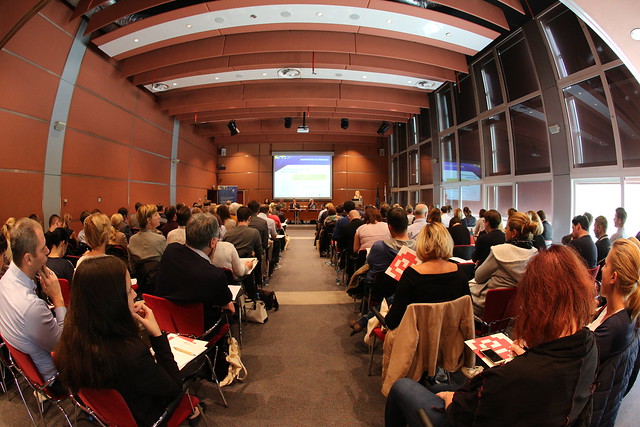
![ROSE Action conference offered new solutions for Slovenia and European Union in exchange of e-Invoices in public procurement]()
22. 9. 2017 | PR, ROSE
“Readiness Of Slovenian E-Invoicing” (ROSE), a Connecting European Facility Action, co-financed by the European Union and implemented by the Public Payments Administration of the Republic of Slovenia, Chamber of Commerce and Industry of Slovenia, ZZI d.o.o., Mojdenar IT d.o.o. and Centre for European Perspective, was today presented officially at the kick-off conference “Will we be ready for European standard for e-invoicing?” in Ljubljana, Slovenia.
The conference provided an in-depth insight into the upcoming requirement for European public service providers to be able to receive e-Invoice when sent to them in European standard. The purpose was to clarify what is Slovenia doing to prepare and be ready to implement the Directive 2014/55/EU on eInvoicing in public procurement and to present how will public service providers be supported, especially through the activities, trainings and solutions provided by “Readiness Of Slovenian E-invoicing” (ROSE). The new EU legislation in the field of digitalization, standardization and inter-operability in public services are crucial due to their positive effect on citizens, economic subjects and EU member states, among them high quality and low cost public services, new employments, sustainable development and more interconnected, stronger Europe.
Dušan Zupančič, director of the Association of Informatics and Telecommunications at the Chamber of Commerce and Industry of Slovenia, emphasized a long-term commitment of Slovenia to digitalization and simplification of e-commerce in his introductory remarks. The main message of mag. Aleksandra Miklavčič, director general of the Public Payments Administration of the Republic of Slovenia, was to point out that the success of introduction of e-commerce in Slovenia depends on cooperation between public sector, business sector and other stakeholders. In her presentation of e-commerce in state accounting, Milena Bremšak, director general at the Directorate for Public Accountancy at the Ministry of Finance, explained the development of e-commerce in state accounting and presented her views on future developments.
Tina Šinkovec of the Public Payments Administration of the Republic of Slovenia offered an insight into the duties and responsibilities according to the EU Directive on eInvoicing in public procurement, and pointed out that the directive binds the subjects listed in the Public Procurement Act. Andreja Dolničar Jeraj, programme director at Centre for European Perspective and ROSE Action coordinator, presented the activities under the ROSE Action so far and called upon the participants of the conference to get prepared to receive e-Invoices sent in European standard and to use the support and solutions offered through the ROSE Action.
Dušan Zupančič, Chamber of Commerce and Industry of Slovenia, clarified EN 16931 standard for e-Invoice and announced that a list of good practices in different sectors will be compiled as part of the ROSE Action. Igor Zorko, director of ZZI d.o.o., introduced the newly developed registry of e-Inovice recipients and presented an overview of useful solutions offered by ROSE Action, while dr. Rok Bojanc, ZZI d.o.o., explained how to receive e-Invoice in European standard. Jorgo Bertalanič of Public Payments Administration of the Republic of Slovenia elaborated on the key novelties and changes, among others also an upgrade of a single entry point for e-Invoices at the Public Payments Administration.
The conference brought together over 140 representatives of the enterprises that are involved in the public procurement processes.
See the photo gallery from the conference below.

20. 9. 2017 | Bled Strategic Forum, PR
Centre for European Perspective is a proud co-organizer of the Bled Strategic Forum. This year’s forum brought together over 1000 participants from 66 countries in the world in order to address the most pressing issues of today’s world. Under the title “New Reality”, topics such as nuclear security, future of the European Union, enlargement and accession of the Western Balkans into the EU, water for peace and security and digital diplomacy were addressed. At the Business BSF special attention was devoted to innovation for and in the new reality, while Young BSF touched upon the concept of the 3E’s: ecology, economy and electronics.
Are you seeking for a recap from the forum?
Find the online content here:
LIST OF PARTICIPANTS
VIDEO FOOTAGE
DISCUSSIONS
PHOTO GALLERY
CEP would like to thank all participants, speakers, moderators for their insightful contributions to the discussions and our most distinguished partners for making the conference possible.
Thank you!

15. 9. 2017 | PR, ROSE
“Will we be ready for European standard for eInvoicing?” Launch Conference for CEF Action
22 September 2017 in Slovenia (Chamber of Commerce and Industry of Slovenia)
 The conference will provide an introduction of the upcoming requirement for European public service providers to be able to receive eInvoice when sent to them in European standard. The purpose is to clarify what is Slovenia doing to prepare and be ready to implement the Directive 2014/55/EU on eInvoicing in public procurement and to present how will public service providers be supported, especially through the activities, trainings and solutions provided by “Readiness Of Slovenian E-invoicing” (ROSE), the Connecting European Facility Action, co-financed by the European Union.
TARGET AUDIENCE: The conference targets primarily representatives of contract authorities and contracting entities in public procurement who are substantively involved in managing work processes in their organisation, including public procurement. The participation of other stakeholder such as IT companies, ERP providers, providers of e-communication services, and subjects who participate in public procurements are also welcomed. The language of the conference is Slovene.
More info at: www.roseslovenia.eu

13. 9. 2017 | Danube, PR
The EU macroregional strategies conference on media and communication – know thy neighbour is aimed at bringing together media people, practicians, academia, general public and interested stakeholders from the four EU macroregional strategies (Baltic, Danube, AdriaticIonian and Alpine) to discuss how to improve the visibility of macro-regional strategies in the public sphere and how to strengthen the media support to macro-regional endeavors.
Globalisation has made countries more interdependent, and problems must now be addressed across borders. This calls for a reflection on how macro-regions, as new functional areas, can contribute to improving the implementation of EU policies.
The emergence of macro-regional strategies (MRS) has been driven by a number of EU countries and regions as a complement to traditional national policies on territorial management. The aim of a macro-regional strategy is to mobilise new projects and initiatives thereby creating a sense of common responsibility. They provide regional building blocks for pursuing EU-wide policy, marshalling national approaches into a more coherent implementation at the EU level.
But without proactive communication, no effort is really seen from the outside, by EU citizens and stakeholders. During the Mediterranean Coast and EU Macro-Regional Strategies Week organised under the Slovenian presidency of the EU Strategy for the Alpine Region (EUSALP) in September 2016, a proposal to create a single horizontal pillar for all 4 EU macro-regional strategies was presented – “the media/communication” pillar – that would be of help in creating sufficient visibility for macro-regional strategies’ joint endeavors and understanding, and support for the exchange of ways of thinking and acting within the MRS.
Join us in Portorož, Slovenia between 20th and 22nd of September!
Registration until 18th September here. The final program with speakers is available here. More information about the Mediterranean Coast and EU Macro-Regional Strategies Week is reachable here.


12. 9. 2017 | PR, Serbia - Traineeships, Slovenian Development Assistance
Centre for European Perspective will conduct a new project in cooperation with the Ministry of European Integration of the Republic of Serbia entitled “Professional traineeships for Serbian public servants”. The project aims to directly strengthen readiness and capacity of the public and civil servants of the ministry of European integration in order to better equip them for the EU accession negotiations.
In the course of the project, CEP foresees to train and educate up to five public servants that will get acquainted with the good practices and organizational solutions of the Slovenian public sector. Special attention will be devoted to the fields related to the European legislation, the demands of aquis communitaire and its implementation. Successful practical examples of Slovenian engagement as a full member of the EU, data bases of the EU and reporting to the European Commission will be examined in details.

The project is funded from the Program of International Development Cooperation of the Republic of Slovenia and the Ministry of European Integration of the Republic of Serbia and implemented by the Centre for European Perspective.

11. 9. 2017 | IECEU, PR
IECEU (Improving the Effectiveness of Capabilities in EU Conflict Prevention) and WOSCAP (Whole of Society Conflict Prevention and Peacebuilding) are together organizing their Final Conference “Effectiveness and Inclusivity of EU Peacebuilding and Conflict Prevention” that will start with an evening reception on November 7 (venue tbc) and continue on November 8, 2017 at the Scotland House in Brussels, Belgium.
The conference will aim to present both H2020 projects’ research results and recommendations as well as to contribute to further debate and improvement in EU’s conflict prevention and peacebuilding interventions through sustainable, comprehensive and innovative means.
The speakers will include representatives from various EU institutions such as the EEAS (PRISM), DEVCO, and the ESDC, alongside academics and peacebuilding practitioners from around the world, who have contributed to these projects. Civil society representatives and practitioners from different partner regions in the world, such as Bosnia and Herzegovina, Kosovo, Mali, Georgia, Yemen and Ukraine will also participate in these debates. Various EU Member States, as well as representatives from the UN and OSCE are also expected to take part.
The conference will specifically focus on:
• Main aspects of conflict prevention
• Integrated approach
• Effectiveness of EU missions and operations
• Potential for pooling and sharing in CSDP
• Civil-military cooperation in CSDP
• Inclusivity, local ownership and civil society perspectives in peacebuilding.
To find out more about the organizers and this conference, please visit the projects’ websites: IECEU & WOSCAP.
IECEU and WOSCAP are kindly inviting you to register for the conference here and are looking forward to welcome you in Brussels, Belgium on November 7 and 8, 2017 at the Scotland House.
For specific inquiries regarding the conference please write to [email protected].


8. 9. 2017 | Bled Strategic Forum, PR
The Bled Strategic Forum, the pre-eminent foreign policy event in Slovenia, ended on Tuesday after two days of reflections that focused on the technology-driven societal and economic change summed up by the forum’s title New Reality. Calls for common solutions to challenges posed by the changing world dominated the agenda of the first day, with senior Slovenian officials opening the forum by singling out challenges such as climate change and existing and emerging security threats.
Foreign Minister Karl Erjavec stressed that “we are facing new international actors” and “still struggle to address climate change and its negative global impact”. Prime Minister Miro Cerar noted that new challenges, which had “become the key driver of progress in society”, demanded new approaches.
The leader’s panel, the central event of the first day of proceedings, took a broad look at the technology-driven change shaping present-day society. While the participants found some cause for concern, they also exuded optimism.
The debate, featuring EU Commission Vice-President Frans Timmermans, OECD Secretary General Angel Gurria, former Slovenian President Danilo Türk and Serbian Prime Minister Ana Brnabić, dedicated a lot of time to debating youths, specifically how they can be activated and engaged in policy-making, and how to create jobs.
Several policy proposals were put forward, but the overarching suggestion was that youths should get active and participate in the democratic process to achieve change; being active on social media is not enough.
With the forum coming just a day after North Korea conducted its latest nuclear test, some of the debates also touched on the escalation of tensions on the Korean Peninsula.
Federica Mogherini, the EU’s High Representative for Foreign Affairs and Security Policy, said a cooperative rather than confrontational approach to existing challenges, including in North Korea and the Western Balkans, was needed.
Miroslav Lajčak, the president-elect for the 72nd session of the UN General Assembly, touched on North Korea indirectly by saying that such issues needed to be addressed by the UN General Assembly as the most representative UN body.
The second day featured over a dozen panels dedicated to issues such as the EU’s future, the progress of the Western Balkans towards the EU, global nuclear governance, human rights in time of change and Twitter diplomacy.
The panel on the EU in the changed world argued that the EU is facing numerous challenges, including a crisis of trust and identity. The key to its future lies in convergence, integration, cooperation and attention to people’s needs.
The debate on global nuclear governance saw South Korean Foreign Ministry official Enna Park saying that condemning the nuclear tests conducted by North Korea was not enough. She called for concrete action by the international community.
At the panel on Western Balkans, a mainstay of the forum, foreign ministers from the region were in broad agreement that the EU accession process has a transformative effect on the countries. But they also warned that the accession was taking too long and ought to be more predictable.
UN High Commissioner for Human Rights Zeid Raad Al Hussein presented his office’s activity and human rights developments in the world at a special panel. He highlighted an erosion of commitments built on the experience of enormous human suffering in the first half of the 20th century and was very critical of the US president.
In line with this year’s motto, the business segment of the BSF focused on various aspects of innovation and how it affects and changes society. It touched on connectivity and leading the change, as well as the relation between government and business in the globalised and digitalised world.
A special panel was dedicated to tourism, in particular the collaborative economy.
The debate revolved around whether and how to regulate the new providers without suffocating the growth, how cities should deal with growing number of tourists, and what the new providers, especially big platforms such as AirBnB, should do to allow policy makers to enforce efficient and just regulation.
Youth BSF, the segment featuring young leaders, featured debates under the banned (Dis)connected Reality, which were condensed in a nine-point manifesto dealing with electronics, the environment and the economy.
While the BSF followed the established formula, there was one novelty this year as Slovak Foreign Minister Miroslav Lajčak received a special accolade in being named a BSF distinguished partner for his enduring support of the purposes and principles of the forum.

5. 9. 2017 | Bled Strategic Forum, PR, Youth
There lived an incredible group of individuals who wanted to make a difference in society. They answered the call from Ministry of Foreign Affairs of the Republic of Slovenia and one weekend they all gathered together for a magical event called ‘Youth Bled Strategic Forum’. They came from many faraway lands – Japan, Brazil, Egypt, Moldova, Montenegro, Australia, Serbia, EU countries and others, to attend this event held in the region of central Slovenia – green Ljubljana at ABC Accelerator. In fact, more than 30 creative minds, tech and social entrepreneurs and researchers gathered for 48 hours to collaborate to create stories and raise awareness on the pressing issues related to the nexus of economy, ecology and electronics in times of (dis)connected reality.
Concrete issues were tackled over the weekend. Groups were created with a mix of professions, including start-up CEOs, researchers, governmental officials, innovators, web designers, social and tech entrepreneurs. Led by a design-thinking coach these groups were tasked with creating a ‘tale for the ages’ regarding their chosen venture. For 48 hours, participants of the 7th Young BSF were networking and bonding, thinking outside the box and making magic. Participants really got to work on Saturday morning in an Opening Reflection with H.E. Dr Miro Cerar, Prime Minister of the Republic of Slovenia, that encouraged the participants not to forget the values behind any positive change in society and to be courageous, bold, innovative, open, but also to be tolerant and cooperate with each other.
Participants prepared a manifesto with 10 actionable policy recommendation for the changing world in three sessions on electronics, environment and economy that were initially presented to the Mayor of Ljubljana Mr Zoran Janković and subsequently at the Bled Strategic Forum. In addition to that, participants walked away knowing that they were helping to make the world a better place. Participants left the event inspired, buzzing and motivated. New partnerships were formed and friendships created. They travelled back to their faraway lands motivated and inspired…
1. Prepare For The Challenge Of Industry 4.0
2. Technological Inclusiveness
3. Problem-Based Learning
4. Universal Technological Ethical Code
5. Incentive-Driven Agriculture Policies
6. Green Urban Planning
7. Sustainable Consumption
8. Increasing The Efficiency Of Public Services
9. Trust Building Through Improving Transparency
10. Enhanced Cyber Security
1. Prepared for the Challenge 4.0: Each stakeholder – policy makers, implementers, educators, non-technological businesses, media, and users should be continuously educated to enable them to adequately participate rather than just observe Industry 4.0. Plans and resources should be made for relevant, efficient and timely training and learning by the best providers in education – public and/or private.
2. Technological Inclusiveness: While technological achievements are common and widely used in more developed and affluent parts of the world, it is not the case across the globe. To address the emergence of regional technological asymmetries and the distinctive form of inequality that it brings, we propose the establishment of a Universal Basic Technology System to act as a redistribution mechanism similar to that of the Universal Basic Income. The system should be financed by a combination of smart taxation and an incentive-focused tax relief policies, built around key stakeholders, both corporate and individual.
3. Problem-based Learning: For the humankind to remain and be a positive factor in the ever-more frantic societal change, we call for an Education Reform employing problem-based, life-long learning with an emphasis on character-building. Such reform would help raise responsible and proactive citizens, capable of critically assessing new issues and responding to them in a swift manner which remains inclusive and sustainable.
4. Universal Technological Ethical Code: We unanimously recognize the development of clearly defined ethical standards as one of the main challenges of our hyper-technologised and often borderless societies. To avoid the misuse of power around scientific breakthroughs, both on the part of states as well as non-state actors and individuals, a clear set of rules and guidelines need to be established. They would direct all areas of human activity heavily impacted by digital and other newly emerging technologies.
5. Incentive-driven Agriculture Policies: Many traditional human activities are facing the challenge of an aging population and disappearing knowledge pools in certain industries. Agriculture, particularly at local level, is a pertinent case in mind. To motivate producers in the agricultural sector to continually educate themselves and strive for sustainable production, we suggest a revision of subsidy policies and smart incentive-oriented approaches that enable local production to better dovetail with the industrial food sector. Such approach would result in higher quality of products while also ensuring a more secure form of income and sustainability for producers at all levels.
6. Green Urban Planning: It is projected that by 2050, 70% of the world’s population will be urban. Cities, regardless of their size, should strive to increase and balance the size of their green areas. This can be achieved by traditional means, such as re-opening old and creating new parks in different forms, as well as using previously idle spaces, as is the case with rooftop gardens. This would provide a valuable example for city-dweller to also engage in responsible and sustainable production within the confines of their own homes and communities. Green urban planning should become an highly-ranked integral part of policy contemplations both at the state and municipal level, while also becoming a fulcrum of private undertakings.
7. Sustainable Consumption: It is important to stress that how we consume is just as important as how we produce. Since the bulk of the global consumption stress is rooted at the level of the individual consumer, the only way for us to lessen the ecological footprint of human consumption is to become more and better aware of the impact of our everyday activities. People should be encouraged to engage in moderate and ideally environmentally neutral consumption, something that can also be supported by innovation and awareness raising campaigns undertaken by both public and private actors, as well as on international level.
8. Increased Efficiency of Public Services: Today, large portions of the public sector seem to be trapped in a pre-digital era. This is perhaps most evident in the case of bureaucratic services, which many people consider to be the epitome of inefficiency and tediousness. It is even more remarkable when we consider the innovation and optimisation potential of modern technology on administrative processes and the fact that technology-based solutions are regularly adopted in the private sector to great avail. In addition to existing digital solutions, newly emerging technologies, such as virtual reality and blockchain should also be considered seriously and in a timely manner to enable e-governance systems to be fit to serve the needs of people in the 21st century.
9. Trust Building through Improving Transparency: Lack of trust both in public institutions and private organisations is undermining people’s ability to tackle contemporary challenges across the global policy spectrum effectively. As technology develops, this problem is likely to worsen, unless ethical standards are introduced along with scientific advancements. To this end, existing as well as emerging technologies should be taken up with the aim of improving the transparency of all societal and economic processes, through open data, big data and more. While process tractability is likely to be affected to an extent, particularly regarding privacy, we still regard these measures worthy of consideration given their trust-building potential.
10. Enhanced Cyber Security: In a world where not only virtual but also physical infrastructure is governed using digital systems, the enhancement of cyber resilience is paramount. To avoid intrusions and disruptions at an individual level as well as curtail systematic risk, a two-pronged approach is required. Firstly, we need to reinforce our technical capabilities by investing in nascent technologies, such as machine-learning and artificial intelligence, which will help us have the necessary level of control in an ever-more complex world. Secondly, restrictive standards should be put into place – they would clearly define which actions are permissible within the cyber realm and crucially how to deal with violations. Cyber security standards should be agreed at a global level and would need to be binding for all relevant stakeholders.
Support the Manifesto at: http://bit.ly/ybsf17manifesto