22. 10. 2019 | PR, V4, Youth
Centre for European Perspective, has in cooperation with following Project Partners:
– Institute for Foreign Affairs and Trade, Hungary
– Research Center of the Slovak Foreign Policy Association, Slovakia
– EUROPEUM Institute for European Policy; Czech Republic
– Bosnia and Herzegovina Association for United Nations, Bosnia and Herzegovina
– Tomorrow Youth Foundation for Sustainability, Hungary
– BETA-Europe, Poland
– PragueMUN, Czech Republic
and with support of International Visegrad Fund , developed and executed a project, titled YOUNG BSF: YOUTH AS A (FUTURE) (RE)SOURCE. Project consisted of various online meetings, one preparatory meeting held in Sarajevo, main event held alongside Bled Strategic Forum, with final product being production of policy recommendations on current world issues. Topics that the project dealt with have been chosen during the applications procedure, where all the applicants had to answer a question on what do they deem the most important issue pertaining to their country, or their region, and what are some of the solutions for it. Through quantitative and qualitative analysis, following four topics have been chosen as those mentioned most commonly by participants from all over the world:
– Impacts of the European integration;
– Sustainable development for Central and Eastern European region;
– Reconciliation as a precondition to regional cooperation;
– Human rights
Participants were honored to be addressed by Mr Andor Dávid, Executive Director of International Visegrad Fund, who engaged into a one-on-one session discussing Western Balkans and IVF role there, youth and sustainability. At the end of the event Mr Dávid also awarded participants with certificates of participation.
Policy recommendations can be found on the following link: Policy Recommendations
Gallery


Young BSF: DAY 1 Young BSF: DAY 2 Young BSF: DAY 3

21. 10. 2019 | PR, Serbia - management of patrols
Click here to read more about the project in Slovenian language. 
Serbia wishes to strengthen, as part of reforms in the EU accession process and with the help of Slovenia, patrol management capabilities, in order to better respond to people’s needs, coordinate work of police officers on the ground more effectively and provide them with greater security when performing police tasks.
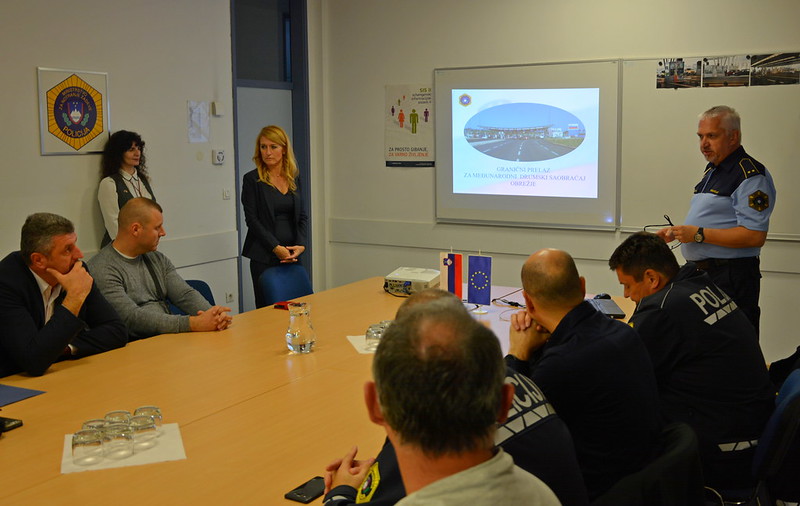
For this purpose, from 16 to 19 October 2019, a study visit of high-level representatives of the Ministry of the Interior of Serbia in Slovenia was successfully carried out. Through simulations of practical cases, they were able to learn how patrolling and patrol management work in Slovenia as an EU member state and what ICT equipment is in use in Slovenia. They were acquainted with the operation of patrols of all police powers, both border, general and traffic police, and work was carried out in Novo Mesto, Ljubljana and Koper. On their arrival in Slovenia, Deputy Director General of the Police of the Republic of Slovenia Jože Senica greeted the Serbian delegation and wished them successful work. The Directors of the police administrations, Stanislav Vrečar and Janez Ogulin presented the experience of the Police Administrations Ljubljana and Novo Mesto. Intensive programme was implemented under the leadership of the Programme Director Andreja Dolničar Jeraj and with involvement of 28 representatives of the Slovenian police, including: Anton Štubljar, Head of the State Border and Aliens Department, Police Station Novo mesto, Miha Ristič, Operations Manager, OKC PU Ljubljana, Primož Kadunc, Head of the Traffic Police Department at the Police Directorate Ljubljana, Robert Bajuk, Head of the Operations and Communication Centre at the Police Directorate of Ljubljana, Bojan Bogovič, Police Commander of the Obrežje Border Police Station; Zoran Obrez, Police Commander of the Ljubljana Traffic Police Station, Srečko Medic, Police Commander of the Brežice Police Station, Ciril Mlakar, CVS Mobile and Dr Tatjana Dragovič, workshop leader.
This is a two-year Republic of Slovenia development aid project for the Republic of Serbia (2019-2019). The project continues with activities and a meeting on November 18-19, 2019 in Belgrade, focused on the development and production of ICT equipment that will assist in the management of patrols in Serbia.
 The project is part of program activities carried out in cooperation with the Ministry of the Interior / Police of the Republic of Slovenia and CVS Mobile, and is financed by the Ministry of Foreign Affairs of the Republic of Slovenia from funds for international development cooperation.
Further information:
Andreja Dolničar Jeraj
Programme Director
Centre for European Perspective

14. 10. 2019 | local self-government, PR, Slovenian Development Assistance, U-LEAD: with Europe
Jable castle is bursting with curious energy as Centre for European Perspective is again happy to welcome International Study Visit within the U-LEAD programme. The event began on Monday, 14th of October and will continue throughout the week.
The topic of the visit is “Cooperation between Business and Local Communities”.
There are currently 15 local officials from Ukraine taking part in the study visit with the vast majority being heads of amalgamated hromadas.
The study visit began with a welcome speech by Ms Meliha Muherina, Project Manager at CEP, who warmly welcomed the participants and presented CEP team and the work of CEP. She continued with an overview of the agenda for the following days. She was followed by Mr Grega Kordež from the Directorate for Regional Development at the Ministry of Economic Development and Technology, who briefly presented the regional development of Slovenia and the work of local actions groups. Participants were also welcomed by Ms Berta Mrak, the Head of the Department for Eastern Europe, South Caucasus, Central Asia and the Arctic at the Ministry of Foreign Affairs, Republic of Slovenia, who welcomed the group from Ukraine and gave a brief insight into work the Ministry does with Ukraine. She was followed Mr Andrii Borodenkov, First Secretary from the Embassy of Ukraine in Ljubljana, who expressed his pleasure at being able to greet the 10th study group from Ukraine on a U-LEAD study visit to Slovenia. He shared a few examples of the work the Embassy does and examples of Slovenian and Ukrainian cooperation.
After a short warm-up session and introduction of participants, the theoretical part of the visit begun.
First lecture of the day was given by Ms Irena Meterc, from SPIRIT Slovenia – Public Agency for Entrepreneurship, Internationalization, Foreign Investments and Technology, who spoke about SME support in Slovenia and establishing environmental conditions conducive for entrepreneurship.
The following lecture was given by Ms Larisa Vodeb, who focused on the work of Chamber of Craft & Small Business of Slovenia and Enterprise Europe Network.
With the theoretical part done, we will move to ‘the field’ in the following days.
On Tuesday, the participants will visit the Municipality of Sveta Ana, where they will hear more about the historical ties between Slovenia and Ukraine. They will also meet with the Mayor, Mr Slaček and visit LAS Ovtar and Development Agency Slovenske Gorice.
Wednesday is a day for visiting the municipality of Juršinci, where participants will hear more about the development of the municipality, local projects and LAS Bogastvo podeželja projects. On Thursday, participants will travel to the municipality of Odranci, where they will meet with the Mayor, Mr Markoja. Thursday activities will end with a meet and greet with local business representatives and representatives of local communities at Kodila.
The visit is taking place in the framework of the multi-donor action U-LEAD established by the European Union and its Member States Denmark, Estonia, Germany, Poland and Sweden. It aims at contributing to the establishment of multilevel governance that is transparent, accountable and responsive to the needs of the population of Ukraine. U-LEAD with Europe is supporting the Ukrainian Government, represented by the Ministry of Regional Development, Construction, Housing and Communal Services of Ukraine (MinRegion) as a key political partner in the coordination and implementation of the decentralization and regional policy reforms. The Program carries out demand-driven and targeted trainings for officials at the national, regional and local level.


11. 10. 2019 | European Digital Diplomacy Exchange, PR
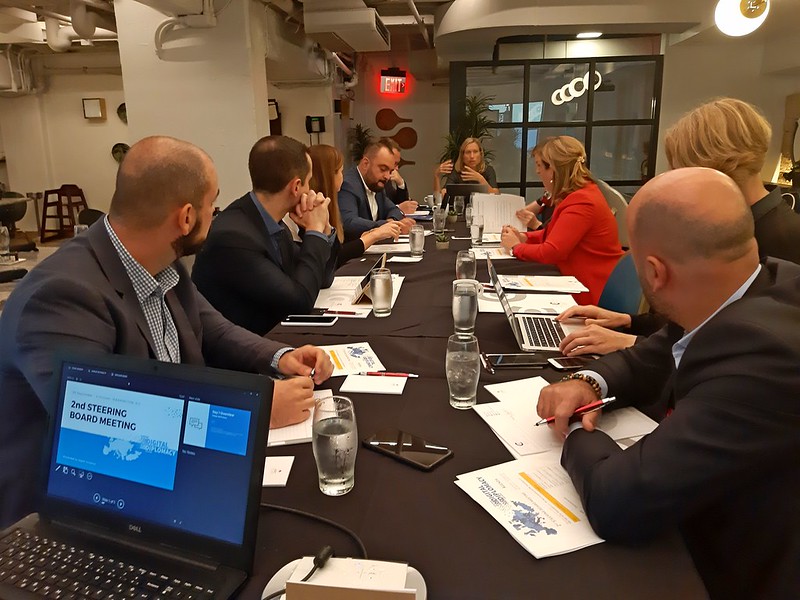
The second meeting of the European Digital Diplomacy Exchange (EDDE) project Steering Board took place in Washington D.C. from 30th September to 4th October 2019 in order to review the project efforts within the current year, address future challenges with an outlook to the sustainability of the project and to build beneficial partnerships with institutions, who are experts in the field of digital diplomacy and countering disinformation.
The first day of the meeting was an opportunity for the Steering Board to review the efforts within the EDDE project that were implemented in the current year, discuss trends and opportunities within the profession and most importantly, to find solutions for challenges ahead of the project. The group was then included in a presentation and open discussion with Mr. Samaruddin Stewart, Media Technologist, who presented the use of Google tools in the context of media reporting, a practical skill set that can also be of high value for governmental communicators within their everyday profession. The official program of the day concluded with a guided tour of the U.S. capital, the home of the United States Congress and the seat of the legislative branch of the U.S. federal government, which offered an interesting background and historical overview of Washington D.C. as the political epicentre of the United States of America.
The second day of the meeting took place within the U.S. Department of state, with presentations and open discussions from various offices within the institution. Their line of work tackles the topics of governmental communication, transparency building through the communication with audiences, efforts of countering disinformation and many other skillsets that offer motivation and inspiration for the EDDE project, but also an opportunity for joint cooperation in the future. The program continued with an evening reception at the Embassy of Slovenia in the United States of America. The guests were addressed by Mr. Ambassador Stanislav Vidovič and Ms Katja Geršak, CEP Executive director.
Wednesday presented the third day of the Steering board meeting with the continuation of fruitful meetings. The morning session took place within the Atlantic Council, a prominent think thank in the field of international relations who shared their experience of digital communication strategies, success stories of their communication campaigns, proactive resilience building against disinformation and other activities. The afternoon session included an open discussion with Professor Steven Livingston who is cooperating with the George Washington University School od Media and Public Affairs. The research of their team addresses disinformation campaigns present online and on multiple social media platforms, researching narratives from different aspects, all bringing to a better understanding of the phenomenon.
After successful meetings with governmental communicators, representatives of think tanks and Accademia, a cooperation with tech companies who actively shape the information environment of today, was a systematic next step for the study visit. The Washington D.C. Facebook outpost hosted the Steering Board on Thursday. The EDDE representatives were informed on new technological advancements and content activities, that are enforced by Facebook to secure a safe space where free speech with equal opportunities can take place. Governments and their digital efforts present an important link in the information landscape, that is why close cooperation with tech companies as Facebook is also imperative in the effort to secure transparent communication between governmental outreach and their audience, leading to more efficient and engaging policy making. With the rise of misinformation and disinformation campaigns, safeguarding the integrity of information is also becoming a high-stake objective, a challenge that can only be addressed by the common needs and strengths of the audiences, governments, tech companies, think thanks, academia and other stakeholders.
Friday marked the fifth and final day of the Steering Board meeting with close attention to the achievements and skillsets gained during the Washington study visit. The sharing of best practices, future EDDE activities planned and ideas to address common challenges have offered a strong base for future cooperation in activities taking place within the EDDE project.
The project is organised as a joint cooperation between the U.S. Department of State, the U.S. Embassy in Ljubljana and the Centre for European Perspective. The activities are only a part of a series of events that will take place in the year 2019, building on past experience and motivation to contribute to the rapidly changing field of digital diplomacy.

3. 10. 2019 | European Digital Diplomacy Exchange, PR
Washington, 2. oktobra – V Washingtonu poteka drugo zasedanje upravnega odbora Evropske izmenjave aktivnosti digitalne diplomacije v ZDA. Gre za projekt, namenjen regiji Zahodnega Balkana in Vzhodne Evrope pri zoperstavljanju dezinformacijam, ki ga izvaja Center za evropsko perspektivo (CEP) s pomočjo slovenskega zunanjega ministrstva in State Departmenta.
Ob robu zasedanja, ki poteka od 30. septembra do 4. oktobra, sta slovenski veleposlanik v ZDA Stanislav Vidovič in direktorica CEP Katja Geršak v torek v prostorih veleposlaništva v Washingtonu pripravila sprejem za člane upravnega odbora.
Upravni odbor se bo v Washingtonu sestal tudi z različnimi think-tanki in akademskimi institucijami, tehnološkimi podjetji in državnimi organi z namenom ustvarjanja produktivnih partnerstev.
State Department, CEP in MZZ so skozi projekt Evropska izmenjava aktivnosti digitalne diplomacije uspeli vzpostaviti mrežo vladnih komunikatorjev iz držav Zahodnega Balkana in Vzhodne Evrope, ki skozi različna usposabljanja krepijo strateško komuniciranje za učinkovito delovanje v informacijskem prostoru.
V zadnjih dveh letih se je usposabljanj udeležilo več kot 240 ljudi iz Albanije, Bosne in Hercegovine, Črne gore, Severne Makedonije, Kosova, Srbije, Gruzije, Moldavije in Ukrajine. Projekt je pritegnil tudi zanimanje komunikatorjev iz Estonije, Latvije, Litve, Češke, Slovaške, Slovenije, Bolgarije in Romunije.
V zadnjem času je iskanje učinkovitega protistrupa za dezinformacije postalo osrednje prizadevanje odločevalcev, novinarjev in akademikov po celem svetu. Januarja lani je Evropska komisija ustanovila skupino strokovnjakov na visoki ravni (HLEG) z namenom svetovanja o političnih pobudah za preprečevanje lažnih novic in dezinformacij, ki se širijo po spletu.
Dezinformacije je HLEG opredelil kot “vse oblike napačnih, netočnih ali zavajajočih informacij, ki so oblikovane, predstavljene ali širjene z namenom škoditi javnosti ali za dobiček.” Slovar slovenskega knjižnega jezika definira pojem dezinformacije kot napačne informacije, zlasti namerne.
Na informacijsko vojno slabo pripravljene institucije in organe odločanja so ob številnih priložnostih presenetili državni in nedržavni akterji, ki lažne informacije vsakodnevno širijo preko tradicionalnih in družbenih medijev. Še večja težava se pojavlja v tranzicijskih državah Zahodnega Balkana in Vzhodne Evrope, kjer dezinformacije zavirajo družbeno-politični napredek držav v smeri demokracije in krepijo protievropska in protiameriška čustva.
Vir: STA

30. 9. 2019 | European Digital Diplomacy Exchange, PR
in the scope of the project European Digital Diplomacy Exchange we are organizing the second Steering Board meeting that will be held from 30th September to 4th October 2019 in Washington D.C., United States.
The meeting will be the opportunity for the Steering Board members to discuss with public- and private sector entities. Importantly, it will seek to cement relationships between tech firms, think thanks, and others that can continue to sustain and support the network. This component will therefore include meetings with various Department of State entities, as well as several think tanks actively engaged in digital communications, and various tech companies with an eye toward developing the familiarity necessary to produce productive public-private partnerships.
The project is organised as a joint cooperation between the U.S. Department of State, the U.S. Embassy in Ljubljana and the Centre for European Perspective. The activities are only a part of a series of events that will take place in the year 2019, building on past experience and motivation to contribute to the rapidly changing field of digital diplomacy.