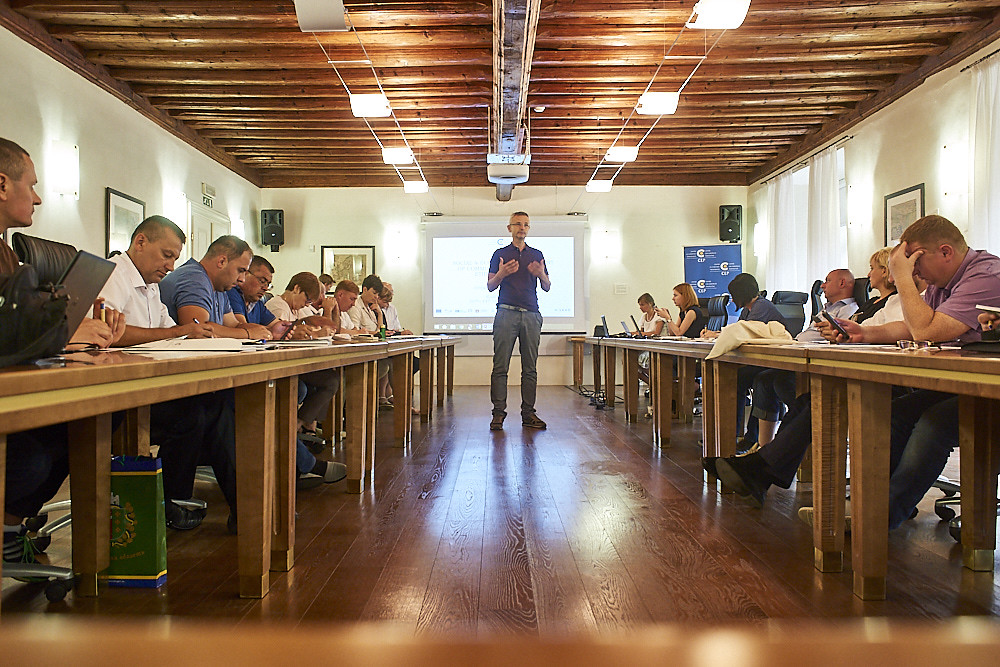
Together with U-LEAD with Europe: Ukraine – Local Empowerment, Accountability and Development Programme, CEP hosted an international study visit on social and economic development of communities with diverse ethnic population between the 10th and 14th of September. During the five day event, participants from Ukraine visited Slovene municipalities of Izola, Koper and Domžale, as well as Italian municipalities of Trst and Dolina.
On the first day of the study visit, seventeen representatives of local and regional authorities from Zakarpattya, Odesa and Chernivtsi oblast learned about the Slovene system of local self-government, regional development in Slovenia and got acquainted with Italian and Hungarian national communities and the Roma community in Slovenia.
Between the 11th and 12th of September, they visited bilingual municipalities of Koper and Izola, where they met with representatives of the Italian minority in Slovenia, Regional development centre Koper, as well as municipalities of Izola and Koper. They were interested in concrete examples of local development projects and also visited Škocjanski zatok, a great example of a revitalisation of a degraded industrial area into a natural reserve. On the 13th of September they travelled to Italy. Firstly, they met with the director of the Slovene Regional Economic Association in Trst and travelled to the business zone in the municipality of Dolina later that day. The last day of the study visit was spent in the municipality of Domžale, where the participants met with the mayor and learned about their examples of local development projects, such as their new bike park and recreational area by the Kamniška Bistrica river.
Ukrainian representatives gained valuable knowledge on the preparation and implementation of local and regional development projects and acquainted themselves with several good practices, which they will strive to apply in their local communities. They were also genuinely interested in establishing peer-to-peer cooperation with Slovene municipalities and organisations.
A similar international study visit will be organised at the end of this year.
The activities were financed by U-LEAD with Europe: Ukraine – Local Empowerment, Accountability and Development Programme, a multi-donor action of the European Union and its Member States Denmark, Estonia, Germany, Poland and Sweden.
The thirteenth Bled Strategic Forum (BSF) was the largest and richest Forum in terms of content so far, featuring 30 different discussions, excellent panellists and relevant topics. The Forum was attended by over 1200 guests from more than 80 countries.
At its conclusion, State Secretary Andrej Logar pointed out that it is becoming a key platform in this part of Europe for exchanging views and for in-depth discussion on the most pressing issues currently concerning not only international relations, but also society as a whole. Among the main achievements of this year’s BSF, he mentioned the panel with EU chief Brexit negotiator Michel Barnier, who offered some serious considerations regarding the future of EU-UK relations and indicated the EU’s possible future action.
By organising BSF, Slovenia aims to bring together at Bled an inclusive group of politicians, members of civil society and businesspeople with a view to promoting the values of solidarity, mutual respect and understanding and to expressing readiness to participate in demanding debates in order to obtain answers to the most pressing regional and global socio-political issues. Slovenia would also like to see BSF established as a trade mark, hosting events throughout the year, which would lead up to the annual meeting in September in Bled; efforts to achieve this began this year.
On the second day of BSF, the various panel debates focused on the future of the EU and the elements that link us together, on joint global action for a sustainable future, on climate change, the digital transformation of societies, mediation in a new multipolar world, cybersecurity, the 20th anniversary of the Rome Statute of the International Criminal Court, the fate of humans in a technological era, and the future of the Western Balkans.
The Young BSF, preceding the conference in Bled, gathered over 70 young leaders from 30 different countries and took a closer look at the sustainable security and its inherent components through 6 lectures and 6 workshop on different locations in Ljubljana.
The State Secretary thanked all Forum participants and organisers for their valuable contributions. Special thanks go to the Forum’s partners, companies and sponsors, for their support now and in the future.
The next, 14th BSF, will take place on 2 and 3 September 2019.
The Enhancing Digital Diplomacy Activities project finished the third training of its kind on September 11th. A four day event brought together digital diplomacy experts from 16 countries, Albania, Bosnia and Herzegovina, Bulgaria, Czech Republic, Estonia, Georgia, Lithuania, Kosovo, Macedonia, Moldova, Montenegro, Romania, Serbia, Slovenia, Slovakia and Ukraine, and served as a platform where everyone could share their best practices, ideas and experience.
Organised with the cooperation of experts from academia, governmental institutions, the media and the private sector, this event allowed the participants to gain experience from different fields beneficial for their profession and workplace. The initial day on Sunday covered topics as determining the value of Digital Diplomacy, and exploring the vast possibilities, challenges and developments social media like Facebook and Twitter have to offer. The digital age brought immense opportunities to access information and make every bodies voice heard. In order to easier navigate in this sea of information, the participants also gained knowledge on Data and Analytics techniques, followed by a best practice on how to counter Digital Disinformation.
The participants were faced with the challenge of developing a vision and future step for the project on the second day. This was the red line of the event, that came to a conclusion on Tuesday evening with a presentation of ideas, also joined by Charge’ d’ Affaires Gautam Rana and Public Affairs Officer Jean B. Leedy from the U.S. Embassy in Ljubljana. The gained inputs will be included in the construction of future activities.
A new wind for the project can also be seen in the synergies with the Bled Strategic Forum (BSF) and Young Bled Strategic Forum (YBSF). Digital Diplomats worked with participants of the YBSF in a workshop on Building a Bridge to audiences. The project was also the organiser of a BSF Panel discussion named Transformation for Institutional Resilience.
The training follows a series of multiple events that focus on Enhancing Digital Diplomacy Activities. All of the trainings serve as a fruitful cooperation between The Centre for European Perspectives, the U.S. Department of state and U.S. Embassy in Ljubljana. It is the common goal of all the organising parties, to further expand the network and strengthen it, so that it may be best equipped for the Digital challenges future has in store.
CEP – Centre for European Perspective is currently hosting 17 representatives of different Ukrainian local and regional authorities. During the five day visit, the participants will get the chance to learn about local economic development, local self-government, Slovenia’s national communities and the co-existence in communities with diverse ethnic population.
17 participants from Zakarpattya, Odesa and Chernivtsi oblast have arrived on the 10th of September. During the first day of the event, they gained knowledge about the Slovenian system of local self-government, regional development and national minorities in Slovenia. The participants showed great interest in cooperation between municipalities, in Slovenia’s minorities, multi-ethnic municipalities and the bilingual school system in certain areas.
In the following days, the participants will visit the bilingual municipalities of Koper and Izola, as well as the municipality of Domžale. They will have a chance to hear first-hand experience from representatives of the Italian minority in Slovenia and representatives of the Slovenian minority in Italy. Furthermore, they will learn more about the local development projects of the regional development agency in Koper.
The activities are financed by U-LEAD with Europe: Ukraine – Local Empowerment, Accountability and Development Programme, a multi-donor action of the European Union and its Member States Denmark, Estonia, Germany, Poland and Sweden.
Young BSF ended in Bled with a panel and round-table workshop organised in close cooperation with Italy, which currently chairs the OSCE. Slovenian Foreign Affairs Ministry State Secretary Iztok Mirošič delivered the first address, in which he pointed to the youth as one of the groups most susceptible to radicalisation. This is why it is necessary to provide it with opportunities for jobs, education and active involvement in political processes.Another challenge faced by the OSCE, EU, and the Mediterranean region are migrations. Youth is also the group widely affected by negative developments related to this, especially through the use of technologies like social media. Mirošič highlighted efforts in Slovenia at fostering an atmosphere of tolerance, for instance through a Foreign Ministry-developed teaching tool intended for pupils in Slovenian schools, who learn about the experience of children refugees. The state secretary also emphasized gender equality efforts, pointing out women are a vulnerable group in migration-related trafficking in people while they also have strong capabilities in the processes of deradicalization and reintegration. “Security is inextricably linked to gender equality,” he stressed.
Matjaž Nemec, the chair of the Slovenian National Assembly’s Foreign Policy Committee, said that the Euro-Mediterranean region has seen many new bonds develop but also tension arise. The challenges require a stepped up effort in the context of OSCE-Mediterranean cooperation. He also highlighted the issues raised by Mirošič, arguing the youth and its role is being underestimated.
“They have the predominant feeling that they live on the margins of society with no voice of power,” he said, expressing the fear things will sooner or later erupt in political instability, economic crises, ethnic religious tension, migration. Occasions and opportunities like today’s can be a good source of pressure on governments to further develop strategies and plans at international, regional and local levels, he noted.Italian Ambassador to Slovenia Paolo Trichilo, who provided the idea for the session, focused on migrations, quoting Italian Foreign Minister Enzo Moavero Milanesi as recently describing migrations as an issue of common responsibility that “must be generally shared to the maximum extent possible without nationalistic reserves since the Mediterranean presents one of the great global challenges”. The phenomenon must also be understood as human trafficking and human slavery exploitation, “therefore we must not close our eyes and turn our head the other way”. He moreover called for action to ameliorate social and economic conditions in the origin countries of migration, taking particular account of the added value of youth.
The round table discussions that followed explored some of the issues raised by the opening speakers, with one of the findings highlighted a lot being the fragmentation of opinions among the young as regards migration as well for instance in their attitude to the establishment. One topic explored was education, with the need raised to transform it so as to enable employability. The need was also expressed for a better understanding of the situation of civil society in individual countries and for maybe moving beyond just working with NGOs to directly empower young individuals. As to the migration situation in general, the need was noted to first find a common understanding of the phenomenon in Europe.
The first of the two Young BSF panels that were incorporated into the main forum in Bled this year tried to find ways to prevent conflicts, build peace and use mediation, by focusing on contemporary cases in the Balkans and the Middle East – from the political, cultural and social aspects.
Faris Kočan, research assistant at the Ljubljana Faculty of Social Sciences, presented an ongoing project, entitled Strengthening European Integration through the Analysis of Conflicting Discourses: Revisiting the Past, Anticipating the Future. The interdisciplinary project, which involves several universities, will include a cross-cultural analysis of the conflict discourses in Cyprus, Ireland, Greece, Bosnia, Kosovo, Spain, Germany, and Poland, looking at histories, media, arts and culture, and political narratives as the key elements allowing a better understanding of the specific situations.
Asked by an audience member about the view that forgetting the past is sometimes similarly important as remembering it, Kočan said that in the case in Bosnia, for instance, it cannot be expected that the past will be forgotten, with three different narratives currently present. “It is important to get a common narrative, so once you have it, you life together. You will never forget about a conflict in my opinion,” he said.
Miro Haček, social sciences professor at the Ljubljana Faculty of Social Sciences, presented a study that highlights democratic consolidation as a key aspect of peacekeeping in the Western Balkans. The study analysed the consolidation trends in former Yugoslav republic, for instance via the Human Development Index and through Freedom House’s Democracy index. Both show Slovenia and Croatia standing out, in particular the former as the only one deemed a consolidated democracy in 2016. Bosnia, Kosovo and Macedonia are currently not considered democratic. Haček is particularly concerned by the negative trend seen in recent years, not only in the former Yugoslavia but across Central and Eastern Europe.
He does “believe that the EU is motivation for the Western Balkans to consolidate its democracy, to at least begin with processes, begin adapting their legislation to the acquis”. “Without this external motivation these democratic processes would be more difficult and we would talk not about four countries that are at least stable, semi-consolidated or consolidated democracies.”
Maja Dolinar, a double PhD candidate in international relations and social and cultural anthropology at the University of Ljubljana, looked at developments in EU-Mediterranean relations. She argued that the EU had approached the region under three basic assumptions that proved misguided. The first was the idea it would be able to engage in region building, ignoring that the region has never been homogeneous. It moreover primarily saw it as its southern neighbourhood, neglecting the influence of other international players that are also present and have become more present after 2011, actually treating the region as a battlefield that has seen rough competition for power and influence. The third assumption was the EU has a high level unity in policy formation and implementation. The EU’s foreign policy however remains highly intergovernmental and consensus and coherent action as regards the Southern Mediterranean has been elusive.
“In the case of the Arab uprising it even become obvious that in several cases the EU members were pursuing national interests which were often at odds with the official position of the EU,” she said, highlighting the military intervention in Libya and the handling of migration flow as examples. The incoherence of the EU’s policies and their implementation has undermined the bloc’s credibility in the region. In its recent declarations the EU has acknowledged the problem and its trying to act with more flexibility and sensitivity towards its partners, which is proving more effective.
Mostafa Khalili, an Irani student at Doshisha University who is researching interethnic relations in Iran with a focus on Iranian Azeris and Kurds, spoke about how Iran is much more fragmented than it seems from the outside – only about 50% of Iranians are Persian. Khalili, who fears “balkanisation”, meaning confrontations, in the area, also noted the many divisions among the Kurds. He sees a more sociological, anthropological approach as very useful for getting to understand how ethnicity is being constructed and deconstructed in the region, including by political players.
“We really need to understand the situation first and only then try to put forward some proposals. This for instance did not happen in Afghanistan, Syria and Iraq – they just started with big policy moves without establishing the social problems,” he illustrated.
Akihiro Ienaka, a graduate student at Doshisha University who has researched politics in modern Turkey and memory studies, provided an analysis of Turkey’s evolution from Kemalism to Erdogan. One thing he highlighted as an issue was the sidetracking of talks on EU membership, which he believes is also a result of the Erdogan government’s alledged focus on staying in power as its main objective.
The Centre for European Perspective, together with U-LEAD with Europe: Ukraine – Local Empowerment, Accountability and Development Programme, a multi-donor action of the European Union and its Member States Denmark, Estonia, Germany, Poland and Sweden, is organizing an international study visit of representatives of Ukrainian local and regional authorities to Slovenia and Italy. The activities will take place in different Slovene and Italian municipalities in the Coastal-Karst region between September 10th and September 14th 2018. During the five day event, participants will exchange good practices in social and economic development of communities with diverse ethnic population.
17 representatives of different Ukrainian local and regional authorities, together with participants from U-LEAD with Europe and CEP, will learn about the Slovene system of local self-government, Italian and Hungarian national communities and the Roma community in Slovenia, the Slovene minority in Italy and will also get an insight into good practices of regional development. Participants of the event will be joined by experts and officials from the Ministry of Public Administration, the Office for National Minorities of the Republic of Slovenia, the Ministry of Economic Development and Technology, Italian Union – Office “Europa”, Regional Development Centre Koper, Slovene Regional Economic Association, as well as from the Italian municipality of Dolina and Slovene municipalities of Izola, Koper and Domžale.
Ukraine is currently implementing reforms of local and regional self-government. Their representatives will therefore address topics such as the preservation of minorities’ identities, cultural diversity, economic activities of minorities and others. The study visit aims to improve participants’ knowledge on preparation and implementation of local and regional development projects, as well as to initiate peer-to-peer cooperation with Ukrainian municipalities. A similar event will take place at the end of the year.
The activities are financed by U-LEAD with Europe: Ukraine – Local Empowerment, Accountability and Development Programme, a multi-donor action of the European Union and its Member States Denmark, Estonia, Germany, Poland and Sweden.
Working with the US Department of state and the U.S. Embassy in Ljubljana, the event “Enhancing Digital Diplomacy Activities” started today to tackle the challenges and opportunities present in the field of Digital Diplomacy. Participants from Albania, Bosnia and Herzegovina, Bulgaria, Czech Republic, Estonia, Georgia, Lithuania, Kosovo, Macedonia, Moldova, Montenegro, Romania, Serbia, Slovenia, Slovakia, Ukraine will interact with guest speakers from academia, governmental institutions, and the private sector. They will join forces, ideas and best practices to bridge challenges in the field and build a strong network for the future of the project.
The current training will be devoted to discover the potential and opportunities of Digital Diplomacy, trends in the field, promising tools like Facebook and other platforms, but also critically think of challenges and dangers, to find proper solutions. On Sunday morning the participants were addressed by Charge’ d’ Affaires Gautam Rana and Public Affairs Officer Jean B. Leedy from the U.S. Embassy in Ljubljana. The training was then set of by Matt Jacobs from the U.S. Department of state and Centre for European Perspective’s very own Project leader Ingrid Omahna, who have been supporting and coordinating the project from the very beginning.
The first day of the training took place in Ljubljana. A discussion by Dr Corneliu Bjola on the value of Digital Diplomacy set a strong theoretical base for the day’s activities. The participants were working closely on developments and opportunities in the field of social media with guest speakers Mathisas Lufkens and Crystal Patterson. Hind Mohamed and Henry Collis from the UK Prime Minister’s Office and Cabinet Office Communications also shared their good practices. The participants equipped their Digital Diplomat’s toolbox on how to analyse data more efficiently, and also got an insight on how to counter Digital Disinformation.
On Monday morning the participants were invited to look back on their experiences and gained knowledge from past trainings. As their workplace encompasses different fields, they also have a broad variety of good practices and ideas to bring to the table. Their final concepts will establish the future direction of the Enhancing Digital Diplomacy Activities project. Participants joined the 2018 edition of the Bled Strategic Forum named Bridging the Divide latter on in the afternoon. Fruitful discussions in the formal and informal environment offered a great opportunity to share knowledge, experience and opinions on multiple topics, certainly also about digital diplomacy.
The third day was also placed at Bled, where the Bled Strategic Forum activities continued. The morning panel discussion named Digital Bridge: Transformation for Institutional Resilience was organized by the Enhancing Digital Diplomacy project and with the support of the U.S. Department of State. Guest speakers from the private sector (Crystal Patterson as the Global Politics and Governmental Outreach Manager representing Facebook and Microsoft Director Corporate Affairs – CEE Dr. Matthias Sachs), academia (Dr. Corneliu Bjola) and media (Nataša Briški as the Co- Founder and editor of Meta’s list) engaged the audience in an open debate regarding technological developments, best practices and experience from their fields of expertise. As the future is digital and evolving rapidly, transformation, flexibility and the will to learn is an essential part of the recipe, that can strengthen Institutional Resilience. (The recorded panel can be accessed below)
The evening continued with the closing ceremony of the project. It was unique from the other trainings, as this time, the participants held a presentation of their ideas on how to expand and strengthen the network. The evening continued in good fashion, with the certificate ceremony, and was also joined by Charge’ d’ Affaires Gautam Rana and Public Affairs Officer Jean B. Leedy from the U.S. Embassy in Ljubljana. Although the event came to a conclusion, it is only the beginning of a bright future for the Enhancing Digital Diplomacy Activities project.