18. 9. 2018 | European Digital Diplomacy Exchange, PR
The Third Edition of the Enhancing Digital Diplomacy Activities training took place in Ljubljana and Bled between the 9th and 11th of September, bringing together 36 participants from different countries, but also representatives of the media, private sector and academia. The event is the success of a joint effort by the Centre of European Perspectives, the U.S. Department of State and the U.S. Embassy in Ljubljana aiming at the establishment of a digital diplomacy network, which will serve as a platform for best practice sharing and cooperation. Watch the teaser video on how the participants from Albania, Bosnia and Herzegovina, Bulgaria, Czech Republic, Estonia, Georgia, Lithuania, Kosovo, Macedonia, Moldova, Montenegro, Romania, Serbia, Slovenia, Slovakia and Ukraine worked as one big happy digital diplomacy family with the aim of learning from each other, and building a bright future for the project.

17. 9. 2018 | Bled Strategic Forum, PR, Security
Centre for European Perspective has been active in providing the security in the Western Balkans region, which would not be possible without good partners. On the margins of the Bled Strategic Forum, CEP’s Executive Director Dr Gorazd Justinek signed a memorandum of understanding between CEP, IISG and DCAF Ljubljana. DCAF was represented by its director, Mr Anton Travner, while IISG by its chairman Mr Rajko Kozmelj.
The IISG (Integrative Internal Security Governance) is a new approach to internal security governance capacity-building and reform introduced in the Western Balkan region. It is hosted by DCAF Ljubljana, Geneva Centre for Democratic Control of Armed Forces, since 8 September 2017. The IISG concept enables a coordinated, aligned and sustainable effort in the major fields of internal security governance reform on part of the EU and all relevant international donors of external assistance.
Main objective of signed memorandum is to identify areas of potential cooperation among all three partners with aim to improve mutual coordination and ensure greater complementary, efficiency and effectiveness in the areas of common interest – advancing the Euro-Atlantic integration of the SEE, contributing to regional and wider European stability and prosperity by fostering regional reform, capacity building and cooperation, contributing knowledge and new expertise in areas of security and rule of law.


17. 9. 2018 | PR, Serbia - Information exchange, Slovenian Development Assistance
What are proposals and guidelines for better flow of information related to illegal migration in the communication system of Ministry of Interior of the Republic of Serbia? This will be evident in the workshop which will take place on 19 September 2018 in Belgrade and will be intended for the development of the proposals which will be produced by Serbian colleagues together with colleagues from Slovenian Police and by taking into consideration standards which are used in the EU. The outcome will be presented to the representatives of the leadership of the Ministry of Interior and Police of the Republic of Serbia which are responsible for effective functioning of the system of information flow in the the area illegal migrations. The goal is to optimize the flow of information by putting to better use the current capacities and consequently, respond better to situations related to illegal migrations.
 Project is part of program activities implemented in the cooperation with the Ministry of Interior/Police of the Republic of Slovenia and financed by the Ministry of Foreign Affairs of the Republic of Slovenia in the framework of Slovenia’s Development Cooperation.

15. 9. 2018 | Decentralisation, local self-government, National communities, PR, Public administration, Slovenian Development Assistance, U-LEAD: with Europe
Together with U-LEAD with Europe: Ukraine – Local Empowerment, Accountability and Development Programme, CEP hosted an international study visit on social and economic development of communities with diverse ethnic population between the 10th and 14th of September. During the five day event, participants from Ukraine visited Slovene municipalities of Izola, Koper and Domžale, as well as Italian municipalities of Trst and Dolina.
On the first day of the study visit, seventeen representatives of local and regional authorities from Zakarpattya, Odesa and Chernivtsi oblast learned about the Slovene system of local self-government, regional development in Slovenia and got acquainted with Italian and Hungarian national communities and the Roma community in Slovenia.
Between the 11th and 12th of September, they visited bilingual municipalities of Koper and Izola, where they met with representatives of the Italian minority in Slovenia, Regional development centre Koper, as well as municipalities of Izola and Koper. They were interested in concrete examples of local development projects and also visited Škocjanski zatok, a great example of a revitalisation of a degraded industrial area into a natural reserve. On the 13th of September they travelled to Italy. Firstly, they met with the director of the Slovene Regional Economic Association in Trst and travelled to the business zone in the municipality of Dolina later that day. The last day of the study visit was spent in the municipality of Domžale, where the participants met with the mayor and learned about their examples of local development projects, such as their new bike park and recreational area by the Kamniška Bistrica river.
Ukrainian representatives gained valuable knowledge on the preparation and implementation of local and regional development projects and acquainted themselves with several good practices, which they will strive to apply in their local communities. They were also genuinely interested in establishing peer-to-peer cooperation with Slovene municipalities and organisations.
A similar international study visit will be organised at the end of this year.
The activities were financed by U-LEAD with Europe: Ukraine – Local Empowerment, Accountability and Development Programme, a multi-donor action of the European Union and its Member States Denmark, Estonia, Germany, Poland and Sweden.



12. 9. 2018 | Bled Strategic Forum, PR
The thirteenth Bled Strategic Forum (BSF) was the largest and richest Forum in terms of content so far, featuring 30 different discussions, excellent panellists and relevant topics. The Forum was attended by over 1200 guests from more than 80 countries.
At its conclusion, State Secretary Andrej Logar pointed out that it is becoming a key platform in this part of Europe for exchanging views and for in-depth discussion on the most pressing issues currently concerning not only international relations, but also society as a whole. Among the main achievements of this year’s BSF, he mentioned the panel with EU chief Brexit negotiator Michel Barnier, who offered some serious considerations regarding the future of EU-UK relations and indicated the EU’s possible future action.
By organising BSF, Slovenia aims to bring together at Bled an inclusive group of politicians, members of civil society and businesspeople with a view to promoting the values of solidarity, mutual respect and understanding and to expressing readiness to participate in demanding debates in order to obtain answers to the most pressing regional and global socio-political issues. Slovenia would also like to see BSF established as a trade mark, hosting events throughout the year, which would lead up to the annual meeting in September in Bled; efforts to achieve this began this year.
On the second day of BSF, the various panel debates focused on the future of the EU and the elements that link us together, on joint global action for a sustainable future, on climate change, the digital transformation of societies, mediation in a new multipolar world, cybersecurity, the 20th anniversary of the Rome Statute of the International Criminal Court, the fate of humans in a technological era, and the future of the Western Balkans.
The Young BSF, preceding the conference in Bled, gathered over 70 young leaders from 30 different countries and took a closer look at the sustainable security and its inherent components through 6 lectures and 6 workshop on different locations in Ljubljana.
The State Secretary thanked all Forum participants and organisers for their valuable contributions. Special thanks go to the Forum’s partners, companies and sponsors, for their support now and in the future.
The next, 14th BSF, will take place on 2 and 3 September 2019.

11. 9. 2018 | European Digital Diplomacy Exchange, PR
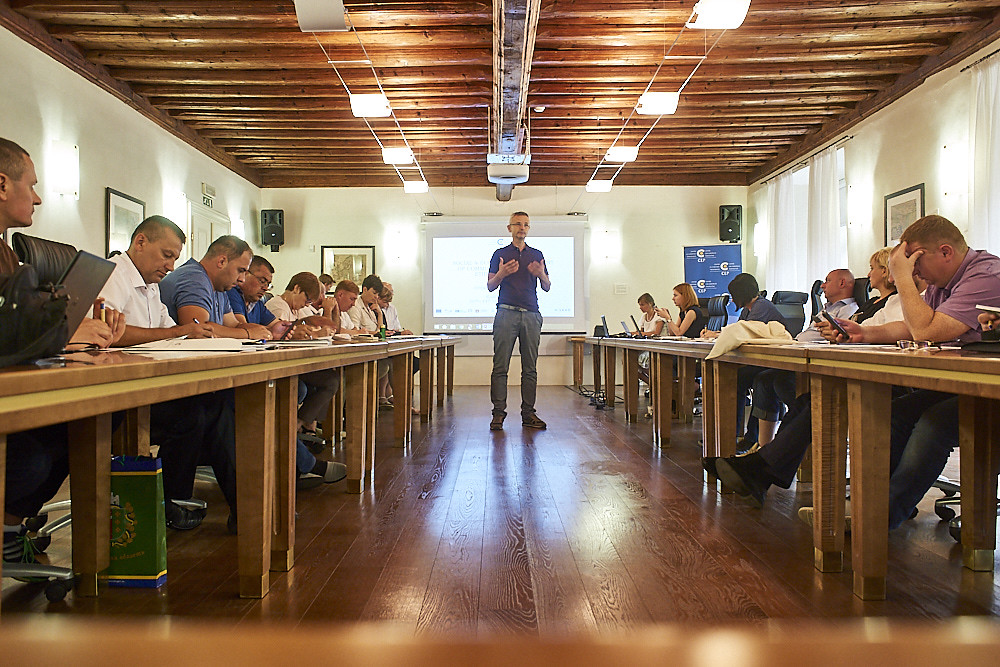
The Enhancing Digital Diplomacy Activities project finished the third training of its kind on September 11th. A four day event brought together digital diplomacy experts from 16 countries, Albania, Bosnia and Herzegovina, Bulgaria, Czech Republic, Estonia, Georgia, Lithuania, Kosovo, Macedonia, Moldova, Montenegro, Romania, Serbia, Slovenia, Slovakia and Ukraine, and served as a platform where everyone could share their best practices, ideas and experience.
Organised with the cooperation of experts from academia, governmental institutions, the media and the private sector, this event allowed the participants to gain experience from different fields beneficial for their profession and workplace. The initial day on Sunday covered topics as determining the value of Digital Diplomacy, and exploring the vast possibilities, challenges and developments social media like Facebook and Twitter have to offer. The digital age brought immense opportunities to access information and make every bodies voice heard. In order to easier navigate in this sea of information, the participants also gained knowledge on Data and Analytics techniques, followed by a best practice on how to counter Digital Disinformation.
The participants were faced with the challenge of developing a vision and future step for the project on the second day. This was the red line of the event, that came to a conclusion on Tuesday evening with a presentation of ideas, also joined by Charge’ d’ Affaires Gautam Rana and Public Affairs Officer Jean B. Leedy from the U.S. Embassy in Ljubljana. The gained inputs will be included in the construction of future activities.
A new wind for the project can also be seen in the synergies with the Bled Strategic Forum (BSF) and Young Bled Strategic Forum (YBSF). Digital Diplomats worked with participants of the YBSF in a workshop on Building a Bridge to audiences. The project was also the organiser of a BSF Panel discussion named Transformation for Institutional Resilience.
The training follows a series of multiple events that focus on Enhancing Digital Diplomacy Activities. All of the trainings serve as a fruitful cooperation between The Centre for European Perspectives, the U.S. Department of state and U.S. Embassy in Ljubljana. It is the common goal of all the organising parties, to further expand the network and strengthen it, so that it may be best equipped for the Digital challenges future has in store.