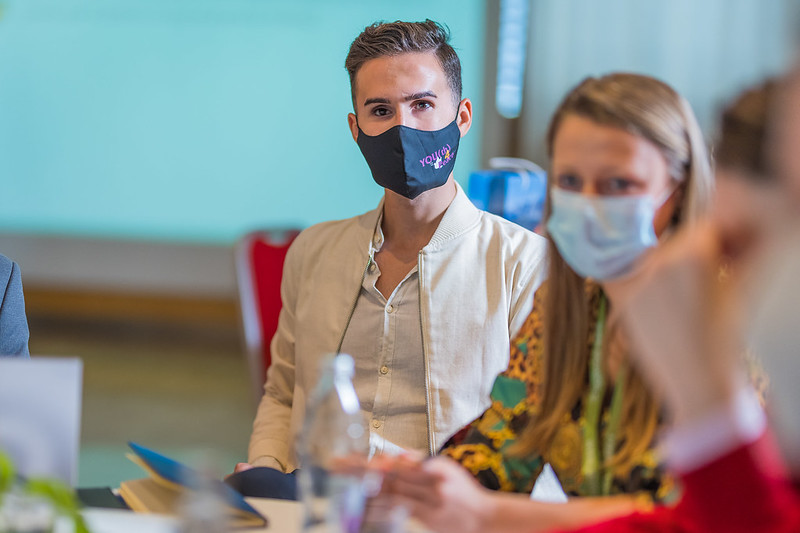
From August 29th 2021 until August 31st 2021 , Bled (Slovenia) was once more the meeting point for young leaders, who in the scope of the Young Bled Strategic Forum and Bled Strategic Forum framework joined forces, shared their creativity and ideas in order to contribute their piece of the puzzle (as active citizens) to the challenges (or rather said) opportunities of today and tomorrow, that civil society, decision-makers, private sector, members of academia and all members of society will need to address jointly, with strong voices and decisive actions, to secure a prosperous Future of Europe.
A group of 40 participants, trainers and organisers from the countries of Albania, Austria, Bosnia and Hercegovina, Croatia, France, Hungary, Ireland, Kosovo, Montenegro, North Macedonia, Poland, Romania, Slovakia, Slovenia, Ukraine and the United States of America participated in an intensive programme of capacity building and exchange of ideas through workshops, panel discussions, networking and other interactive activities the Young BSF is known for. The Programme was prepared in close cooperation with an international group of trainers and experts, who have extensive experience in the field of European Union policy, regional cooperation and the perspective of the Western Balkans region, economy and employability, resilience and recovery (in the scope of the COVID-19 pandemic), climate change and green transformation, civil society engagement in decision making and other topics.
Young participants contributed their voices and vision through the preparation of a joint declaration on the Future of Europe they desire, deserve and wish to help create, that will be further supported and promoted within the Conference on the Future of Europe and the Slovenian Presidency of the Council of the European Union.
The Young BSF programme began on Sunday 29th of August at Bled (Slovenia) with introductory remarks presented by Mr. Peter Grk, Secretary-General of the Bled Strategic Forum, Ms Katja Geršak, Executive Director of the Centre for European Perspective, Mr Jernej Grahor, BSF Project Manager (Responsible for Young Bled Strategic Forum) and Ms Dafina Peci, Young Bled Strategic Forum Master of Ceremony.
On Monday, 30th of August 2021 the programme continued with workshops structured on decisive elements of creating an inclusive and engaging environment for the active participation of youth, and discussions on global challenges where perspectives (ideas) of youth need to be further supported. The first session was prepared by Ms Krisela Hackaj, Western Balkans Youth Cooperation Platform Executive Director and Ms Gresa Smolica, Cooperation and Development Institute Project Officer. Participants explored different initiatives, strategies and projects on the topic of economy and development, leading to the drafting of recommendations on how to take action towards youth participation in sectoral policymaking. Mr Jan Kulenović, Regional Youth Cooperation Office Director of Programs continued with a workshop on the topic of diversity, working on the important roles and opportunities of actors within society in the process of advancing the implementation of tolerance and inclusivity. Building on the broad experience and knowledge of V4SDG on the topic of climate change and green transformation, Ms Lilla Judit Bartuszek, V4SDG Secretary-General, engaged the participants in a discussion on the potential for cooperation, joint opportunities and responsibilities of promoting sustainability through cross-sectoral opportunities and actions towards a long term vision. The evening programme of Young BSF Day one was devoted to a structured approach towards the drafting of a joint Young BSF declaration, and an evening Night owl session presented by Mr Matt Jacobs, Digital Coordinator at the Bureau of European and Eurasian Affairs of the U.S. Department of State and Coordinator of the European Digital Diplomacy Exchange Programme. An open discussion tackled the challenges of successful digital communication and social listening, that within the opportunities of the digital environmental space, hold the opportunity of further bridging the gap between decision-makers (or institutions they represent) and civil society, the opportunity to in effect contribute to the safeguarding of digital resilience and information integrity protection.
On Tuesday, 31st of March the intensive programme continued with presentations of partnering organisations. The first session foresaw the implementation of the Third Fundamental Rights Dialogue, organised by the European Union Agency for Fundamental Rights in the form of a live event streamed on social media and online platforms. Participants cooperated with Mr Michael O´Flaherty, Director of the European Union Agency for Fundamental Rights, in an open discussion on topics of fundamental rights protection and advancement. The discussion was moderated by Ms Dafina Peci, Young BSF Master of Ceremony. Dr Staša Mesec, Government Office for Development and Cohesion Policy and European Union Strategy for the Adriatic and Ionian Region (EUSAIR) and Mr Jernej Grahor, European Union Strategy for the Danube Region (EUSDR) Priority Area 10 Coordinator continued the programme of the day, and engaged the participants in a workshop on civil society engagement in decision making. Young leaders began by exploring the opportunities for cooperation and work within the established structures of the Macroregional strategies, moving towards group work on specific topics closely supported by the Danube and Adriatic-Ionian region, discussing opportunities for closer engagement of civil society and youth in decision making on a local, regional and transnational level. The first-afternoon session was prepared in cooperation with the Regional Cooperation Council and the Western Balkans Youth Lab, presented by Ms Petra Balažič, Regional Cooperation Council Political Advisor. The discussion included the opportunities for better cooperation on a regional level as within the Western Balkans six economies and a bridge between regions as the WB6 together with the European Union, with a strong emphasis on economical cooperation, mobility and other cross-cutting topics that contribute to the creation of a more prosperous environment for youth, as well as contribute to progress and advancement of the region as a whole. The final session of the day included a panel discussion organised in cooperation with the Youth Council of Slovenia. Participants discussed the topic of youth participation in the European Union and exchanged their ideas with the session moderator Mr Patrik Bole, National Youth Council of Slovenia Vice President for International Cooperation, Ms Lucija Karnelutti, United Nations Youth Delegate of Slovenia, Mr Jaša Levstik, Project Manager of the 94th International Session of European Youth Parliament – Ljubljana 2021 and Ms Tjaša Božič representing the Institute for Political Management.
The programme of the Young BSF continued with the participation of young leaders in the proceedings of the Bled Strategic Forum as active participants of the workshops, panel discussions and meetings taking place between September 1st and September 2nd 2021.
The Young Bled Strategic Forum and Bled Strategic Forum platform once more wish to express gratitude and admiration to the sponsor and partner organisation, who contributed their expertise, knowledge and trust in the creation of a comprehensive programme. The organisation of the Young Bled Strategic Forum would not be possible without the support of the Regional Cooperation Council programme co-funded by the European Union, The Danube Transnational Programme, Triglav d.d. and the Central European Initiative.



 Virtual workshop on negotiation techniques and women´s empowerment continues the activities of Centre for European Perspective – CEP, aimed at the empowerment of women that began within the Peace Operations Training Centre and EUPCST project.