4. 3. 2020 | European Digital Diplomacy Exchange, PR
The Centre for European Perspective (CEP), together with the U.S. Department of State, and the support from the Moldovan State Chancellery and the Ministry of Health, Labour and Social Protection of the Republic of Moldova, is organizing a two-day training for Moldovan government communicators within the scope of “European Digital Diplomacy Exchange (EDDE)” project. The training will take place on 5 – 6 March in Government House in Chișinău.
Today’s public sphere is shaped by the proliferation of digital communication channels that are constantly bringing new challenges for governments. Government communicators are required to be active on social networks, but this role is too often taken for granted. In order to ensure successful communication, they constantly need to expand their knowledge, experience, different abilities and skills.
This training will cover a range of topics from public relations and public diplomacy theory to the practical application of digital tools, conducted by experienced public and private sector communicators in this emerging media environment.

28. 1. 2020 | PR, Serbia - management of patrols, Slovenian Development Assistance
Achieving results in Slovenian international development cooperation with the Republic of Serbia through innovative ICT technologies
Click here to read more about the project in Slovenian language. 
The strategic orientation of the state authorities of the Republic of Serbia, including its important part – the Ministry of the Interior, in the process of reforms and approximation to the EU is to modernize public administration and become an effective service for all citizens. In the year 2020 the implementation of Slovenian international development assistance to the Republic of Serbia continues, with the aim of improving the response of police patrols to the needs of the people, coordination of police work in the field, including adequate response to migration and protection of police officers in the performance of police tasks. It is a contribution to the UN sustainable development goals, to develop an efficient, responsible and transparent institution, which Slovenia has also identified as a priority in the implementation of international development cooperation.
The ICT transformation is a public sector imperative in current times and governments have to harness innovative technologies to create better outcomes for citizens, which is also part of subject matter development assistance. To this end and among other activities, innovative ICT technology is being jointly developed that will help Serbia to effectively manage patrols. In addition to ICT professionals, the development is closely involved with representatives of all police powers; general, traffic and border police, who gathered in Belgrade on January 22, 2020 and successfully tested the ICT solutions developed so far.

The project is part of program activities carried out in cooperation with the Ministry of the Interior / Police of the Republic of Slovenia and CVS Mobile,and is financed by the Ministry of Foreign Affairs of the Republic of Slovenia from funds for international development cooperation.
Further information:
Andreja Dolničar Jeraj
Programme Director
Centre for European Perspective

15. 1. 2020 | PR, Serbia - management of patrols, Slovenian Development Assistance
Press release: By innovative information technologies to achieve results in international development cooperation with the Republic of Serbia
Click here to read more about the project in Slovenian language.
In the year 2020 the implementation of Slovenian international development assistance to the Republic of Serbia continues, with the aim of improving the response of police patrols to the needs of the people, coordination of police work in the field, including adequate response to migration and protection of police officers in the performance of police tasks. The strategic orientation of the state authorities of the Republic of Serbia in the process of reforms and approximation to the EU is to modernize public administration and become an effective service for all citizens. In this respect the modern technology and digitalisation of government operations is crucial for success. It is a contribution to the UN sustainable development goals, to develop an efficient, responsible and transparent institution, which Slovenia has also identified as a priority in the implementation of international development cooperation.
To this end and among other activities, innovative ICT technology is being jointly developed that will help Serbia to effectively manage patrols. In addition to ICT professionals, the development is closely involved with representatives of all police powers; general, traffic and border police, who will gather in Belgrade on January 22, 2020 to test the ICT solutions developed so far.
The project is part of program activities carried out in cooperation with the Ministry of the Interior / Police of the Republic of Slovenia and CVS Mobile,and is financed by the Ministry of Foreign Affairs of the Republic of Slovenia from funds for international development cooperation.
Further information:
Andreja Dolničar Jeraj
Programme Director
Centre for European Perspective

20. 12. 2019 | LET4CAP, PR
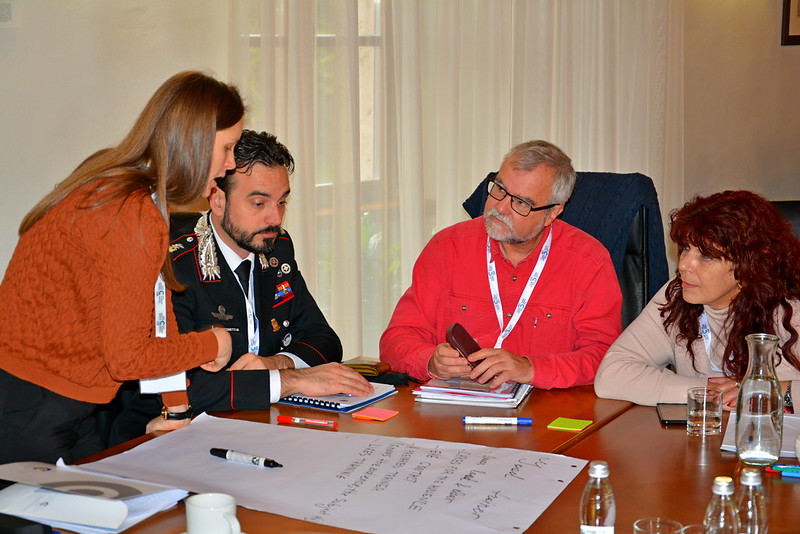
Training of trainers was the last activity within the LET4CAP project – “Law Enforcement Training for Capacity Building project” that implemented seven trainings in the last two years. Project members – Centre for European Perspective, Italian Carabinieri, Sant’Anna School of Advanced Studies, the Polish police force “Policja” and the in-house agency of the Italian Ministry of Economy and Finance, “Studiare Sviluppo”, have contributed to more consistent and efficient assistance in law enforcement capacity building to third countries.
Training or trainers in Ljubljana from 17 – 18 December brought together 17 experienced trainers from 13 countries that learned from each other, worked on their presentation and communication skills and improved their knowledge about training theory, design and evaluation. Group work and dynamic programme contributed to an excellent atmosphere that facilitated great peer-to-peer learning as well as expertise from various working environments.
Project has been co-financed by Internal Security Fund of the European Union.

16. 12. 2019 | European Digital Diplomacy Exchange, PR
Nowadays, everyone has a powerful video camera in a pocket: a smartphone. With a little practice, tools, tips, government communicators have all they need at their fingertips. The Centre for European Perspective (CEP) in cooperation with the United States Department of State, therefore conducted a training on Smartphone Videography between 10 and 12 December 2019 in Bled, Slovenia.
The training attracted more than 30 government communicators coming from different ministries of Albania, Bosnia and Herzegovina, Bulgaria, Montenegro, North Macedonia, Kosovo, Romania, Serbia, Georgia, Ukraine and Slovenia.
Since video is undoubtedly one of the most engaging and effective tools to communicate with audiences at the time, the participants were introduced to the world of smartphone filmmaking. After a course with Boštjan Romih they became confident and engaging public speakers, digital storytellers after a session with Charlelie Jourdan and effective communicators during the crisis after the lecture from Matt Jacobs. For the finals, they learned about the digital convergence with Matej Praprotnik and media strategies in Bosnia and Herzegovina with Admir Malagic on the first day.
On the second day, film director and CEO of Studio Production House Dražen Štader guided participants through the process of smartphone video production, including the needed equipment, video-techniques and editing of video products. U.S. Embassy Ljubljana Public Affairs Officer, J.B. Leedy presented best practices in smartphone photography, while Ingrid Omahna focused on visual communication design. Andy Carvin from the Digital Forensic Research Lab of the Atlantic Council and Nina Pejič, Researcher at Faculty of Social Sciences of the University in Ljubljana talked about the emerging threats in the digital space.
On the last day, participants divided into 6 teams needed to put the gained knowledge into practice. They became a team of government communicators for the Ministry of Citizen Protection of a country called Sloland that is challenged with a huge influx of refugees from a neighboring country called Gotan. They were tasked to launch a 3-day digital campaign to communicate the benefits of immigration and push back against anti-immigrant and anti-refugee rhetoric, which they completed with excellence.
European Digital Diplomacy Exchange project that started off in 2017 on the initiative of the U.S. Department of State, is committed to increasing members’ collective capacities to effectively operate within the digital information space. The strong relationships fostered over the courses of the project have precipitated a network of dedicated professionals who are committed to ensuring governments are operating ahead of the digital curve, and therefore able to better communicate with their citizens, better listen to their citizens, and both embrace and protect their role within the context of this new, democratized, digital information environment.


10. 12. 2019 | European Digital Diplomacy Exchange, PR
The Centre for European Perspective, together with the U.S. Department of State is organizing a three-day training that is tailor made for government communicators, public officers and digital diplomats alike. The training will take place between Tuesday 10th of December and Thursday 12th of December at Bled, Slovenia.
The modern information and media sphere form an information highway, that has unveiled both opportunities and pressing challenges for all the stakeholders that work to protect information integrity. Technological advancement and innovation have made it significantly easier for individuals to participate in the information flow, a significant contribution to the democratic dialogue. The same opportunities are unfortunately also available to harmful narratives, that may use amplification tools to mis- and dis-inform. Governments are therefore uniquely challenged, to proactively and re-actively inform their citizens and cooperate with their audience in a dialogue of equal voices. Government communicators, who effectively safeguard information integrity through their every day work as a result need to poses an unique skillet of abilities and knowledge to be effective and address the challenges with a stronger voice.
For this purpose, a fifth iteration of the training, taking place between 10th and 12st June 2019 at Bled, Slovenia, will join the forces of government communicators from Albania, Bosnia and Herzegovina, Bulgaria, Georgia, Kosovo, North Macedonia, Moldova, Montenegro, Romania, Serbia, Slovenia and Ukraine. The training will cover a range of topics from public relations and public diplomacy theory to practical application of digital tools. Participants will also gain valuable knowledge on the practical application of smartphones, technology, that presents a world of opportunities at the touch of our fingertips.
The project is a result of a joint cooperation between the U.S. Department of State, the U.S. Embassy in Ljubljana and the Centre for European Perspective.