In the framework of the project “Professional Experience for Serbian Civil Servants”, CEP cooperated with the Ministry of the Economic Development and Technology, The Ministry of Education, Science and Sport of the Republic of Slovenia and Ministry of Labour, Family and Social Affairs.
From October to November, three Serbian civil servants from the Ministry of European Integration of Republic of Serbia were trained in the area of Free movement of capital, goods and labour, competition policies, consumer protection and health, science and research and company law. In addition, the project has facilitated the collaboration of experts who will in the future work within the EU.
The project is part of the CEP program activities financed by the Ministry of Foreign Affairs of the Republic of Slovenia from the funds for international development cooperation.
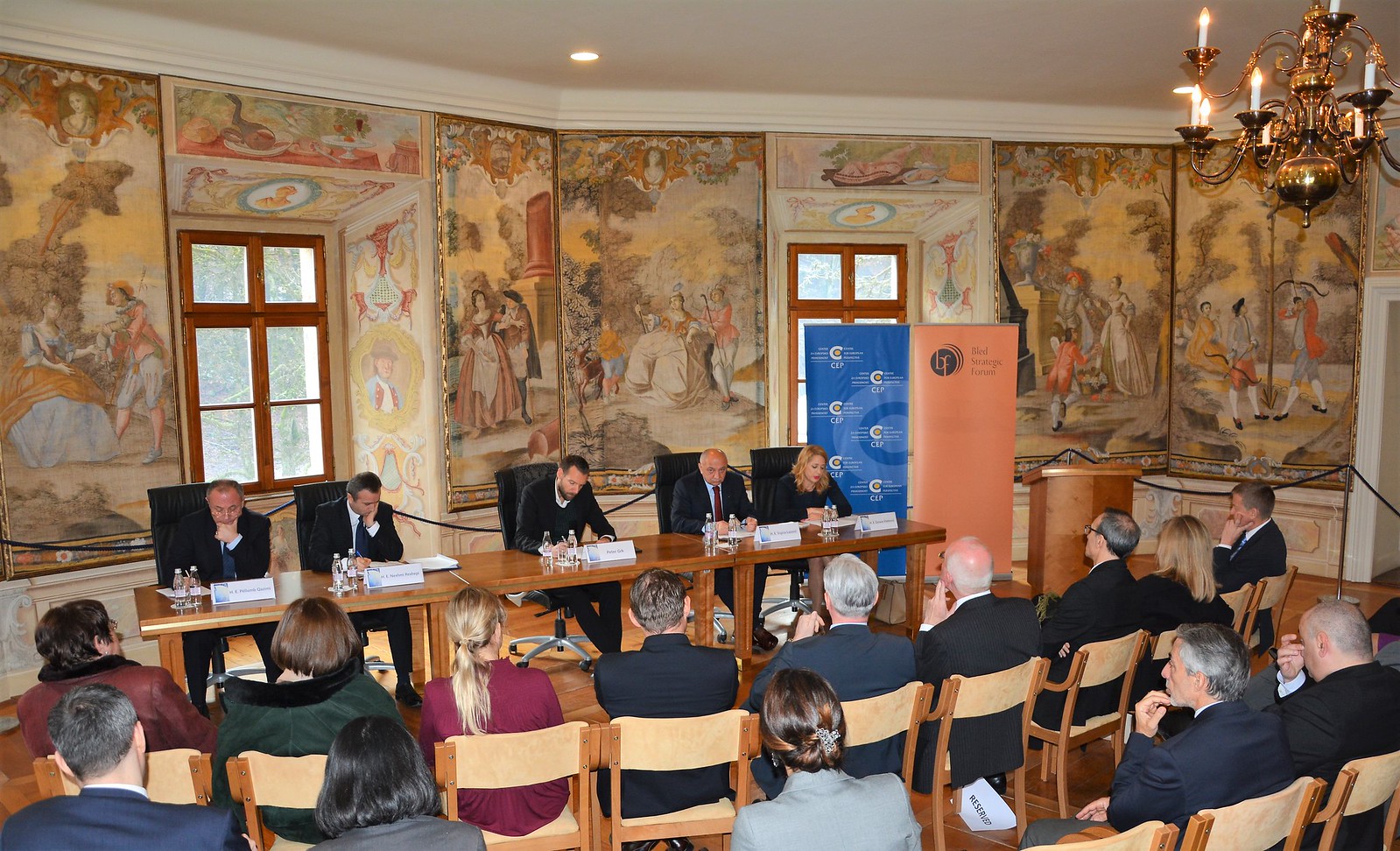
Centre for European Perspective has in cooperation with the Bled Strategic Forum international conference and the Ministry of Foreign Affairs of the Republic of Slovenia held its traditional December round table on the topic of Western Balkans. Round table was attended by more than 50 participants, coming from the Slovenian ministry of Foreign Affairs, Academia, Embassies and long-standing partners of CEP and BSF.
The discussion was based on the conclusions of the Panel on the Western Balkans, held at the Bled Strategic Forum 2017, where a clear message emerged – the process of enlargement of the European Union is still an incentive for transformation for the countries in the Western Balkans, and the speakers agreed in September that the future of the region is within the European Union. The values shared by the region and the EU represent a strong driving force for both sides. However, not attractiveness nor support should not be taken for granted, and the process must have a clearly defined ultimate goal.
Welcome address was delivered by Dr Gorazd Justinek, Executive Director, Centre for European Perspective who shortly presented CEP activities in 2017, stating that there were more than 60, while BSF was seen as the most remarkable one. He also thanked all the partners who have helped us to achieve and conclude a successful year.
Opening remarks were given by Mr Iztok Mirošič, State Secretary, Ministry of Foreign Affairs of the Republic of Slovenia who stressed the importance of inclusion of WB countries into the EU for the prosperity and stability of the region, arguing that Slovenia greatly supports European integrations but stays aware of work that both sides still have to do. He underlined there is a new impetus in regard of the enlargement process and EU still sees vast potential in the region, but reminiscences of the past are sometimes better trigger than anything else, and different accounts of history are stopping the reconciliation process. Past is stopping thinking about the most important – future. Most significant priorities in the WB countries should be the rule of law and economic prosperity. Mr Mirošič said regional initiatives are continuing their work harder than they did in the past and is up to the countries in WB to use this momentum in order to move the things on the ground and achieve its goals. In conclusion State Secretary stated “There is always light at the end of the tunnel, if we all move in the same way”.
Round table was moderated by Mr Peter Grk, National Coordinator for Western Balkans, Ministry of Foreign Affairs of the Republic of Slovenia, who argued that today we have the window of opportunity in the Western Balkans. Today, compared to 5 years ago, when President of European Commission Juncker said enlargement process is over, we had a speech where Juncker argued Serbia and Montenegro are expected to enter EU before 2025. That marks first time European Commission has set a date, causing change in enlargement atmosphere that until then was facing enlargement fatigue and enlargement patience. Question remains whether the date set is feasible, as well as what actions will be taken in order to close the economic gap between the countries in the region.
Speakers of the round table were H. E. Mr Pëllumb Qazimi, Ambassador of the Republic of Albania, H. E. Mr Nexhmi Rexhepi, Ambassador of Kosovo, H. E. Dr Vujica Lazović, Ambassador of Montenegro and H. E. Mrs Zorana Vlatković, Ambassador of the Republic of Serbia.
Main points of the debate focused on improvement in atmosphere regarding the enlargement, where Balkans are not presented in negative sense anymore; there is a good vibration coming from the EU regarding the regions integration process. Speakers agreed there is a need for a clear enlargement strategy in the region and the need to speed up the process, while they have remained aware that opening the negotiations is just the beginning of a long and challenging path. Panelists underlined the importance of European integration remaining key goal of their foreign policies, while public support for integration remains very high in all the countries, with no alternatives to be considered. Debate touched upon the reconciliation as a pre-requisite for European integration and regional cooperation, nationalistic narratives and wars that were not structurally addressed are hampering the enlargement process. Two main conclusions were drawn, first one being the importance of current positive atmosphere and second one the importance of not losing the momentum, where positive atmosphere should be translated into actions.
Views on the subject were given by H. E. Mr Paolo Trichilo, Ambassador of the Republic of Italy, H. E. Mr Bart Twaalfhoven, Ambassador of the Kingdom of the Netherlands, H. E. Mr Pawel Czerwiński, Ambassador of the Republic of Poland, H. E. Ms Edit Szilágyiné Bátorfi, Ambassador of Hungary, Nicola Stewart, UK Embassy and Zoran Stančič, Head of the European Commission Representation in Slovenia who stressed the importance of such events that are facilitating the integration process. They have argued very little progress was seen from the WB states in regards the integrations, while the current positive momentum should be used to advance their agenda in more aggressive way. Speakers agreed that from a policy perspective we are in a stage where interdependence between WB and EU is very high, due to different cross-state issues, such as refugee crisis and illegal trade, that cannot be resolved without the inclusion of the whole European region. They have agreed the debate on whether WB should enter or not is useless, since positions are clear, the prosperity of the EU clearly depends on the success of integration process, but on the other hand accessing countries are themselves responsible for acquiring proper acquis, meeting all the criteria and setting the pace of change. Importance of regional initiatives was underlined, where cooperation between the countries can help them in speeding up the process, while renewed political efforts are expected from WB countries.
On November 8th, over a hundred participants attended the final joint conference of two Horizon 2020 research projects, WOSCAP & IECEU, at the Scotland House in Brussels, which was organised by the Centre for European Perspective (CEP) in cooperation with ESSEC IRENE, the Global Partnership for the Prevention of Armed Conflict (GPPAC) and Laurea University. Both projects developed a catalogue of best practices, lessons learnt and recommendations to improve the EU’s conflict prevention and peacebuilding interventions.
Centre for European Perspective’s representative took part in the fifth panel, focusing on Integrated Approach. Ivana Boštjančič Pulko stressed that the IECEU project developed very concrete recommendations on how to improve the CSDP missions, those are mainly focused on the operational part of the missions. However, as long as the strategic level issues and operational level in CSDP are kept separate, the overall progress in CSDP at the operational level will not be possible. Namely, as long as the issue of member states’ commitment is not resolved, it will be difficult to improve the technical side and concrete implementation of the missions. CSDP missions are political missions with an operational mandate and they seem to be positioned very low on the political agendas of the EU member states. Since member states’ representatives are largely absent from the think tank discussions on CSDP, it would be positive to boost further debate on this issue on the member states level.
WOSCAP specifically focused on three types of existing EU interventions, namely multi‐track diplomacy, security sector reform, and governance reform, whereas IECEU analysed the effectiveness of ten on-going and past European Union civilian missions and military operations.
The conference was organized around five panels, which were composed of project representatives together with members of the European External Action Service (EEAS). The conference was opened by Prof.Dr. Linda Benrais, ESSEC IRENE and both project coordinators, Gabriella Vogelaar Project Coordinator of WOSCAP, GPPAC and Kirsi Hyttinen, the Project Coordinator of IECEU, Laurea University presented objectives, methodology and main highlights of research of the last two and a half years.
The main introductory speaker, Mr Stefano Tomat, Head of Division of PRISM (Prevention of conflicts, Rule of law/ SSR, Integrated approach, Stabilisation and Mediation), of the EEAS highlighted the importance of research projects, which clearly show where the mandate of EEAS should lead to. He also mentioned PRISM that has been put on top of the EEAS organigram, where the aim is to join all various capacities, such as CSDP, conflict prevention and others under one roof.
Panel 1 on How to enhance the effectiveness of EU CSDP missions was chaired by Petteri Taitto, Principal Scientist, Laurea University, who presented six core capabilities that were identified within the IECEU project, as well as ten missions used for field research on the basis of which the IECEU recommendations were produced.
Maria Mekri, Executive Director, SaferGlobe, explained that a mixture of strengths and weaknesses was found within all missions that were subject of IECEU research. She stressed the importance of ongoing strategic planning, as well as incorporating lessons learned into the planning process. Giorgio Porzio, Head of Division, Concepts and Capabilities, CMPD, EEAS, stressed the fact that different member states have different interests and Ministries of Foreign Affairs many times do not see ‘what is CSDP’ for them, whereas the Ministries of Defence seem to possess a better understanding. He explained that civilian missions became much more complex and the importance of strategic communication involves also ‘explaining it to our own political partners’. Anselmo Martin Segovia, Head of Division, Exercises, Training, Analysis, EUMS, EEAS stressed the importance of presenting the shortfalls to member states and mentioned that it seems NATO is better at identifying what they need and assigning tasks to the member states. Annemarie Peen-Rodt, Associate Professor, Royal Danish Defence College, argued that the biggest challenges of CSDP missions lay in its internal complexity; namely member states using different instruments and then trying to work together with field offices as well as external complexity, the ever-changing environment.
Panel 2 on How to strengthen EU capabilities on Multi-Track Diplomacy discussed lessons learnt and policy recommendations based on research findings from Georgia, Ukraine, Mali and Yemen, with particular emphasis on multi-track coordination in EU mediation and dialogue support, as well as institutional capacity-building for inclusive diplomatic engagement (including EU gender architectures). The panel was chaired by Dr. Véronique Dudouet, Programme Director, Berghof Foundation.
Nina Tsikhistavi-Khutsishvili, Executive Director, International Center on Conflict and Negotiation (ICCN), Tbilisi, Georgia stressed that because of involvement of many different stakeholders, a lot of hope was placed on the WOSCAP programme to influence policy-making with special emphasis on the participation of civil society, which is not involved in any negotiations, preparation and discussions. Ana Villellas, Researcher, School for a Culture of Peace, Universitat Autonoma de Barcelona explained that when formal participatory mechanisms are not in place, the EU should push for better connected outcome tracking. The EU has in her opinion enlarged its gender architecture throughout the years and communities of practice have been created. However, this gender aspect is sometimes overlooked internally. Olai Voionmaa, Policy Officer, Mediation Support Team, PRISM, EEAS confirmed that capacity building is important for EEAS in mediation supporting activities since the organised individual coaching seminars (for heads of missions and EUSRs) provide tips and skills on how to make peace processes more inclusive and are also very good opportunities to think through what the EU Global Strategy is. Toivo Klaar, European Union Special Representative for the South Caucasus and the Crisis in Georgia furthermore confirmed that the WOSCAP project provides new impetus for his team’s work. There should be more coordination between the three tracks and wider participation of conflict-afflicted people in peace process. Monique van Es, Programmes Director, European Institute of Peace, confirmed that with broadening the inclusion the sustainability of peace processes are encouraged. The more people that are included, the more change will be witnessed on the ground. She believes that more MTD bodies among EU institutions would enhance awareness, mainstreaming and collaboration between the different tracks but also having clarity on roles, assignment of roles and coordination would be beneficial.
Panel 3 on New approaches and solutions to enhance EU effectiveness in conflict prevention assessed the potential of the EU’s integrated approach by enhancing civil-military synergies. It also discusses new approaches in enhancing the effectiveness of EU conflict prevention capabilities. The panel was chaired by Dr. Arnold Kammel, Director, AIES.
Anna-Karin Häggeborg, Operational Capability Section, Civilian Planning and Conduct Capability, EEAS presented CPCC’s view on the topic. Mascia Toussaint, Executive Director, Enquiry emphasized that more research is needed on how technology impacts CSDP and the following key areas should be improved: standardization of needs, training, exercise and international co-operation. Tobias Flessenkemper, Programme Associate, ECDPM listed concrete recommendations for the development of a future Situational Awareness, Information Exchange and Operation Control Platform (OCP) in EU civilian CSDP missions, those are segmented on the institutional, organisational and technical level. Jan Reinder Rosing, Policy Officer, PRISM, EEAS believes that EU institutions and CSDP missions are overburdened, what is needed are tailor-made solutions on how to improve conflict prevention. Dr. Tedla Desta, Researcher, Maynooth University spoke about strategic communication, which is becoming one of the key branches and programmes of contemporary organisations and governments. Most of the missions and operations are present on most social media platforms but they often garner very small number of likes, comments, shares, replies or interactions from their targeted audiences. Features of echo-chamber are also observed.
Panel 4 on Inclusivity and Local Ownership in EU’s Conflict Prevention and Peacebuilding discussed lessons learnt and policy recommendations based on research findings, with particular emphasis on inclusivity and local ownership in the EU’s conflict prevention and peacebuilding interventions. The panel was chaired by Prof. dr. ir. Georg Frerks, Utrecht University.
Dr. Chris van Borgh, Assistant Professor, Utrecht University, argued that there is a lack of guidelines to identify stakeholders for the missions. He believes that there is a lot of room for improvement in the field of local ownership and inclusivity and that the EU has strong capacity to coordinate with the local government, rather good with civil society, while it has little capacity to do so with the non-state actors. Pr. dr. Moussa Djiré, Rector, Université des Sciences Juridiques et Politiques de Bamako, Mali, focused his presentation on EUCAP, established in 2014 to provide strategic advice and training in order to support reform in security sector and to modernise the security sector. Dr. Mary Martin, Senior Research Fellow, Department of International Relations, London School of Economics, argued that the field of local ownership is a big normative challenge within the EU, where also the largest room for improvement lies. She also presented the triangular approach between inclusivity, relationships and complementary practices, where the whole of society approach found crossing points. Dr. Rok Zupančič, Marie Curie Research Fellow & Assistant Professor, University of Graz & University of Ljubljana, questioned the quality of research results that are gathered by interviewing local staff, who are nowadays cautious to share information and thoughts, while local interviewees are usually also in favour of the EU since they are being employed by it.
Panel 5 on How to make the integrated systemic approach workable and operational? aimed at reflecting on the current development of the EU Integrated Approach, to see how final inputs from WOSCAP and IECEU projects could feed into its concrete implementation and workability. It was chaired by Mr. René Van NES, Deputy Head of Division, PRISM, EEAS, who stressed that ‘coordination requires a mandate to coordinate’.
Prof. dir. Linda Benraïs, Programme Director, ESSEC IRENE mentioned that the Integrated Approach is a process and requires a multidimensional approach and that political cooperation with member states should be enhanced. Dr. Thierry Tardy, Senior analyst, ISS mentioned that EU missions are likely to change focus in third countries in the future with more focus on migration and terrorism since CSDP should include more activities to secure the EU citizens, which derives from EU Global Strategy. Added value of cooperation and coordination must be known to get actors to work together, since the Integrated Approach requires coordination from different initiatives and actors. Ivana Bostjancic Pulko, Project Manager and researcher, CEP stressed the importance of involving member states in these debates on the effectiveness of CSDP and the Integrated Approach, since they seem to be largely missing in them. Member states are the main actors in shaping policies and adopting the recommendations of both research projects. Debate on the level of member states should be given an additional boost since the member states’ commitment is the main contributor to the effectiveness of CSDP missions. For the moment, it seems that CSDP missions are positioned quite low on the political agendas of the member states. Ms. Sonya Reines – Djivanides, Executive Director, EPLO stressed that CSDP is not a solution to everything and highlighted the importance of other tools available as part of the Integrated Approach.
The conference ended with a pitching session What’s next? Capitalizing on our results where five H2020 research projects presented their results and how can they be exploitable and sustainable in the future. Those projects were IECEU – Improving the Effectiveness of Capabilities in EU Conflict Prevention, WOSCAP – Whole of Society Conflict Prevention and Peacebuilding, EU-CIVCAP – Preventing and responding to conflict: developing EU CIVilian CAPabilities for a sustainable peace, GAP – Gaming for Peace and PeaceTraining.eu – Strengthening the Capabilities and Training Curricula for Conflict Prevention and Peace Building Personnel.
At the Wrap-up and closing of the conference Prof. dr. ir. Georg Frerks, Utrecht University mentioned: ‘We need to invest, and have to continue doing that, in critical research, continuous monitoring and evidence based policies. What all this work that we have been presenting today shows us, is that that type of critical attitude needs to accompany policy implementation.’
Take a look at the video from the conference:
This project has received funding from the EU Framework Programme for Research and Innovation HORIZON 2020 under grant agreement no 653371.
You can access the deliverables of the project here:
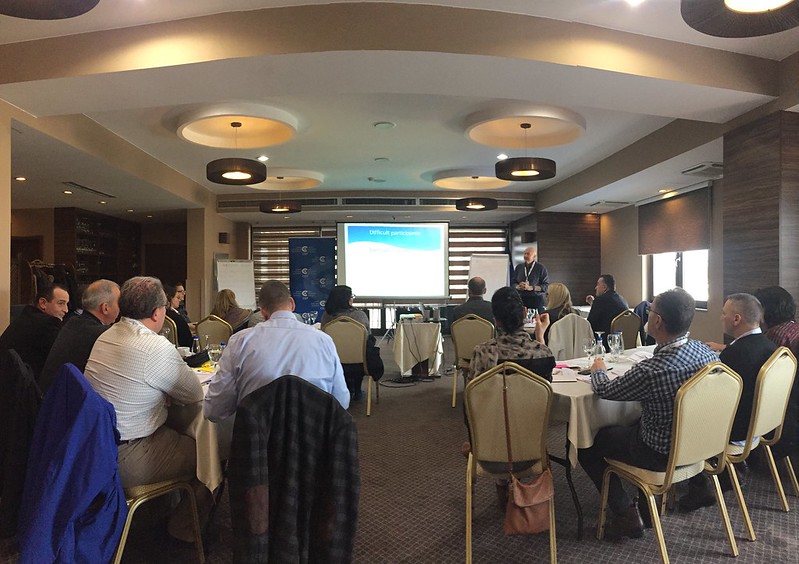
Training of Trainer (ToT), organised by the Centre for European Perspective between 29 November and 1 December in Prishtina, Kosovo, is an important feature of civilian crisis management missions due to constant rotation of staff, the challenging environment in which the missions operate and the necessary soft skills of mission personnel to effectively operate in the international setting of particular missions. Train the Trainer is a very relevant course for mission personnel delivering in mission training in order to increase their pedagogical and methodological skills.
Training is oganised in the framework of the ENTRi project, which is a unique capacity building programme that was initiated in early 2011. Currently the project is in its third cycle, lasting until 2019. The main focus lies in the training of civilians that are either going to, or already working in, crisis management missions worldwide. ENTRi consists of 12 partners, led by German Center for Peace Operations (ZIF) from Berlin.
Training was organized in close cooperation with the EULEX mission, mainly for EULEX and OSCE mission staff. CEP Project Manager Ivana Boštjančič Pulko presented a session on the ways training can support work in crisis management operations, blended learning and current training landscape and possibilities.
CEP has also been developing a ToT course package, which will be completed by the end of the year and will offer a comprehensive and free material from the ENTRi website, containing all necessary materials for course organizers or subject matter experts interested in training methodology and presentation skills.
Get an insight into the training through our photo gallery:
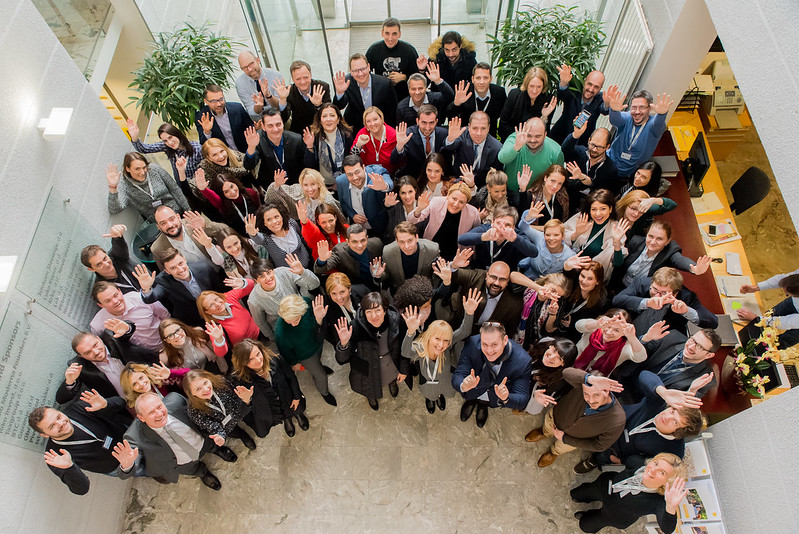
Digital diplomats, PR representatives, digital media editors and other digital devotees gathered in Bled, Slovenia this week for the training course “Enhancing Digital Diplomacy in the Western Balkans and Eastern European Countries”. The training took place between 28 and 30 November and attracted over 70 participants from Albania, Bosnia and Herzegovina, Georgia, Kosovo, Macedonia, Moldova, Montenegro, Ukraine and Slovenia. Through a training, covering a range of topics from theory of public relations and public diplomacy to specific use of digital tools and practical examples of digital campaigning, high-ranking officials from nine participating countries boosted their communication skills and established a network of digital diplomacy professionals.
The morning of the first day was devoted to introductions by the representatives of the organizers, Gautam Rana, Deputy Chief of Mission at the U.S. Embassy in Slovenia, Sabina R. Stadler, Director-General of the Directorate For Multilateral Affairs, Development Cooperation and International Law, Ministry of Foreign Affairs of the Republic of Slovenia, and Peter Grk, Secretary General of the Bled Strategic Forum and Member of Executive Board of the Centre for European Perspective.
Afterwards, the participants were absorbed in the nature of the digital future, discussing why is it important to be present online, what is the state of the digital media in Europe and who are the audiences that the institutions would target. Story-telling, misinformation and digital ecosystem building were also addressed by a number of excellent practitioners, among them Shawn Powers, Lee Nilsson and Matt Jacobs of the U.S. Department of State, Mathias Lüfkens, Burson-Marsteller, Marko Zoric, BBC YouTube Editor, and Nataša Briški and Aljaž Pengov Bitenc from Metina lista.
The second day of the training brought a close-up view on the digital campaigning, starting with a session on the interconnections between digital campaigns and official development cooperation on the case of Slovenia, where dr. Melita Gabrič, Simona Vučak and Miriam Možgan of the Ministry of Foreign Affairs of the Republic of Slovenia presented the activities in the framework of Slovenian diplomacy. In the afternoon, participants were given different scenarios through which they had to build a digital campaign, answering the most important questions that appear in the process of planning. Facebook keynote on the importance of digital communities was delivered by Sharon Yang from Facebook.
The last day focused on the visual and video content and YouTube as a channel of communication featuring workshops with Marko Zoric, BBC YouTube Editor and Oliver Mertz of U.S. Department of State. Aljaž Pengov Bitenc and Nataša Briški from Metina lista reflected on their path of establishment of an online media platform and Jeremy Caplan from Tow-Knight Center for Entrepreneurial Journalism, CUNY Graduate School of Journalism engaged participants in an interactive learning-by-doing presentation of online production tools.
The project is organised in cooperation with the U.S. Department of State and is also a part of the CEP program activities financed by the Ministry of Foreign Affairs of the Republic of Slovenia in the scope of international development cooperation.
Take a look at the photo gallery from the training here:
And get an insight into the bootcamp in our sneak peek video:
Pomurska Chamber of Commerce hosted a workshop entitled »Preparing for the EU standard of eInvoice« today in the framework of the “Readiness Of Slovenian E-Invoicing” (ROSE) Action in order to discuss the requirements of the European Directive on eInvoicing for Public Procurement (2014/55/EU) with 26 discussants.
The Directive and the new European standard for eInvoices bring some changes to the operations of budget users and an entirely new obligation for public companies and private law entities operating on the basis of special or exclusive rights in infrastructure-related activities. Therefore, the representatives of management, heads of financial services and officials responsible for procurement processes, are among the most interested workshop participants.
The partners of the ROSE Action, Public Payments Administration of the Republic of Slovenia, Chamber of Commerce and Industry of Slovenia, ZZI d.o.o.,Mojdenar IT d.o.o. and Centre for European Perspective, which are working on the preparation of the project and technical solutions for Slovenia in order to prepare it for the upcoming changes in the field of eInvoicing, briefed the participants on the new directive, the process and goals of ROSE Action, new EU standard and eSlog 2.0. standard, technical solutions for eInvoices reception and the single eInvoices recipients register.
All interested parties and those who would like to participate in the future workshops, are kindly invited to sign up for a newsletter at [email protected].