30. 5. 2019 | BIH - Supporting the way to the EU, PR, Slovenian Development Assistance
Click here to read more about the project in Slovenian language. 
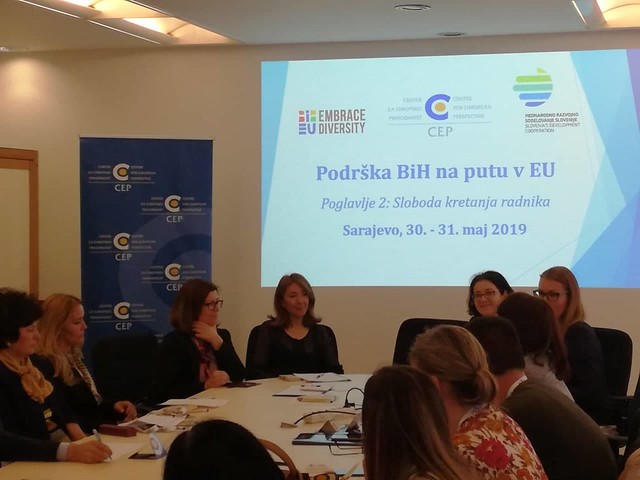
In the framework of the project “Supporting BiH on its way to the EU” the Centre for European Perspective (CEP) today starts with implementation of its first training for selected chapters of the acquis communautaire, that is designed for Bosnian civil servants. A two-day training is held at Directorate for European Integration in Sarajevo and covers the topic of freedom of movement for workers.
Three Slovenian experts from the Ministry of Labour, Family, Social Affairs and Equal Opportunities and Employment service of Slovenia are sharing their knowledge and experience on the challenges that Slovenia has encountered in the context of the mentioned topic in the adoption of the acquis. Thirty civil servants from different ministries and governmental working groups of BiH are participating at the training.
Maja Rimac Bjelobrk, assistant director at the Division for Communication and Training in the Field of European Integration at the Directorate for European Integration, welcomed participants and stressed that the CEP’s training was prepared just at the right moment, as BiH has received the first opinion of the European Commission on Bosnia and Herzegovina’s application for membership of the EU yesterday. For the country, this is the first assessment of the situation and the first set of recommendations for further work in the pre-accession process.
Participants were addressed by Zorica Bukinac, Ambassador of the Republic of Slovenia in Sarajevo as well. She agreed that the Commission’s opinion is an important message for BiH, adding that Slovenia continues to strongly support the EU’s enlargement. BiH should understand the opinion of the Commission as a signpost for direction of the future work, and the document itself indicates that BiH is in the right direction already. She told participants that in the pre-accession process they should learn from the mistakes of others that have been through the same processes, including Slovene.
 The project is part of the CEP program activities supported by the Ministry of Foreign Affairs of the Republic of Slovenia in the framework of the Slovenia’s Development Cooperation.

27. 5. 2019 | Macedonia - Finance, PR, Slovenian Development Assistance
Click here to read more about the project in Slovenian language.
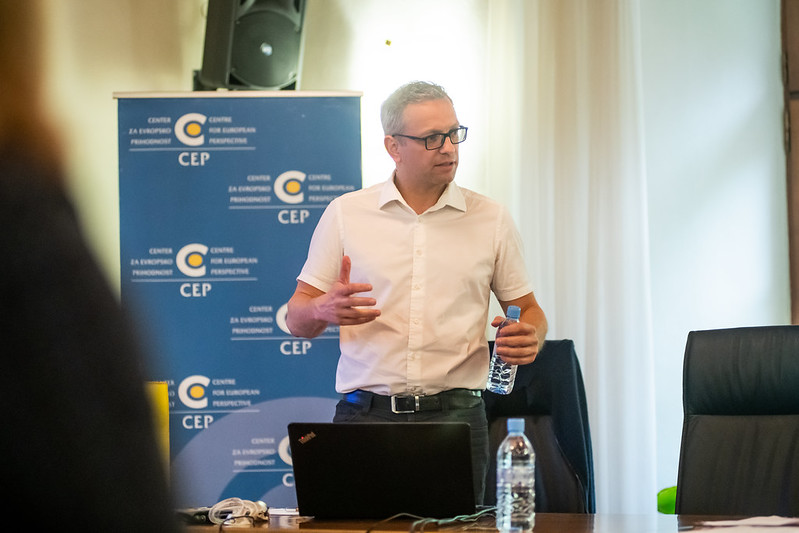
A delegation from the Republic of North Macedonia, led by State Prosecutor General Ljubomir Joveski, will be on a working visit from 4th to 7th June 2019 in Slovenia. The delegation will include the heads of the Customs Administration, Public Revenue Office, Financial Police Administration and Financial Intelligence Office, with Ministry of Interior and Central Registry involved. The purpose of the working visit is to demonstrate the functioning of Slovenian system of financial and integrated investigations, especially in terms of successful confiscation of property of illegal origin, exchange of applicable experiences and further development of the functioning of North Macedonian system in this area.
The project is part of programme activities of the Slovenia’s Development Cooperation Programme financed by the Ministry of Foreign Affairs of the Republic of Slovenia and carried out together with the Supreme State Prosecution, State Prosecution for Organised Crime and Corruption, Financial Administration, Ministry of Interior/ Police of the Republic of Slovenia as well as Office for Money Laundering Prevention and Agency of the Republic of Slovenia for Public Legal Records and Related Services.
Further information:
Andreja Dolničar Jeraj
Programme Director
[email protected]

27. 5. 2019 | PR, U-LEAD: with Europe
Centre for European Perspective is hosting its 6th International Study Visit in Slovenia. The event begun on Monday, 27th of May at Jable Castle and will continue throughout the week.
The topic of the visit is “Local Economic Development”. Local economic development is one of the key issues for ensuring the success of the decentralization process in Ukraine. However, the number of enterprises and economic activity at the local level remains very low. It concerns both the lack of enterprises in general and the problem of registration outside the place of operation.
There are currently 14 local officials from Ukraine taking part in the study visit. Participants are coming from different spheres, ranging from Project coordinators, Directors of Regional Councils, Heads of amalgamated hromadas, Heads of financial units in amalgamated hromadas, Starosta in hromadas, Economists of units on humanitarian issues, family, youth and sports in amalgamated hromadas councils, state registrars in land issues, Deputy head of Department of economic policy, State Expert on interregional and cross-border cooperation and Leaders of Expert Group on strategic planning of regional development.
The first day started by an opening delivered by Andrii Borodenkov and Oleksandra Yanushevska from the Embassy of Ukraine in the Republic of Slovenia, who have been present in all of the study visits so far. They gave an overview of Slovenia, doing business in Slovenia. Meliha Muherina, Project Manager at CEP, followed their introductory remarks with an overview of the agenda for the following days and answered all the questions participants had.
First lecture of the day was given by Mr. Robert Drobnič, discussing the topic of Regional Development Planning. He focused on planning regional development, implementation of national programs, implementation of EU programs and Social Entrepreneurship.
The second lecture was given by mag. Peter Medved, who focused on East and West Slovenia Cohesion Region Development Councils, the Functioning of development councils of cohesion regions, Initiating consultations, coordination, cooperation and joint action of ministries, development regions and development partners in the development region (representatives of municipalities, the economy and the non-governmental sector).
Third and last lecture of the day was given by Dr. Boštjan Grabner, on Development Agency of Savinjska Region, where he gave an insight to regional sustainable development in Slovenia; National and international regional development; connecting and developing partnerships for sustainable development; finding financial resources and promotion of the region.
The visit is taking place in the framework of the multi-donor action U-LEAD established by the European Union and its Member States Denmark, Estonia, Germany, Poland and Sweden. It aims at contributing to the establishment of multilevel governance that is transparent, accountable and responsive to the needs of the population of Ukraine. U-LEAD with Europe is supporting the Ukrainian Government, represented by the Ministry of Regional Development, Construction, Housing and Communal Services of Ukraine (MinRegion) as a key political partner in the coordination and implementation of the decentralization and regional policy reforms. The Program carries out demand-driven and targeted trainings for officials at the national, regional and local level.

23. 5. 2019 | PR, WB6 Startup academy, Youth
Click here to read more about the project in Slovenian language.
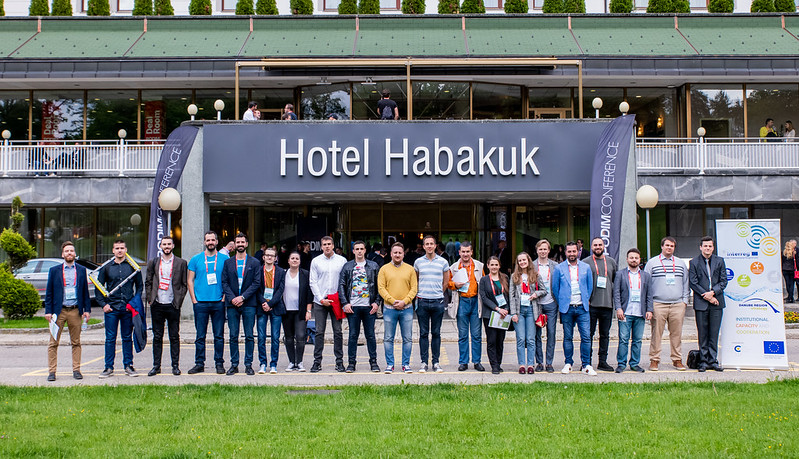
Young people represent a very active and quick learning part of the society, that is why we have been dedicating quite some activities and projects to them. We especially wanted to activate young entrepreneurs, whose functioning is inherently dependent on cooperation, wide minded thinking and out of the box thinking. Our last project concluded yesterday, when 25 young entrepreneurs from all six Western Balkan countries attended the international startup conference Podim. The whole process of the planning, organization and implementation was prepared through close co-operation with the German development agency GIZ that has crossed our path in our previous engagements for youth. We have named the program Start up Academy – Building the WB6 Unicorn (explanation: unicorn is a term used in startup circles to describe a well-established and well-pitched business idea), and by doing so putting our firm belief in the success of their ideas and the overall region.
The main objective of all the activities was to connect youth in the region, bring peers from neighboring countries closer, to support the development of their business ideas and inspire, support and convince them that many ideas can be realized. But we started step by step. In February we implemented a workshop in Tirana for their main supporters – accelerators, mentors, hubs and university incubators – these are the first institutions that young entrepreneurs with great ideas turn to. We introduced them to the importance of cooperation, openness and highlighted the way the Slovenian startup system is interconnected. Then we invited young entrepreneurs with interesting business ideas. During two workshops, in Niksic and Pristina, and with strong mentorship between them, we have been improving, building and working on the presentation of 17 business ideas. Better understanding of business plans, different types of investments, sales approaches and marketing were some of the many topics on the agenda, together with training on knowing the advantages of each enterpreneur, their competition and deficiencies on the way of their business ideas. We have also been discussing the importance of cooperation, pitching and connections – all with great aim that everyone involved in our workshops would have no problem presenting their idea in a short and understandable way. And that was the main goal of our last gathering – to present their idea, team and also themselves in an excellent and clear manner – first in Ljubljana in front of Slovene investors and Business Angels Club of Slovenia, and later in Maribor, at the Podim conference.
We have implemented our last workshop through 25 youngsters that have represented their 15 ideas from Albania, Bosnia and Herzegovina, Kosovo, North Macedonia and Serbia. Some have been pitching in front of the investors, some have been competing at the Podim Challenge and have been listed among the top 20, some have presented their products, talked to potential investors, met new partners, surprised their competitors – and used the largest international startup conference in the region in the way that best benefited the growth of their business ideas.
From workshop to workshop, young entrepreneurs showed more energy, interest, enthusiasm and desire for advancement, which at the end fueled excellent pitches. That was the main goal of all our activities, and at the same time key to all the future steps for young entrepreneurs that will without a doubt support and boost the whole startup scene in the region, that has also through our support become better connected, united and is working in a more cooperative manned.
This project is part of the activities supported by the Ministry of Foreign Affairs of the Republic of Slovenia through the Slovenia’s Development Cooperation.

23. 5. 2019 | BIH - Supporting the way to the EU, PR, Slovenian Development Assistance
Click here to read more about the project in Slovenian language.
In the framework of the project “Supporting BiH on its way to the EU” the Centre for European Perspective (CEP) will implement its first training for selected chapters of the acquis communautaire which is intended for Bosnian civil servants. A two-day training will be held on 30 and 31 May 2019 and will cover the topic of freedom of movement for workers.
Slovenian experts will share experiences and good practices with their colleagues from BiH in the field of recognition of professional qualifications, active employment policy and strengthening public service – Employment Service.
The project is part of the CEP program activities financed by the Ministry of Foreign Affairs in the scope of international development cooperation.

22. 5. 2019 | Global Education Network Europe, PR
Click here to read more about the project in Slovenian language.
From 8th of May through May 12th 2019 a special train provided by the Slovenian Railways was travelling from Ljubljana to Sofia and back. The train passengers were young entrepreneurs, who developed their business ideas during the journey, and more than successfully pitched the latter to the investors fund Launchub upon arrival to the Bulgarian capital Sofia. As part of the project ‘Global responsibility for the future’ one of the mentors was also a representative of non-governmental organizations, who helped the young entrepreneurs, so that their ideas also included a sustainable global component.
Esteemed business owners also joined the startup journey on train tracks in the role of mentors. The organizers of the project wished to enable the fifty selected young participants to start their business and provide inspiration for the young entrepreneurs to implement their business ideas. The role of non-governmental organizations was to integrate the global sustainable component into the project ideas. By doing so, their business ideas would transcend the base of societal responsibility, as to raise awareness for all three pillars of sustainability: social, economic and environmental.
The award for the socially most beneficial idea was received by the project Help, which focuses on helping elderly people with their household chores and is led by Filip Uranc. The award was enabled by supporters and co-financers GENE, CEP, European Commission and the Ministry of Foreign Affairs of the Republic of Slovenia.
Some of the young participants, who were engaged in our workshops on the topic of global learning before the train journey, have in many aspects shown their interest for global learning, asked about fair trade, acquirement process for certification materials and other relevant subjects. The most memorable workshop was devoted to clothing, where the participants discovered how much water is needed to produce pants (jeans). Some of the participants who were interested in the topic decided to research the possibilities on how to integrate the ethical component into their business idea.
Source: Platform SLOGA