22. 1. 2018 | Danube, PR
For victims of trafficking in human beings, the Danube Region is not only a destination for exploitation. A significant amount of victims of human trafficking in Europe is recruited from within the Danube Region, in particular within Romania and Bulgaria. Cities and municipalities can play a crucial role in identifying and assisting victims as well as preventing trafficking in human beings as local actors are closest to both victims and traffickers. Effectively combatting trafficking in human beings requires cooperation between different local stakeholders from public authorities and law enforcement, civil society and further actors involved in the field as well as a coordinated transnational approach. However, cities and municipalities often lack the capacities and know-how to act accordingly and need to establish cooperation ties between the various stakeholders.
Priority Area 10 “Institutional Capacity and Cooperation” of the EU Strategy for the Danube Region (EUSDR) organized the Round Table on “Preventing & Combating Human Trafficking and Exploitation at Local Level” in Vienna on 24th of November 2017. Experts and newcomers from public administration, civil society, international organizations and academia shared their experience in the fight against trafficking in human beings (THB). Slovene experiences were presented by Society Ključ (Društvo Ključ) and Slovenian Karitas, supported by CEP representative.
The participants emphasized the important role of local actors in fighting trafficking in human beings as they are the closest to both victims and traffickers and can therefore more easily detect them. However, there are severe gaps and training needs among frontline responders. Claudia Singer (EUSDR Priority Area 10) presented the recent “Guidelines for Municipalities” in the Danube Region that provides some guidance for identifying and assisting victims of human trafficking as well as mapping and preventing human trafficking at local level.
In a current study, the International Centre for Migration Policy Development (ICMPD) analyses the risks of exploitation, training needs as well as good practices in victim protection. Enrico Ragaglia (ICMPD) pointed out that one of the challenges is that victims might not be aware what crime they are victim of, which makes the detection of victims more difficult for official bodies. Additionally, the status of victims can be challenged through the transnationality of the crime, meaning that victims of human trafficking might not be classified as victims in the legal sense in the country of destination as the crime of human trafficking took place in a different country. Thus, victims are not part of a legal procedure and are not granted victim rights.
Against this background, the experts shared examples of proven measures to support victims such as toll-free helplines, setting up crisis units with stakeholders from different sectors that assist victims and evaluate the state of play on a regular basis, drafting a set of tasks for collaboration or envisaging protection programmes. Experts from city administrations and civil society presents some good practices addressing better coordination through standing working groups (Vienna, AT), cooperation between civil society and law enforcement (Ljubljana, SI), comprehensive assistance for victims (Barcelona, ES) and awareness raising (Moscow, RU).
The next D-CAHT seminar will take place in the first half of 2018 in Ljubljana, Slovenia.
The Round Table on “Preventing & Combating Human Trafficking and Exploitation at Local Level” is part of the initiative Danube Cities Against Human Trafficking (D-CAHT) of Priority Area 10 “Institutional Capacity and Cooperation” of the EU Strategy for the Danube Region (EUSDR). The initiative aims at raising awareness of trafficking in human beings among local actors, providing local actors, administration, representatives of NGOs with information and know-how by highlighting good practices in cities and municipalities and identifying common challenges and provide practical tools for the work of local actors.
The Round Table on “Preventing & Combating Human Trafficking and Exploitation at Local Level” was co-financed by the Interreg Danube Transnational Programme/European Union and the city of Vienna.
Documents:
Guidelines for Municipalities: Stepping up local action against human trafficking in the EU Strategy for the Danube Region
Danube Cities against Human Trafficking: Round Table on Preventing and Combating Human Trafficking and Exploitation at Local Level


18. 1. 2018 | PR
Na gradu Jable se je 18. januarja odvil drugi dialog v seriji razprav o prihodnosti Evropske unije, tokrat na temo evropske socialne razsežnosti, ki ga je organiziralo Ministrstvo za zunanje zadeve RS, udeležili pa so se ga tudi predstavniki Centra za evropsko prihodnost. Med ključnimi sogovorniki na razpravi so bili predstavniki zunanjega ministrstva ter ministrstva za delo, aktivno pa je sodelovalo preko 20 udeležencev iz državne uprave, izobraževalnih institucij, nevladnih organizacij in medijev.
V središču razprave je bil razmislek o prihodnjem evropskem socialnem modelu in odzivanju na spremembe, ki se odvijajo v evropski družbi. Evropska unija priznava močan pomen skupne evropske socialne razsežnosti, hkrati pa opozarja na različnost nacionalnih sistemov v državah članicah. Za dolgoročno stabilnost mora Evropska unija socialno kohezijo nujno okrepiti, so se strinjali udeleženci, je pa pomembno razumeti, da se le-ta v državah članicah razume in izvaja različno.
V luči rastoče neenakosti v evropski družbi, ki se kaže tudi v vzponu radikalnih idej in protievropskega duha, se odpirajo novi pogledi na vprašanja družbene kohezivnosti, kot so prekariat, novi družbeni razred ter izginjanje srednjega razreda. Med ključnimi besedami se v kontekstu razprave o socialnih modelih pojavlja koncept subsidiarnosti. Države namreč imajo možnost, da izbirajo različne odzive na socialne izzive in socialno kohezijo, naloga Evropske unije pa je uravnotežiti odgovornost držav članic.
Razprava je izhajala tudi iz zaključkov Socialnega vrha držav članic Evropske unije, ki je potekal novembra 2017 v Goetheburgu na Švedskem, poimenovanega “Za pravična delovna mesta in rast”. Na socialnem vrhu so Evropski parlament, Svet in Evropska komisija skupaj razglasili evropski steber socialnih pravic, ki ga je predsednik Evropske komisije Juncker napovedal že v svojem govoru o stanju v uniji leta 2015. Gre za skupno zavezo voditeljev EU k varovanju in podpiranju 20 načel in pravic, zapisanih v stebru. Voditelji so decembra lani na Evropskem svetu opozorili predvsem na pomen postavljanja človeka na prvo mesto ter na konvergenco med državami članicami.
Med problematikami, ki so se jih govorci dotaknili, je bila tudi dvojna narava inkluzivne rasti preko odvisnosti prosperitete držav od gospodarske rasti ob poskusu vključevanja državljanov, tako ekonomskega kot političnega. Kot ena izmed konkretnih posledic, je bila izpostavljena prihodnost mladih, ki so dandanes prva generacija, ki v velikem deležu ne bo dosegla standarda svojih prednikov. Med potencialnimi ključnimi instrumenti za prihodnost socialnih modelov so bili navedeni izobraževanje, progresivna globalna obdavčitev kapitala, sheme solastništva, socialni programi proti neenakosti, spodbujanje novih oblik socialne organizacije, ki bo omogočala vzdržnostni razvoj, prihodnost dela in z njo skrajšanje delovnega časa.
Ob izzivih demografije in staranja prebivalstva se sočasno odpirajo potrebe po vseživljenjskem učenju, ob digitalizaciji, ustvarjanju novih delovnih mest ter potrebah po novih veščinah pa poglobljeno izobraževanje in usposabljanje, hkrati pa tudi ureditev mobilnosti delavcev, regulacija čezmejnega delovanja z uporabo digitalnih platform, poglobljena koordinacija sistemov socialne varnosti.
V evropski sliki obstajajo številni kontrasti, medtem ko vzhod ob visoki zaposlenosti ohranja nižji standard in nizke plače, zahod povečuje divergenco med bogatimi in revnimi, mnoge države pa se še vedno soočajo s posledicami finančne krize. Prav zato mora Evropska unija nadaljevati z iskanjem konvergenc, iskati in vzpostaviti razmerje med solidarnostjo in subsidiarnostjo ter biti pripravljena na prihajajoče krize. Temelj Evrope mora ostati na ljudeh. Slovenija mora pri tem biti v svojih ciljih jasna ter ostati v središču širših evropskih integracij in razmislekov o prihodnosti.

22. 12. 2017 | PR, ROSE
Slovenian obligors for public procurements are getting such exchange hub for eInvoices which will enable them to receive eInvoice in European standard, a requirement of the newly adopted Directive 2014/55/EU on eInvoicing.
The technical solution in the form of upgraded single entry and exit point is being implemented by the Public Payments Administration of the Republic of Slovenia for public procurement obligors, which are budget users. A brand new exchange hub is designed by ZZI d.o.o. for contracting authorities and contracting entities, which are not budget users, under the patronage of the Chamber of Commerce and Industry of Slovenia. Both solutions will be compatible, following the same concept of functioning and will thus be establishing a common system, taking into account interfaces with ERP providers who service both budget users as well as obligors who are not budget users. Both solutions will translate UN/CEFACT CII and UBL 2.1 syntax eInvoice into the new EN 16931 compliant Slovenian standard eSLOG 2.0 and will ensure visualisation of 2.0 eInvoice. In the transitional period, technical solutions will also generate conversions of eSLOG 2.0 eInvoice into eSLOG 1.6 eInvoice, which will ensure easier and smoother transition into novelties.
Informing stakeholders is among the key activities of the Action
In order to successfully implement the Directive 2014/55/EU in Slovenian public procurement market, the inclusion of the stakeholders and awareness raising is among the key priorities of the actors, involved in the ROSE Action. Workshops and lectures across Slovenia started in November 2017 and will be continued in January 2018. More details are available at www.roseslovenia.eu.
Solution development was presented on 21 December 2017 at 7th Steering Board meeting of the ROSE Action, a Connecting European Facility Action, co-financed by the European Union and implemented by the Public Payments Administration of the Republic of Slovenia, Chamber of Commerce and Industry of Slovenia, ZZI d.o.o., Mojdenar IT d.o.o. and Centre for European Perspective.

21. 12. 2017 | Montenegro - EU Accession, PR
In the framework of the CEP’s bilateral technical assistance project “Assistance to Montenegro in negotiations on accession to the EU 2017” experts from Slovene Securities Market Agency (ATVP) host their counterparts from Montenegrin Securities and Exchange Commission on a two day study visit.
The participants were welcomed by Miloš Čas, Director of ATVP, who presented the experience of the Agency in the process of adapting and implementing of the EU legislation in the field of financial services. Three experts from the Agency will present different EU directives that regulate the field of financial services to Montenegrin colleague. On Friday, they will visit the management company KD Skladi.
ATVP experts provide their counterparts consultations and exchange of Slovene experience in negotiating Chapter 9 – Financial services in the securities market.
The project is part of the CEP program activities financed by the Ministry of Foreign Affairs in the scope of international development cooperation.
Read Slovene article here.

14. 12. 2017 | Montenegro - EU Accession, Slovenian Development Assistance
In the framework of the CEP’s bilateral technical assistance project “Assistance to Montenegro in negotiations on accession to the EU 2017” experts from Slovene Securities Market Agency (ATVP) will on 21 and 22 December 2017 host their counterparts from Montenegrin Securities and Exchange Commission on a two day study visit.
ATVP experts will provide their counterparts consultations and exchange of Slovene experience in negotiating Chapter 9 – Financial services in the securities market.
The project is part of the CEP program activities financed by the Ministry of Foreign Affairs in the scope of international development cooperation.
Read this article in Slovene language.

12. 12. 2017 | Danube, PR
European Parliament recently published Report on the implementation of EU macro-regional strategies, where the institution strongly supports macro-regional integration and offers a number of elements and suggestions for concrete activities on the level of macro-regions in the future.
Macro-regional strategies have gained importance in recent years as a platform for transnational cooperation between Member States but also with third countries. They provide an integrated framework to address mutual challenges and exploit common potential. In the 2014-2020 programming period, MRS have been incorporated in the European Structural and Investment Funds (ESI Funds) programmes.
Currently, four existing MRS (Baltic, Danube, Adriatic-Ionian and Alpine) are bringing together 19 Member States and 8 non-EU countries. Some Member States participate in more than one MRS, whereas Slovenia is the only country that participates in three macro-regions.
MRS are set within the boundaries of the “three no’s” principle: no new EU funds, no additional EU formal structures and no new EU legislation. Financial support does come in form of European Territorial Cooperation (ETC) transnational cooperation programmes which are financed by the European Regional Development Fund (ERDF).
As the Commission states, MRS are about more than just funding because they “bring citizens of different Member States together and improve their social and economic living conditions through trans-border cooperation.”
Centre for European Perspective as the coordinator of the EU Strategy for Danube Region’s priority area Institutional Capacity and Cooperation in the Danube Region (PA 10) aims to promote cooperation between the 14 countries (Germany, Austria, Czech Republic, Slovakia, Hungary, Slovenia, Romania, Bulgaria, Croatia, Serbia, Bosnia and Herzegovina, Montenegro, Moldova and Ukraine) for enhancing sustainable development and competitiveness of this part of Europe and follows closely the developments in the field.
A full report of the European Parliament can be accessed here.

8. 12. 2017 | PR, Serbia - Traineeships
In the framework of the project “Professional Experience for Serbian Civil Servants”, CEP cooperated with the Ministry of the Economic Development and Technology, The Ministry of Education, Science and Sport of the Republic of Slovenia and Ministry of Labour, Family and Social Affairs.

From October to November, three Serbian civil servants from the Ministry of European Integration of Republic of Serbia were trained in the area of Free movement of capital, goods and labour, competition policies, consumer protection and health, science and research and company law. In addition, the project has facilitated the collaboration of experts who will in the future work within the EU.
The project is part of the CEP program activities financed by the Ministry of Foreign Affairs of the Republic of Slovenia from the funds for international development cooperation.

7. 12. 2017 | Bled Strategic Forum, PR
Centre for European Perspective has in cooperation with the Bled Strategic Forum international conference and the Ministry of Foreign Affairs of the Republic of Slovenia held its traditional December round table on the topic of Western Balkans. Round table was attended by more than 50 participants, coming from the Slovenian ministry of Foreign Affairs, Academia, Embassies and long-standing partners of CEP and BSF.
The discussion was based on the conclusions of the Panel on the Western Balkans, held at the Bled Strategic Forum 2017, where a clear message emerged – the process of enlargement of the European Union is still an incentive for transformation for the countries in the Western Balkans, and the speakers agreed in September that the future of the region is within the European Union. The values shared by the region and the EU represent a strong driving force for both sides. However, not attractiveness nor support should not be taken for granted, and the process must have a clearly defined ultimate goal.
Welcome address was delivered by Dr Gorazd Justinek, Executive Director, Centre for European Perspective who shortly presented CEP activities in 2017, stating that there were more than 60, while BSF was seen as the most remarkable one. He also thanked all the partners who have helped us to achieve and conclude a successful year.
Opening remarks were given by Mr Iztok Mirošič, State Secretary, Ministry of Foreign Affairs of the Republic of Slovenia who stressed the importance of inclusion of WB countries into the EU for the prosperity and stability of the region, arguing that Slovenia greatly supports European integrations but stays aware of work that both sides still have to do. He underlined there is a new impetus in regard of the enlargement process and EU still sees vast potential in the region, but reminiscences of the past are sometimes better trigger than anything else, and different accounts of history are stopping the reconciliation process. Past is stopping thinking about the most important – future. Most significant priorities in the WB countries should be the rule of law and economic prosperity. Mr Mirošič said regional initiatives are continuing their work harder than they did in the past and is up to the countries in WB to use this momentum in order to move the things on the ground and achieve its goals. In conclusion State Secretary stated “There is always light at the end of the tunnel, if we all move in the same way”.
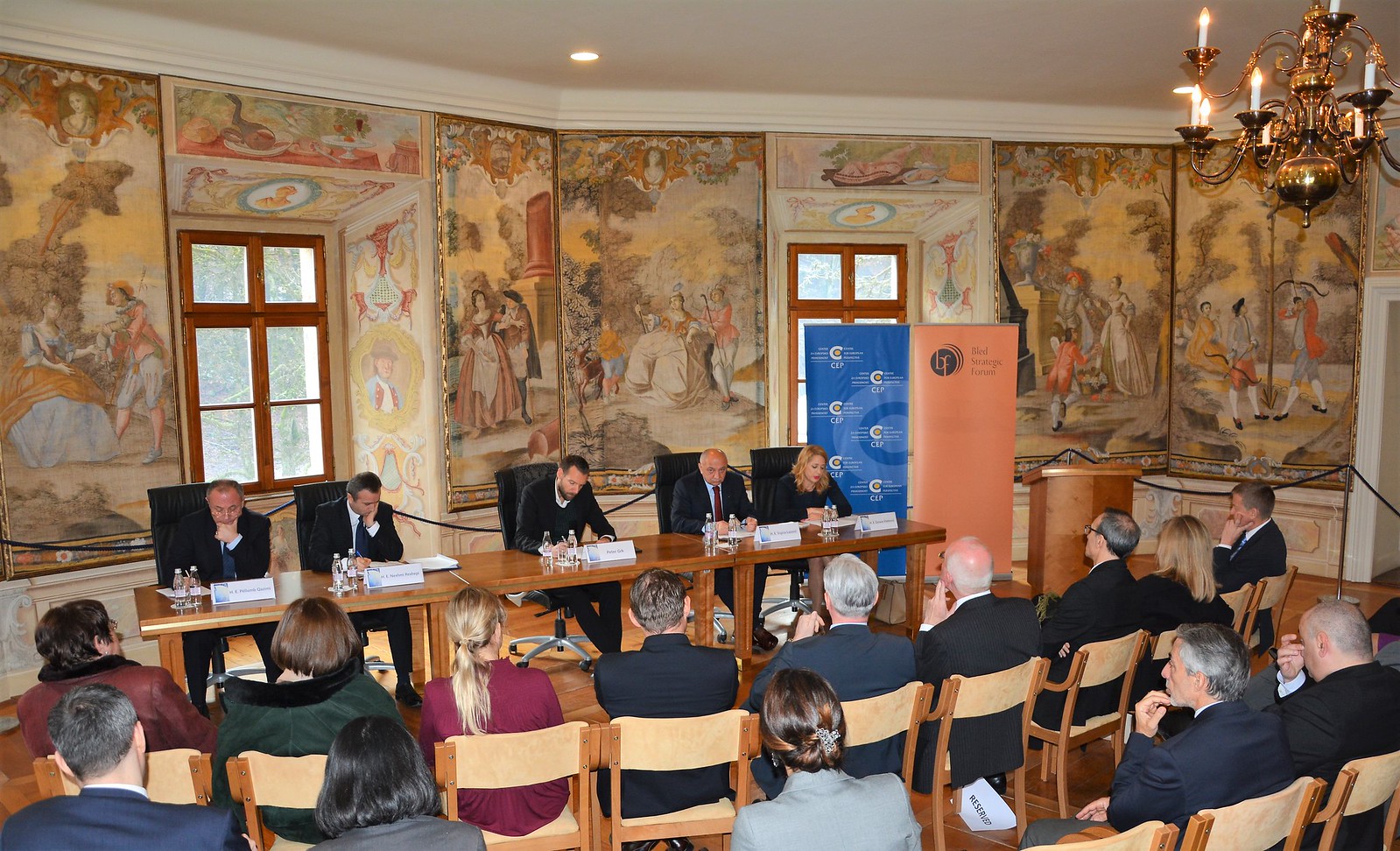 Round table was moderated by Mr Peter Grk, National Coordinator for Western Balkans, Ministry of Foreign Affairs of the Republic of Slovenia, who argued that today we have the window of opportunity in the Western Balkans. Today, compared to 5 years ago, when President of European Commission Juncker said enlargement process is over, we had a speech where Juncker argued Serbia and Montenegro are expected to enter EU before 2025. That marks first time European Commission has set a date, causing change in enlargement atmosphere that until then was facing enlargement fatigue and enlargement patience. Question remains whether the date set is feasible, as well as what actions will be taken in order to close the economic gap between the countries in the region.
Speakers of the round table were H. E. Mr Pëllumb Qazimi, Ambassador of the Republic of Albania, H. E. Mr Nexhmi Rexhepi, Ambassador of Kosovo, H. E. Dr Vujica Lazović, Ambassador of Montenegro and H. E. Mrs Zorana Vlatković, Ambassador of the Republic of Serbia.
Main points of the debate focused on improvement in atmosphere regarding the enlargement, where Balkans are not presented in negative sense anymore; there is a good vibration coming from the EU regarding the regions integration process. Speakers agreed there is a need for a clear enlargement strategy in the region and the need to speed up the process, while they have remained aware that opening the negotiations is just the beginning of a long and challenging path. Panelists underlined the importance of European integration remaining key goal of their foreign policies, while public support for integration remains very high in all the countries, with no alternatives to be considered. Debate touched upon the reconciliation as a pre-requisite for European integration and regional cooperation, nationalistic narratives and wars that were not structurally addressed are hampering the enlargement process. Two main conclusions were drawn, first one being the importance of current positive atmosphere and second one the importance of not losing the momentum, where positive atmosphere should be translated into actions.
Views on the subject were given by H. E. Mr Paolo Trichilo, Ambassador of the Republic of Italy, H. E. Mr Bart Twaalfhoven, Ambassador of the Kingdom of the Netherlands, H. E. Mr Pawel Czerwiński, Ambassador of the Republic of Poland, H. E. Ms Edit Szilágyiné Bátorfi, Ambassador of Hungary, Nicola Stewart, UK Embassy and Zoran Stančič, Head of the European Commission Representation in Slovenia who stressed the importance of such events that are facilitating the integration process. They have argued very little progress was seen from the WB states in regards the integrations, while the current positive momentum should be used to advance their agenda in more aggressive way. Speakers agreed that from a policy perspective we are in a stage where interdependence between WB and EU is very high, due to different cross-state issues, such as refugee crisis and illegal trade, that cannot be resolved without the inclusion of the whole European region. They have agreed the debate on whether WB should enter or not is useless, since positions are clear, the prosperity of the EU clearly depends on the success of integration process, but on the other hand accessing countries are themselves responsible for acquiring proper acquis, meeting all the criteria and setting the pace of change. Importance of regional initiatives was underlined, where cooperation between the countries can help them in speeding up the process, while renewed political efforts are expected from WB countries.
Read in Slovene language.