23. 5. 2019 | PR, WB6 Startup academy, Youth
Click here to read more about the project in Slovenian language. 
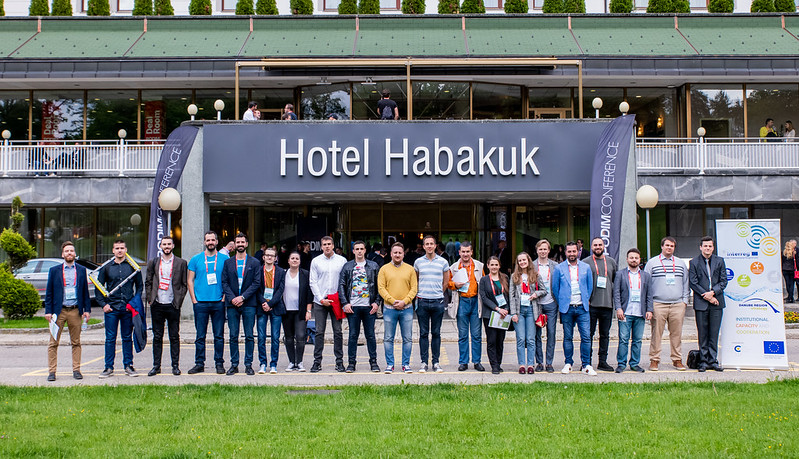
Young people represent a very active and quick learning part of the society, that is why we have been dedicating quite some activities and projects to them. We especially wanted to activate young entrepreneurs, whose functioning is inherently dependent on cooperation, wide minded thinking and out of the box thinking. Our last project concluded yesterday, when 25 young entrepreneurs from all six Western Balkan countries attended the international startup conference Podim. The whole process of the planning, organization and implementation was prepared through close co-operation with the German development agency GIZ that has crossed our path in our previous engagements for youth. We have named the program Start up Academy – Building the WB6 Unicorn (explanation: unicorn is a term used in startup circles to describe a well-established and well-pitched business idea), and by doing so putting our firm belief in the success of their ideas and the overall region.
The main objective of all the activities was to connect youth in the region, bring peers from neighboring countries closer, to support the development of their business ideas and inspire, support and convince them that many ideas can be realized. But we started step by step. In February we implemented a workshop in Tirana for their main supporters – accelerators, mentors, hubs and university incubators – these are the first institutions that young entrepreneurs with great ideas turn to. We introduced them to the importance of cooperation, openness and highlighted the way the Slovenian startup system is interconnected. Then we invited young entrepreneurs with interesting business ideas. During two workshops, in Niksic and Pristina, and with strong mentorship between them, we have been improving, building and working on the presentation of 17 business ideas. Better understanding of business plans, different types of investments, sales approaches and marketing were some of the many topics on the agenda, together with training on knowing the advantages of each enterpreneur, their competition and deficiencies on the way of their business ideas. We have also been discussing the importance of cooperation, pitching and connections – all with great aim that everyone involved in our workshops would have no problem presenting their idea in a short and understandable way. And that was the main goal of our last gathering – to present their idea, team and also themselves in an excellent and clear manner – first in Ljubljana in front of Slovene investors and Business Angels Club of Slovenia, and later in Maribor, at the Podim conference.
We have implemented our last workshop through 25 youngsters that have represented their 15 ideas from Albania, Bosnia and Herzegovina, Kosovo, North Macedonia and Serbia. Some have been pitching in front of the investors, some have been competing at the Podim Challenge and have been listed among the top 20, some have presented their products, talked to potential investors, met new partners, surprised their competitors – and used the largest international startup conference in the region in the way that best benefited the growth of their business ideas.
From workshop to workshop, young entrepreneurs showed more energy, interest, enthusiasm and desire for advancement, which at the end fueled excellent pitches. That was the main goal of all our activities, and at the same time key to all the future steps for young entrepreneurs that will without a doubt support and boost the whole startup scene in the region, that has also through our support become better connected, united and is working in a more cooperative manned.
 This project is part of the activities supported by the Ministry of Foreign Affairs of the Republic of Slovenia through the Slovenia’s Development Cooperation.

23. 5. 2019 | BIH - Supporting the way to the EU, PR, Slovenian Development Assistance
Click here to read more about the project in Slovenian language.
In the framework of the project “Supporting BiH on its way to the EU” the Centre for European Perspective (CEP) will implement its first training for selected chapters of the acquis communautaire which is intended for Bosnian civil servants. A two-day training will be held on 30 and 31 May 2019 and will cover the topic of freedom of movement for workers.
Slovenian experts will share experiences and good practices with their colleagues from BiH in the field of recognition of professional qualifications, active employment policy and strengthening public service – Employment Service.
The project is part of the CEP program activities financed by the Ministry of Foreign Affairs in the scope of international development cooperation.

22. 5. 2019 | Global Education Network Europe, PR
Click here to read more about the project in Slovenian language.
From 8th of May through May 12th 2019 a special train provided by the Slovenian Railways was travelling from Ljubljana to Sofia and back. The train passengers were young entrepreneurs, who developed their business ideas during the journey, and more than successfully pitched the latter to the investors fund Launchub upon arrival to the Bulgarian capital Sofia. As part of the project ‘Global responsibility for the future’ one of the mentors was also a representative of non-governmental organizations, who helped the young entrepreneurs, so that their ideas also included a sustainable global component.
Esteemed business owners also joined the startup journey on train tracks in the role of mentors. The organizers of the project wished to enable the fifty selected young participants to start their business and provide inspiration for the young entrepreneurs to implement their business ideas. The role of non-governmental organizations was to integrate the global sustainable component into the project ideas. By doing so, their business ideas would transcend the base of societal responsibility, as to raise awareness for all three pillars of sustainability: social, economic and environmental.
The award for the socially most beneficial idea was received by the project Help, which focuses on helping elderly people with their household chores and is led by Filip Uranc. The award was enabled by supporters and co-financers GENE, CEP, European Commission and the Ministry of Foreign Affairs of the Republic of Slovenia.
Some of the young participants, who were engaged in our workshops on the topic of global learning before the train journey, have in many aspects shown their interest for global learning, asked about fair trade, acquirement process for certification materials and other relevant subjects. The most memorable workshop was devoted to clothing, where the participants discovered how much water is needed to produce pants (jeans). Some of the participants who were interested in the topic decided to research the possibilities on how to integrate the ethical component into their business idea.
Source: Platform SLOGA

20. 5. 2019 | Bled Strategic Forum, PR, Youth
The Young Bled Strategic Forum (Young BSF) is an annual conference bringing together young leaders to engage in lively discussion and develop out-of-the-box solutions to some of the most pressing world issues. The Young BSF model has been growing and changing and has become a unique meeting place for a diverse array of young leaders, entrepreneurs, influencers, thinkers and social activists and thus, offering them a platform to share their visions, exchange ideas and connect with one-another. The Young BSF 2019 will host young leaders under the title “Youth as a (future) (re)source”.
Young BSF 2019 will reflect the topics of the BSF and focus on sources and resources of (in)stability and look up at young people as a (re)source for the future. The young people that will attend this year’s edition of Young BSF will prove youth is a valuable resource in several ways. Young people are not solely valued as potential contributors to society, in their status as adults-to-be, but also in their present status as youth, whereby they contribute to society for the very reason that they are young, full of innovative ideas and able of thinking out of the box.
Special emphasis at the Young Bled Strategic Forum will be given to the cross-regional cooperation. A new generation of leaders will demonstrate that such cooperation is not only necessary, but rather inevitable for positive next steps in democratization, advancement of human rights, sustainable development, women empowerment, counter-terrorism and climate change. To do this, young leaders have to learn from their peers from different regions, share their knowledge, ideas and know-how. Sustainable regional cooperation programs are the key towards a comprehensive, inclusive, and innovative approach that engages youth and prepares agents for change.
Strong, committed and inclusive democratic youth leadership will be of crucial importance for the process of democratization, conscientious European integration and future EU expansion in general. In our efforts to build a structured regional cooperation we must therefore bring young leaders on board in order to build tighter ties among civil societies, offer room for youth-to-youth exchanges, and enable a continuous flow of information and knowledge among the EU member states and non-EU states.
Youth, being the essential cornerstone of dynamic civil societies, should be given an opportunity to:
- Contribute to the regional integration,
- Be the herald of European values and democratic leadership with dedication and perseverance,
- Identify topics of common interest and tackle issues of shared concern for communities in the region.
Young leaders will also be selected to participate as speakers at the main event. This practice has proven its worth in past editions and to the benefit of BSF, as it brought innovative solutions and shed a light on youth perspectives. Youth will through active participation at BSF have an opportunity to meet the leaders from the governmental, business and nongovernmental sectors and join them in discussions addressing salient issues.
Young Bled Strategic Forum is committed to ensuring equal opportunities to attend the YBSF are available to young leaders, regardless of their ability to pay. We work closely with our partners to provide all of our participants with accommodation, while a number of travel grants for candidates of various backgrounds and nationalities will be ensured. Travel grants may be awarded to selected participants on an individual basis and only up to the amount decided by the organizers, while we will ensure regional and expertise representation.
Countries eligible for the travel grant: Albania, Austria, Bosnia and Herzegovina, Bulgaria, Croatia, Czech Republic, Germany, Hungary, Kosovo, Macedonia, Moldova, Montenegro, Poland, Romania, Serbia, Slovakia, Ukraine.
The selected participants are expected to join in the extensive preparations and pre-event online meetings. Please note that the official language of the event is English, and that this is a prerequisite for participation in our activities. Only selected participants will be notified.
Apply by 10th of June 2019 at the latest.
For any additional inquiries, do not hesitate to contact us at [email protected]


20. 5. 2019 | PR, Start:up Balkan, WB6 Startup academy
Click here to read more about the project in Slovenian language.
Center for European Perspective has this year, with the support of the Ministry of Foreign Affairs of the Republic of Slovenia, in cooperation with the GIZ Regional Office in Sarajevo, implemented a project ‘WB6 Startup Academy’. The main purpose of the project is to empower innovative young entrepreneurs from all six Western Balkan countries to strengthen their knowledge and increase the opportunities for realizing their business idea.
The last module of the project started in Ljubljana, on 20th of May, at ABC Accelerator. 25 young people, representing 15 entrepreneurial ideas from all six Western Balkan countries, met with the Business Angels of Slovenia, where the best 5 got a chance to pitch in front of the investors. Ivmax, Marleq, ELS Development, Blocknify and Tratics got 6 minutes to present their innovative idea. Investors gave them feedback with critical comments and tips, enabling them to further develop and improve their concept.
The group will move to Maribor, where the international conference Podim will be held from May 21 through May 22. The latter is largest conference for start-ups, investors and other experts in the region. The young entrepreneurs will be able to present their ideas at the event, look for potential partners, investors and learn a lot through participating in various lectures from world-renowned experts. One of the main dimensions of the whole workshop is also the peer-to-peer networking of young people, who often face similar challenges in the region.
The project is part of the activities that are through the Slovenia’s Development Cooperation financed by the Ministry of Foreign Affairs of Slovenia.


17. 5. 2019 | PR, U-LEAD: with Europe
Centre for European Perspective has this week hosted the 5th International Study Visit in Slovenia, that began on Monday, 13th of May at Jable Castle and concluded on 17th of May in Graz.
There were 17 local officials, entrepreneurs and business associations from Ukraine taking part in the study visit. The topic of the visit was “Role of Business Organisation’s cooperation with local communities”.
The first day started by an opening delivered by our Executive Director Katja Geršak who welcomed the participants and introduced keynote speakers, mag. Aleš Cantarutti, State Secretary and Marko Drofenik, Director General from Directorate for Regional Development, Ministry of Economic Development and Technology, Slovenia. All the speakers welcomed our participants and expressed their satisfaction that such projects are happening and hope they will continue in a meaningful manner. We were also thrilled to host Andrii Borodenkov and Oleksandra Yanushevska from the Embassy of Ukraine in the Republic of Slovenia, who have been present in all of the study visits so far. The content part of the visit started by a presentation delivered by Irena Meter, from SPIRIT Slovenia – Public Agency for Entrepreneurship, Internationalization, Foreign Investments and Technology, who focused on incentives for companies in Slovenia, its program and activities. She was followed by Zoran Stamatovski, who focused on Systemic approach to business environment development; Small business assistance programs and Local communities in developing business environment. Third on the agenda was Gorazd Jenko, expert on Smart specializations strategy of Slovenia from the Government Office for Development and European Cohesion Policy, who focused on Challenges of Slovenia and answers form the S3 strategy, Projects under the S3 strategy and Bilateral national and local partnerships. Last but not least, participants were addressed by Matej Rogelj from Chamber of commerce and Industry of Slovenia, who focused on Forms of organization of associations and chambers; Local and regional forms of associations and Cooperation between Private and Public Sector.
After a successful first day, full of background knowledge for following days, participants had a chance to experience the mentioned topics in practice. The full second day was spent in Kamnik, where we were kindly welcomed by Local Entrepreneurs club Kamnik, Kik Štarter, TIC Kamnik and Mayor of the Municipality Mr. Matej Slapar. We are also very proud of two Letters of Intent that were signed that day, signalizing a will for cooperation continuation. Letters of Intent were signed between Aleš Juhant, Vice President of Business Club Kamnik, Mykola Savulyak, Business Community Club from Ukraine and Tetiana Palamarchuk, Executive director of Union of Ukrainian entrepreneurs. We are looking forward to the future and hearing how the events will develop for them.
The third day of the event was spent with a visit to Technology Park Ljubljana where participants were greeted by the Director of the Technology park, Mr. Cerar Matej. The setting of the activities in that afternoon was the city center of Ljubljana, where the participants were introduced to investment and development plans for the city while exploring it´s hidden treasures. They were familiarized with such projects as the old town renewal and the city renewal, found out about traffic that is closed in the city center and the impact of the projects on small business.
The fourth morning started very early with a business breakfast with BNI Slovenia, followed by a trip to Graz. In Graz participants were greeted by many speakers, ranging from municipality representatives, local business coordinators, Ukrainian Honorary Consul and others. The topics of discussion were: The city of Graz and the region Styria as business location and co-operations, clusters, co-working in the area; Political agenda and export support also with local subsidies and other initiatives to support companies; Strategy of the Internationalization Centre Styria. The visit was finalized with a short summary of everything discussed, feedback session and certificates ceremony.
The visit is taking place in the framework of the multi-donor action U-LEAD established by the European Union and its Member States Denmark, Estonia, Germany, Poland and Sweden. It aims to contribute to the establishment of multilevel governance that is transparent, accountable and responsive to the needs of the population of Ukraine. U-LEAD with Europe is supporting the Ukrainian Government, represented by the Ministry of Regional Development, Construction, Housing and Communal Services of Ukraine (MinRegion) as a key political partner, in the coordination and implementation of the decentralization and regional policy reforms. The Program carries out demand-driven and targeted trainings for officials at the national, regional and local level.


16. 5. 2019 | Bled Strategic Forum, PR
Centre for European Perspective has together with Bled Strategic Forum supported Salient – Youth Conference titled “The Transatlantic Divide”
The Salient conference has always been about great content delivered in innovative ways. This year they have taken their approach a step further by introducing a 1+4 format: one whole day dedicated to public discussions with experts, policy-makers and political representatives, followed by four days of crisis-driven MUN and MEU simulations. This approach aims at providing a more focused learning experience that will give participants an opportunity to deepen their conceptual knowledge of the issues before testing it out in practice.
CEP has actively participated in one round table, titled “The Iran Deal: Beyond Salvageable?”, with CEP Executive Director Katja Geršak as a panelist, and project manager Meliha Muherina as moderator. The second panelist on the panel was Jožef Kunič, Former Ambassador to Iran.
The dispute over the Joint Comprehensive Plan of Action (JCPOA), also known as the ‘Iran deal’ has split European countries and United States. US Presidents’ decision to withdraw from the Iran nuclear deal has led to serious transatlantic tensions. The disagreement and withdrawal came when bilateral issues between the two traditional allies have been compromised by many discords, such as trade tariffs, ecological policies, US Presidents complaints about Europe’s low defense spending and others. But the disagreement over the Iran nuclear deal is worrying because not only does it damage already detached transatlantic relationships but also due to the underlying political issue on dealing with the revolutionary regime in Tehran. Iran’s nuclear ambitions, aggression in the region and support for terrorism call for strong transatlantic unity. Instead, the West is divided. The panel that leaded to an active dialogue addressed the historical events leading to the current situation, its geostrategic importance as well as developed various possible scenarios for the future.
CEP is dedicated to supporting youth initiatives and looks forward to participating in future editions.
For more info about Salient please visit the Salient website.


13. 5. 2019 | PR, U-LEAD: with Europe
Centre for European Perspective is hosting the 5th International Study Visit in Slovenia this week. The event begun on Monday, 13th of May at Jable Castle.
There are currently 17 local officials, entrepreneurs and business associations from Ukraine taking part in the study visit. The topic of the visit is “Role of Business Organisation’s cooperation with local communities”.
The first day started by an opening delivered by our Executive Director Katja Geršak who welcomed the participants and introduced keynote speakers, mag. Aleš Cantarutti, State Secretary and Marko Drofenik, Director General from the Directorate for Regional Development, Ministry of Economic Development and Technology, Slovenia. All the speakers welcomed our participants, expressed their satisfaction that such projects are happening, and hope they will continue in a meaningful manner.
We were also thrilled to host Andrii Borodenkov and Oleksandra Yanushevska from the Embassy of Ukraine in the Republic of Slovenia, who have been present in all of the study visits so far.
The content part of the visit started by a presentation delivered by Irena Meter, from SPIRIT Slovenia – Public Agency for Entrepreneurship, Internationalization, Foreign Investments and Technology, who focused on incentives for companies in Slovenia, its program and activities. The presentation that followed was organized by Zoran Stamatovski, who focused on Systemic approach to business environment development; Small business assistance programs and Local communities in the developing business environment.
Third on the agenda was Gorazd Jenko, expert on Smart specialization strategy of Slovenia from the Government Office for Development and European Cohesion Policy, who focused on Challenges of Slovenia and answers from the S3 strategy, projects under the S3 strategy, bilateral national and local partnerships.
Finally, participants were addressed by Matej Rogelj from Chamber of commerce and Industry of Slovenia, who focused on Forms of organization in associations and chambers; Local and regional forms of associations and Cooperation between the Private and Public Sector.
In the following days, the participants will learn more about doing business in Slovenia and about Slovenian business associations. They will meet representatives from the Local Entrepreneurs Club in Kamnik, visit their incubator Kik Štarter, as well as Technology Park Ljubljana, join a business breakfast with Local Business Global Network, meet the mayor of Kamnik and visit Graz and the region of Styria.
The visit is taking place in the framework of the multi-donor action U-LEAD established by the European Union and its Member States Denmark, Estonia, Germany, Poland and Sweden. It aims at contributing to the establishment of multilevel governance that is transparent, accountable and responsive to the needs of the population of Ukraine. U-LEAD with Europe is supporting the Ukrainian Government, represented by the Ministry of Regional Development, Construction, Housing and Communal Services of Ukraine (MinRegion) as a key political partner in the coordination and implementation of the decentralization and regional policy reforms. The Program carries out demand-driven and targeted trainings for officials at the national, regional and local level.